
Introduction
Think about two students you knew at school. One was quick. Answers seemed to arrive before the teacher had finished the question. The other took longer to catch on but never missed a deadline, always did the reading and kept a planner that would embarrass an airline. Which one got the better marks?
If you guessed the quick one, you would be right more often than not in a primary school. By university the race looks very different, and the reason is one of the more interesting stories in personality research.
The trait the second student had in abundance is called conscientiousness. It is one of the Big Five dimensions of personality, and it describes how organised, hard-working, careful and dependable someone tends to be. For two decades it has carried a striking headline. It predicts grades as well as IQ does.
That headline is true. But it holds only in particular places, for particular kinds of grades and with particular ways of measuring the trait. Most of what you will read about it skips those conditions. This article puts the numbers side by side, so you can see where conscientiousness matches intelligence, where intelligence still wins comfortably, and why the answer changes with the kind of grade and with who fills in the questionnaire.
What Conscientiousness Actually Is
Researchers did not invent conscientiousness. They found it in the dictionary, on the idea that the traits people care about get words. In 1990 Lewis Goldberg grouped 1,431 trait adjectives into 75 clusters and found virtually the same five-factor structure in 10 replications, with no factor beyond the fifth holding up across samples [1]. A 2005 study then gave 737 adults 36 scales drawn from seven major personality inventories and found six facets inside conscientiousness, namely industriousness, order, self-control, responsibility, traditionalism and virtue [2], and in 2007 an analysis of two samples of about 480 people split the trait into two broader aspects, industriousness and orderliness [3].
That split matters more than it sounds. Being tidy and being driven are not the same thing, and when you read a single number for conscientiousness you are reading an average over several different habits. Keep the driven half in mind. It comes back.
One boundary is worth drawing early. Conscientiousness is a trait, judged from how people describe themselves or are described by others over months and years. It is not performance on a laboratory self-control task such as waiting for a second sweet. That experiment has its own literature, covered in our article on delayed gratification and the marshmallow test, and treating the two as one is how a lot of popular writing goes wrong.
The Trait That Predicted Every Job
Before anyone asked whether conscientiousness predicts grades, it had already been shown to predict work. In 1991 Barrick and Mount pooled studies across five occupational groups and found that conscientiousness was the only one of the five traits related to job performance in every group and on every type of criterion [4]. In 1998 a summary of 85 years of selection research reported a corrected correlation of 0.51 for general mental ability tests against 0.31 for conscientiousness [5], and a 2022 reanalysis argued that range-restriction corrections had inflated many such validities by anywhere from 0.10 to 0.20, bringing the two down to about 0.31 and 0.19 [6].
The ranking survived the correction. Intelligence predicted more. But conscientiousness predicted something intelligence did not, and it did so almost everywhere it was measured.
If you have ever wondered why employers care about reliability as much as ability, that is part of the reason. The same pattern was waiting in the classroom.
The Number Everyone Quotes
In 2009 Arthur Poropat published the meta-analysis that most later headlines trace back to. It pooled up to 70,926 students across 138 samples and found that conscientiousness correlated with academic performance at r = 0.19, while intelligence, measured in 47 of those samples with 31,955 students, correlated at r = 0.23 [7]. A 2014 synthesis of 17,717 university students found conscientiousness the strongest Big Five predictor of grade point average by far, with a summary correlation of 0.26 [8], and a 2007 review added that narrower facets usually predicted grades better than the broad trait [9].
Those two headline numbers are close. That alone was the surprise. A short personality questionnaire was doing nearly as well as an intelligence test.
Poropat translated the effect into something a student would recognise. The gap between students high and low in conscientiousness came to about a third of a grade point, a standardised difference of d = 0.46. He imagined a course in which one student in ten fails and wrote that students "low on Conscientiousness would be nearly twice as likely to fail."
Two more details in the paper change how you read the headline. Conscientiousness and intelligence were almost unrelated, correlating at r = -0.03, so controlling for intelligence did not weaken the personality effect at all. And for university students whose secondary school grades were taken into account, conscientiousness added as much to the prediction of university grades as intelligence did.
That second result is the real origin of the phrase "as well as IQ". It is a precise claim about university students whose earlier grades are known. It is not a claim about children, and it is not a claim that personality beats intelligence in general.
The Line That Stays Flat and the Line That Falls
The most revealing table in Poropat's paper splits the results by stage of education. Conscientiousness correlated with performance at 0.28 in primary school, 0.21 in secondary school and 0.23 at university, while intelligence fell from 0.58 to 0.24 between primary and secondary school and reached 0.23 at university [7]. Twelve years later Sakhavat Mammadov pooled 267 samples with 413,074 students and found correlations of 0.31 in elementary and middle school, 0.27 in secondary school and 0.26 after school, with no significant change across levels, while openness fell from 0.40 to 0.10 [10].
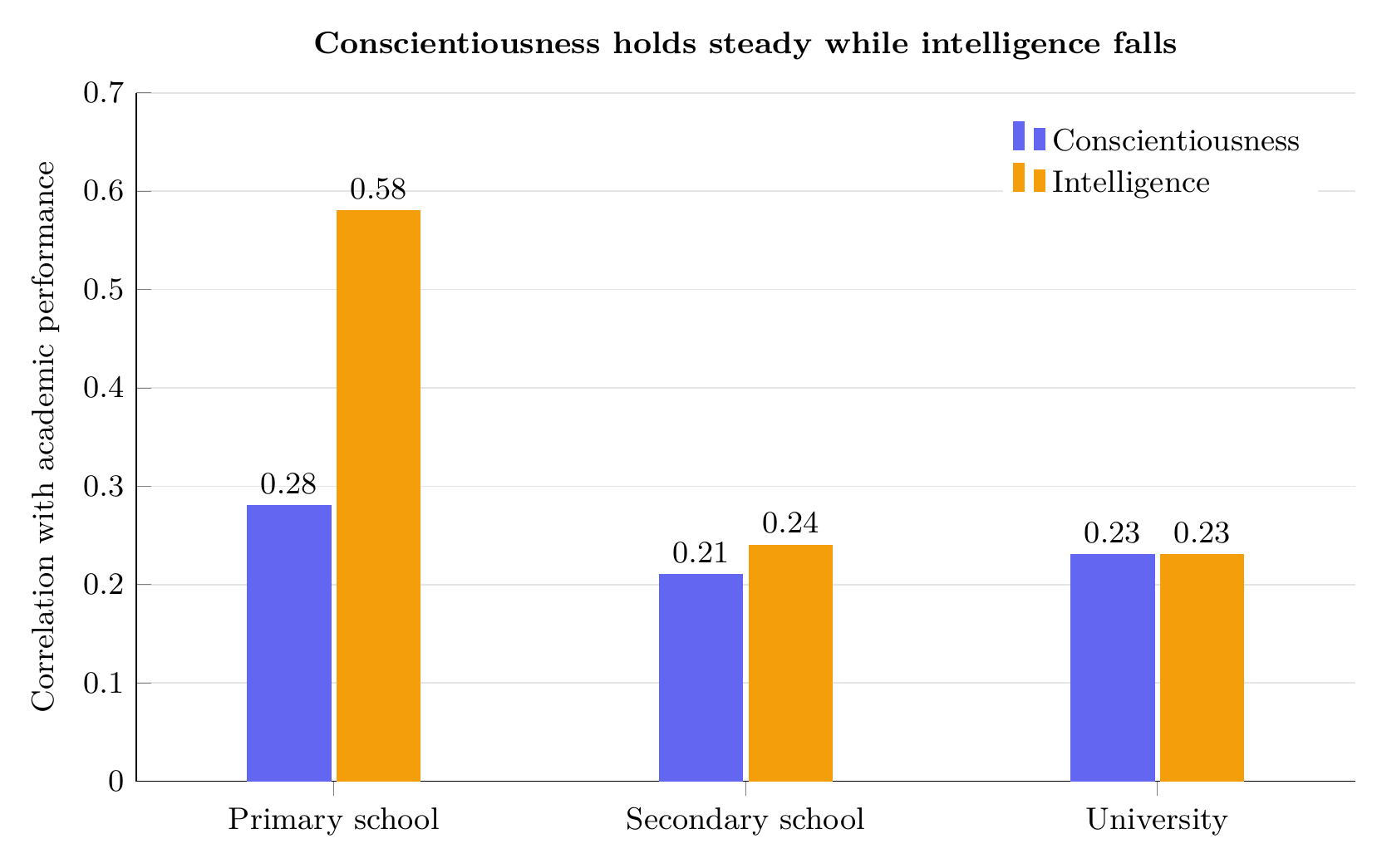
Data from Poropat 2009, Table 2. Chart by Mindomax.
Read the chart from left to right and the story tells itself. Conscientiousness barely moves. Intelligence drops toward it. By university the two bars are the same height.
Why would intelligence fade like that? The likeliest answer is range restriction, which Poropat himself pointed to. A primary school class holds nearly the full spread of ability in a neighbourhood. A university lecture hall does not, because admission has already filtered students on grades and test scores. When everyone in the room is fairly bright, brightness stops separating them. Effort, which the filter checked far less carefully, still does.
That makes "as well as IQ" partly a statement about who gets into university, not about personality growing stronger. It does not make the claim false. If you are comparing yourself with your classmates, you are competing inside that restricted range, so for you the claim is the one that applies.
The trait also seems to gain weight as study comes to resemble work. Following a whole European country's 1997 cohort of 627 students in medical school, researchers found that the operational validity of conscientiousness for grades rose from 0.18 in the first year to 0.45 by the seventh, when 306 students remained [11]. A 2026 review of 12 studies with 3,847 students in medical school found the trait more strongly tied to clinical assessments than to written exams, and barely tied at all to procedural skills [12].
Clinical training rewards turning up prepared, following procedures and finishing what you start. You can see why the trait stops being one asset among several and becomes a main one.
Where IQ Still Wins
None of this means intelligence matters less than you think. Across the whole of schooling it matters more than conscientiousness, and by a wide margin.
In Mammadov's analysis, cognitive ability correlated with performance at 0.42 across 55,260 participants, and entered together with the Big Five it accounted for 63.6 percent of the explained variance against 27.9 percent for conscientiousness [10]. A 2015 meta-analysis of 240 samples with 105,185 students put the corrected correlation between intelligence tests and school grades at 0.54 [13], and a five-year study of more than 70,000 students in England found a correlation of 0.81 between general intelligence at 11 and a general factor of exam results at 16 [14].
The chart makes the hierarchy plain. Conscientiousness sits far ahead of every other personality trait and far behind intelligence. That is the honest summary of the title's claim across all ages, and it is the one most headlines leave out.
Look at studies designed to find what personality adds, and intelligence is still standing beside it. In 498 students in eighth grade in Austria, intelligence and conscientiousness together explained about 40 percent of the variance in school achievement [15]. No other personality or motivational trait added anything for overall grades. In the American Project TALENT data on 35,446 participants who went on to finish a degree, general mental ability correlated with self-reported college grades at r = 0.32 and conscientiousness at r = 0.17 [16]. A 2026 second-order meta-analysis of 29 meta-analyses ranked cognitive abilities as the strongest correlate of achievement, ahead of positive personality traits [17].
Notice that conscientiousness still adds something in each of these. It is never the bigger number. It is rarely zero.
Some recent work goes further and questions how much personality adds at all. A four-year study of 738 students in secondary school found that personality and motivation correlated meaningfully with later achievement but added less than expected once abilities were known [18]. A 2025 review argued that the Big Five show low predictive power in large international surveys such as PISA and TIMSS, where self-beliefs like self-efficacy, confidence and test anxiety do better [19]. And in two samples of undergraduates studied in 2026, conscientiousness predicted grade point average in one and not in the other, while a measure of irresponsibility predicted grades in both [20].
So hold two facts together. Within a group already sorted by ability, conscientiousness can match intelligence. Across the full range of children, intelligence predicts grades better, and some measures make personality look weak.
The 2005 Study That Started a Press Cycle
The study that made the idea famous outside psychology did not even use the word conscientiousness. In 2005 Duckworth and Seligman followed 140 students in eighth grade and measured self-discipline through the students' own reports, reports from parents and teachers, and questionnaires about choosing a smaller reward now or a larger one later, then repeated the study with 164 students and added an IQ test [21].
Self-discipline measured in the autumn accounted for more than twice as much variance as IQ in final grades. It also predicted attendance, hours spent on homework and admission to a competitive high school programme, and its effect on grades held after controlling for first-term grades, achievement test scores and IQ. The authors wrote that their findings pointed to "a major reason for students falling short of their intellectual potential: their failure to exercise self-discipline."
It was a vivid result. It travelled fast. It was also a result about report cards, and the same research group later showed what happens when you change the outcome.
In 2012 Duckworth and two colleagues followed 510 students through middle school and a second sample of 1,364 students from fourth grade onward, and found that intelligence predicted changes in standardised achievement test scores better than self-control did, while self-control predicted changes in report card grades better than intelligence did [22]. In the larger sample, the advantage of self-control on grades ran through teachers' ratings of homework completion and classroom conduct.
That is not a contradiction of the 2005 paper. It is the explanation for it. The kind of measure decides which trait wins.
What a Report Card Measures That a Test Does Not
Think about what earns a good grade over a semester. You hand in homework on time. You revise before every quiz rather than the night before the exam. You come to class, ask when you are lost and redo the problem set that went badly. Almost every one of those behaviours is what a conscientiousness questionnaire asks about.
A standardised test asks for none of it. It samples what you can work out in an hour or two, on material you may never have met in that exact form.
The data line up with that intuition. A 2007 study of four independent samples found conscientiousness the strongest Big Five predictor of high school and university grades, even after high school grades and SAT scores were controlled, while openness was the strongest predictor of verbal SAT scores [23]. In 2016 a team of economists that included James Heckman showed, across several large data sets, that grades and achievement tests both predict adult outcomes better than pure intelligence measures because both carry personality, with personality weighing more on grades and intelligence more on tests [24]. A 2017 replication in 13,648 students in ninth grade in Germany found that personality explained a substantial share of the variance in achievement while explaining very little of the variance in intelligence [25].
Put those three side by side. A pattern appears. The more a measure depends on what you do across many weeks, the more of you it captures beyond your raw ability.
The clearest demonstration of how much grades carry is older. In 2002 a team studied 8,454 students in their final year of high school and asked why grades and test scores so often disagree [26]. They aligned the subjects, corrected for differences in grading standards, and added teacher ratings and a measure of scholastic engagement. The prediction of grade averages rose from 0.62 to 0.90.
Engagement, in that study, meant three kinds of observable behaviour: using school skills, showing initiative and avoiding competing activities. You could hardly write a better description of a conscientious student.
A 2022 framework called the personality-achievement saturation hypothesis turns this into a prediction [27]. It argues that the link depends on four features of a measure: how standardised it is, how much it matters to the student, how closely it follows the curriculum and how sensitive it is to teaching. On that logic, conscientiousness should relate most to grade point averages, then to course grades, then to final examinations.
Twin studies point the same way. In a 2014 analysis of twins in the UK, personality and other traits carried part of the genetic influence on exam results at 16, beyond what intelligence carried [28]. Together with intelligence, those traits accounted for 75 percent of the heritability of the results. Whatever an exam grade measures, it is not intelligence alone. That is good news if you work hard, and a warning if you treat grades as an IQ test.
How the Trait Turns Into Marks
If conscientiousness works through behaviour, you should be able to see the behaviour. You can.
Across three studies with 571, 415 and 1,535 students, Trautwein and colleagues found in 2009 that conscientiousness predicted effort across a wide range of subjects, while reasoning ability only loosely predicted effort [29]. Two 2022 studies of first-year university students, with 106 and 355 participants, found that time management and effort regulation strategies carried the trait's effect on results, and in the larger sample the effort route vanished for students low in conscientiousness [30]. Across six studies with 2,274 participants, Galla and Duckworth found in 2015 that people high in self-control relied on good habits, including study and homework habits, and used less effortful inhibition in daily life, not more [31].
That last finding runs against the image of the conscientious student grinding through on willpower. The disciplined student is often the one who has made the right thing automatic, and our article on how habits become automatic explains how that happens.
Procrastination is the same trait seen from the other side. A 2007 meta-analysis of 691 correlations found conscientiousness and its facets of self-control, organisation and achievement motivation among the strongest and most consistent predictors of putting things off [32]. A 2024 study reported that academic procrastination mediated the link between conscientiousness and achievement [33], and a 2023 study of 746 students learning online found that the proactive side of the trait, which drives effort, and the inhibitive side, which holds back impulses, reduced procrastination through different emotional routes [34].
If you want the mechanics of delay itself, our piece on procrastination as mood repair covers them. The short version is that putting work off is usually about feelings, not time.
The diagram simplifies, but the asymmetry is real. Intelligence feeds both kinds of measure. Conscientiousness feeds mostly the kind that builds up through weeks of behaviour.
Some popular claims about mechanism do not survive the data. Class attendance predicts university grades strongly, with correlations of 0.44 for class grades and 0.41 for grade point average, yet a 2010 meta-analysis of 21,195 students found attendance only weakly related to conscientiousness [35]. Study habits are a better candidate, and a 2008 meta-analysis of 72,431 students found that study habits, skills and attitudes rivalled admission tests and previous grades as predictors while being moderately related to personality [36].
The practical version of all this is unglamorous. Goals help when they are specific and checked, which is the subject of goal-setting theory, and plans work better when they name exactly when and where, which is what implementation intentions do. Neither requires you to have a different personality.
Who Fills In the Questionnaire Changes the Answer
Almost everything above relied on self-reports. Students rated their own diligence. That turns out to be the weakest way to measure the trait.
In 2014 Poropat pooled the studies in which someone else, such as a teacher, a parent or a peer, rated the student's personality, and found correlations with academic performance substantially higher than for self-ratings on all five traits, not explained by intelligence [37]. A companion meta-analysis of primary school pupils, covering up to 5,706 children in 12 reports, found adult ratings of conscientiousness more strongly linked to performance than the children's own [38]. A 2010 synthesis of 263 samples with 44,178 people rated by others found that when the outcome was academic achievement or job performance, other-ratings were substantially more predictive than self-ratings and added to them [39].
That is an awkward result for a field built on self-report. The person answering the questions is not the best judge of the answer.
Newer studies show where the extra comes from. A 2021 study of 1,411 children in elementary school found that teachers' unique views of conscientiousness and openness had the strongest associations with both grades and standardised test scores [40]. A 2022 study of 3,997 students in France compared a student questionnaire, a teacher questionnaire and a behavioural task after polling 114 international researchers, most of whom predicted the task would win, and the teacher questionnaire came out best while the task came last [41]. A 2022 study of 422 students at a military academy in South Korea found that the observers' unique view, the reputation a person builds, dominated the prediction of performance from conscientiousness [42].
Why would someone else know you better than you know yourself? Part of the answer is that conscientiousness is visible. Missed deadlines, forgotten books and unfinished work happen in front of other people.
There is a second reason, and it is more uncomfortable. Self-reports do not use a fixed ruler, and the next study shows how badly that can mislead.
The Paradox of the Best Schools
In 2016 a team led by Martin West surveyed 1,368 students in eighth grade [43]. Among individual students, those who rated themselves higher in conscientiousness, self-control and grit had better attendance, better behaviour and larger gains in test scores. Yet students at oversubscribed charter schools, which admission lotteries showed were raising achievement, rated themselves lower on those same traits.
The explanation the authors favoured is reference bias. A student surrounded by classmates who do two hours of homework a night judges the statement "I am hard-working" against a high bar. A student in a less demanding school judges the same statement against a lower one. The questionnaire is identical. The ruler is not.
In 2022 a team led by Benjamin Lira made the case at enormous scale. Across three studies with 229,685 adolescents, students whose peers performed better rated themselves lower in self-regulation and held higher standards for it, while task-based measures showed no such distortion [44]. A 2008 study found the same failure between countries, where behavioural markers of conscientiousness tracked perceptions of national character but not national averages of self-reported or peer-reported conscientiousness [45].
The Lira team found the bias strong enough to produce backwards predictions of whether students persisted in college six years later. The authors wrote that "standards for self-regulation vary by social group."
This matters if you want to use personality questionnaires to judge schools. A school that raises its students' standards may watch their self-reported conscientiousness fall. Compare students who share a classroom and the bias should be small. Compare across schools and it can reverse the answer.
None of this makes self-reports useless. It makes them a tool for comparing people who share a reference group, which is the situation inside most research studies and exactly not the situation in school league tables.
Are Clever People Less Conscientious?
If conscientiousness and intelligence both predict grades but barely correlate, a tempting idea follows. Perhaps less able people become more conscientious to keep up. That is the intelligence compensation hypothesis, and it has been argued over for twenty years.
It began with a 2004 study of managers attending staff development centres, which found conscientiousness negatively correlated with fluid intelligence and proposed that people with lower fluid ability compensate by becoming more conscientious [46]. In 2014 Murray and colleagues tested the idea in samples not selected on achievement, 2,412 adolescents and 3,276 of their parents from two Minnesota family studies, and found the associations zero or slightly positive, for example r = 0.14 for achievement striving among the adolescents [47].
Then they removed everyone below rising thresholds of educational or occupational achievement, mimicking how university and workplace samples are formed, and the correlations turned negative. As they put it, the true association "may be zero or positive at the population level".
That looked like a clean resolution. It was not the last word. A 2016 analysis of a heterogeneous population sample replicated the negative link, and found that it depended on whether people were in the labour force [48]. A 2023 study that followed 3,880 students in Germany from age 11 to 14 found that higher conscientiousness at the first assessment predicted lower intelligence at the second, a year later, within the same students [49]. Pulling the other way, a 2022 comparison of 617 MENSA members with more than 112,000 people in reference samples found the high-IQ group higher in conscientiousness, not lower [50].
The pooled picture is simpler than any single study. Poropat's meta-analytic correlation between the two traits was r = -0.03, and the estimate in Mammadov's regression was -0.04. For a typical classroom, knowing how bright you are tells your teacher almost nothing about how conscientious you are.
The finer details are messier. A 2023 synthesis of 3,543 meta-analyses found that particular facets of conscientiousness do relate to specific abilities, which helps explain why small studies disagree [51]. In 2022 Meyer and colleagues pooled four data sets covering 18,637 students in upper secondary school in Germany. They found a small synergy, with the link between ability and achievement slightly stronger in more conscientious students [52]. A 2023 study of 1,043 students followed from age 11 to 15 found the opposite, a small compensatory effect, and only for starting levels of mathematics grades [53].
Both interaction effects are small. They point in opposite directions. The question is open.
Grit, Self-Control and Other Close Relatives
Conscientiousness has a habit of being rediscovered under new names. Grit, defined in 2007 as perseverance and passion for long-term goals, explained about 4 percent of the variance in outcomes such as grades at an Ivy League university and retention at West Point, and correlated highly with conscientiousness [54]. A 2017 meta-analysis of 88 samples with 66,807 people found grit very strongly correlated with conscientiousness, with only its perseverance facet explaining academic performance beyond it [55], and in a representative American sample intelligence contributed 48 to 90 times more than grit to educational success, while conscientiousness contributed about twice as much as grit [56].
The authors of the 2017 meta-analysis wrote that interventions designed to build grit "may only have weak effects on performance and success". If you have read that grit beats talent, this is the evidence that says otherwise.
Self-control is the other close relative. A 2004 study that introduced a widely used self-control scale found higher scores linked to a higher grade point average and better adjustment, with no sign that very high self-control did harm [57]. The best known long-term study followed 1,000 children from birth to age 32 and found that childhood self-control predicted health, wealth and criminal offending along a gradient, independent of intelligence and social class [58].
These measures overlap heavily, but they are not interchangeable with the trait. A child who waits for the second marshmallow has passed a test of one moment. Conscientiousness describes years.
Can a Student Become More Conscientious?
Personality is not set in stone. Over adulthood, conscientiousness mostly rises. A 2006 meta-analysis of 92 longitudinal samples found that average conscientiousness increases across adulthood, especially between 20 and 40 [59]. A 2022 update with data on 242,542 people confirmed that average traits keep changing, while people's rankings relative to one another settle down through young adulthood [60]. Adolescence runs the other way. In a cross-sectional sample of 1,267,218 people aged 10 to 65, signs of psychosocial maturity dipped from late childhood into adolescence, the opposite of the adult pattern [61].
If you teach thirteen-year-olds, you may be seeing them at a low point. If you are one, the level you have now is probably not where you will be at 30.
Homework may help pull students out of the dip. A 2017 study of students in Germany between grades 5 and 8 found that those who put a lot of effort into homework became more conscientious over time, while those who reported little effort showed a substantial decline, and parents' reports agreed [62]. A 2025 study of two samples of 5,470 and 788 adolescents in Germany found individual personality highly stable, and classmates' average conscientiousness did not rub off on individual students [63].
So the behaviour may shape the trait even when the surroundings do not. Conscientious students do their homework, and doing homework seems to build conscientiousness.
Deliberate change is possible but modest. In two experiments lasting 16 weeks, published in 2015, people who set goals to increase a trait tended to show real increases in their self-reports and daily behaviour, and an intervention that taught them to form if-then plans helped [64]. A 2021 randomised trial with 1,523 adults used a smartphone programme lasting 3 months and found changes in the intended direction, larger than in the control group, noticed by observers to a lesser degree, and still present 3 months later [65]. Across 207 studies, a 2017 meta-analysis found that interventions changed personality measures by about d = 0.37 over 24 weeks on average, mostly in emotional stability and extraversion rather than conscientiousness [66].
That last result is a useful brake on enthusiasm. Personality can move, but the trait this article is about is not the one that moves most easily.
When More Is Not Better
Conscientiousness is mostly good news. That is exactly why its limits deserve attention.
At the extreme it can tip into rigidity. A 2015 study of 912 participants found a curvilinear relationship between conscientiousness and well-being, with the decline at the top end tied to obsessive-compulsive tendencies [67]. In the workplace, a 2019 review of 92 meta-analyses found an average correlation of 0.20 between conscientiousness and occupational outcomes, with weaker performance effects in high-complexity jobs [68].
Striving for high standards and punishing yourself for missing them are different things, a distinction explored in our article on perfectionism. The trait works best when it serves your goals rather than replacing them.
Grades, Gender and Family Background
Because grades reward conscientiousness, they also inherit how the trait is spread across groups. For gender that matters a lot. For family background it matters much less. A 2022 study of 4,719 students at Dutch universities found that conscientiousness fully accounted for the higher achievement of women, even after controlling for high school grades [69]. A 2021 study of 9,300 students in ninth grade in Germany found only small Big Five differences between students from richer and poorer families, with correlations of 0.04 to 0.09 [70]. And a 2022 analysis of 8,303 students in England found that cognitive ability and conscientiousness together explained almost as much of the variation in exam results at 16 as every measure combined, and far more than socioeconomic factors [71].
The gender finding deserves a pause. If a gap in grades is largely a gap in conscientiousness, then grades are partly rewarding a disposition rather than knowledge. Whether that is a feature or a flaw depends on what you think grades are for.
Beyond the Report Card
The reason anyone cares about grades is what they lead to, and here conscientiousness stops looking like a school trait.
A 2007 review of prospective studies found that the effects of personality traits on mortality, divorce and occupational attainment were indistinguishable in size from the effects of socioeconomic status and cognitive ability [72]. In 2004 a meta-analysis of 194 studies found conscientiousness-related traits negatively related to every leading behavioural contributor to death in the United States, from tobacco use and poor diet to risky driving [73]. And a study that followed 745 people from age 12 in 1968 to age 52 in 2008 found that being a responsible student, rule breaking and teacher-rated studiousness all predicted career success four decades later, after adjusting for childhood IQ and parents' socioeconomic status [74].
The long view is the strongest argument for taking the trait seriously. Habits that look small at 12 are still showing up at 52.
Findings like these can be fragile. So it matters that they hold. In a UK-representative sample of 2,277 young people followed from adolescence, a 2022 study found personality the most consistent predictor across educational and social outcomes, although intelligence better predicted how far people went in education [75]. In 2019 a preregistered project repeated 78 published links between personality traits and life outcomes with a median sample of 1,504 people, and 87 percent of the replications succeeded, with effects on average 77 percent as strong as the originals [76].
That is a good record for any field. You can trust the direction of these findings more than their exact size.
Thirty Years of the Same Argument
The debate has moved in a recognisable rhythm. A strong claim, then a correction, then a better measure.
Each step narrowed the claim rather than killing it. That is what a healthy literature looks like, and it is why the headline survives in a smaller, sturdier form.
What Is Settled and What Is Not
Some things are now secure. Conscientiousness is the Big Five trait most consistently related to grades, from primary school to university. Its link with grades is largely independent of intelligence. Intelligence remains the larger single predictor across the full range of students. Conscientiousness predicts grades more than standardised tests, and ratings by people who watch a student work predict better than the student's own answers.
Recent syntheses keep arriving at the same place. A 2026 reanalysis of 84 university studies with 45,477 students, which modelled the overlap between the five traits, still found conscientiousness the strongest unique predictor [77], and a 2021 synthesis of 54 meta-analyses covering 554,778 people found a correlation of 0.28 between conscientiousness and academic performance against 0.20 for job performance [78].
Other questions are genuinely open. Nobody yet knows whether less able people become more conscientious to compensate, or whether that pattern is mostly an artefact of how samples are chosen. The interaction between the two traits has been found in both directions, and the long-term effect of trying to raise a student's conscientiousness has not been tested at scale.
There is a further question this article cannot settle, which is how much of the trait's effect runs through what students believe about themselves. In a 2024 study of 791 adolescents in China, conscientiousness added nothing to the prediction of grades once subject-specific academic self-concept was in the model [79], and a 2022 study of 285 undergraduates in Australia found the self-efficacy and achievement striving facets of conscientiousness the parts most related to academic motivation [80].
If that line of work holds up, some of what we credit to the trait may really be about how students see themselves. That connects to the wider literature on motivation and self-determination.
Conclusion
So does conscientiousness predict grades as well as IQ? At university, among students who have already been sorted by ability, and for grades earned over a term rather than scores earned in an afternoon, yes. Across all of schooling, no. Intelligence still carries roughly twice the weight.
What the trait captures is the part of learning that happens between tests. It is the reading done on a Tuesday, the essay started early, the problem set redone after a bad mark. Grades reward that work because teachers see it, which is also why teachers often judge the trait better than students do.
If you are a student, that is good news in an unglamorous form. How quickly you learn is hard to change. You can work on the behaviours that make up conscientiousness directly, and they are exactly the behaviours your report card counts.
Frequently Asked Questions
What is conscientiousness in psychology?
Conscientiousness is a Big Five personality trait. It describes how organised, hard-working, careful and dependable a person tends to be. Researchers usually split it into narrower facets such as industriousness, orderliness, self-control and responsibility. It is measured with questionnaires completed by the person or by people who know them well.
Does conscientiousness predict grades better than IQ?
Not overall. In the largest meta-analysis, covering 413,074 students, intelligence accounted for about 64 percent of the explained variance in academic performance and conscientiousness for about 28 percent. At university the two predict about equally well, mainly because intelligence matters less among students who have already been selected on ability.
Why does conscientiousness matter more for grades than for test scores?
Because grades reward behaviour over time. Grades build up over weeks of homework, attendance, deadlines and classroom behaviour, all of which conscientious students manage more reliably. Standardised tests sample what a student can work out in a single sitting, which depends more on intelligence. Studies that measured both outcomes in the same students found self-control predicted grades better and IQ predicted test scores better.
Can you become more conscientious?
Yes, slowly. Average conscientiousness rises through early and middle adulthood, after a dip in adolescence. Experiments in which people set goals to change their personality, including a randomised trial of 1,523 adults using a smartphone programme, have produced modest changes that lasted at least 3 months. The behaviours that make up the trait, such as planning and finishing work, are easier to change than the trait itself.
Are smarter people less conscientious?
The evidence is mixed. Across large meta-analyses the two traits are almost unrelated, with correlations close to zero. Some studies of managers and working adults found a small negative link, but research in unselected samples suggests that pattern can appear when samples are filtered on achievement. A study of MENSA members found them higher, not lower, in conscientiousness.


