
Introduction
You have set a goal you did not keep. Most people have. Somewhere between deciding to revise four chapters and reading half of one, a well tested piece of psychology was at work, and you were never told what it measured.
The theory has a short public version. A definition, five principles, a note about SMART goals. It leaves out what you would want first: how much better a specific hard goal actually is than telling yourself to do your best.
The numbers exist.
Across the meta-analyses collected by the theory's own authors, goal difficulty produced effect sizes between d = .52 and .82, and specific difficult goals beat urging people to do their best by d = .42 to .80 [26]. In behavioural science those are respectable, sometimes large. They are not the whole story. When researchers isolated what goal setting adds on its own in randomised trials of real behaviour change, across 141 papers and 384 effect sizes covering 16,523 people, the answer was d = 0.34 [49].
Both of those figures are correct. They answer different questions, and quoting one without the other is how the theory gets oversold.
This piece puts numbers on the claims, explains the mechanism the five principles come from, and spends real space on when a specific hard goal makes performance worse.
The Experiment That Came Thirty Years Early
The founding paper is usually dated to 1968, when Edwin Locke published a theory of task motivation and incentives in Organizational Behavior and Human Performance [1].
That is right for the theory. It is wrong for the experiment.
In 1935 the British psychologist Cecil Alec Mace published a monograph called Incentives: Some Experimental Studies for the Industrial Health Research Board, report number 72, printed by HMSO in London. Mace had already compared telling somebody to do their best against giving them a specified target. The work predates journal identifiers, so it has no DOI and sits outside the citation trails modern reviews follow, which is most of why it is easy to miss.
That gap of three decades is worth noticing. The observation was available; what was missing was a theory saying why it should be true, and Locke supplied that.
By 1981 there was enough evidence to synthesise. Locke, Shaw, Saari and Latham reviewed the goal setting work published between 1969 and 1980 and reported strong support for two components in particular, goal difficulty and goal specificity [5].
The theory had gone from one man's argument to a body of results in twelve years.
The theory has spent sixty years being tested, and it has been revised at least three times by the people who built it [30]. They described in 2015 how it was assembled by induction, one testable claim at a time, rather than deduced from a model [44], and their 2007 survey set out where they expected it to go next [34].
That is unusual and it is a point in its favour.
Thirty-Six Logging Trucks
The demonstration that should be famous is not a laboratory study, and not a controlled one. In 1975 Gary Latham and J. J. Baldes reported what happened when logging truck drivers were given a specific hard goal.
Net weight was recorded from a sample of 36 trucks across 6 logging operations, for 12 months [2].
Before the goal, drivers were loading well under the legal limit and were told to do their best. Then they were given a specific target for the percentage of legal net weight to carry, and performance rose immediately.
Here is the detail that matters more than the result.
The drivers started modifying their trucks so they could estimate the load before driving to the weighing station, a detail Locke and Latham singled out in their 2002 retrospective [26].
Nobody told them to. The obvious reading is that the goal did not make them try harder in any simple sense. It made them find a way to know where they stood.
Hold onto that detail. It comes back when the theory starts to break.
What The Numbers Say
Start with the biggest single comparison, and with what it actually measured.
Across the meta-analytic record summarised in 2002, harder goals produced better performance than easier ones with effect sizes running from d = .52 to .82, and the relationship was close to linear rather than curved [26].
Performance stopped climbing only at the limit of ability, or when people stopped accepting the goal. Specific difficult goals against a do-your-best instruction produced d = .42 to .80 in the same body of work.
An earlier meta-analysis covering 1966 to 1984 had already reported strong support for both components, comparing hard against easy goals and specific hard goals against general instructions [9].
Group goals were measured separately, and the numbers are sharper. In 2011 Kleingeld, van Mierlo and Arends found specific difficult group goals beat nonspecific ones at d = 0.80 across 23 effect sizes, and all group goals beat them at d = 0.56 across 49 [39].
The same paper carries a second finding pointing the other way. When people in an interdependent group were given goals aimed at maximising their own performance, group performance fell at d = -1.75 across 6 effect sizes. When the individual goal was aimed at their contribution to the group, it rose at d = 1.20 across 4.
Six effect sizes is a thin base for a number that large. Both halves of that sentence matter.
The four bars are not the same kind of thing, and the differences matter more than the heights.
The first two come from controlled comparisons of group performance in 2011 [39], the third from progress-monitoring interventions measured across 19,951 participants in 2016 [47], and the fourth from what goal setting uniquely adds to a field behaviour-change programme [49].
A controlled task and a person changing their behaviour are not the same measurement problem.
The 2017 behaviour-change meta-analysis is the most conservative estimate in the literature and it comes from the most rigorous design. Epton, Currie and Armitage used only randomised controlled trials that isolated goal setting from everything else in the intervention.
The overall figure was d = 0.34 with a confidence interval running from 0.28 to 0.41 [49].
Their moderator analysis found the effect was larger when the goal was difficult, set publicly, or a group goal. That is the theory's own prediction surviving inside the most conservative design anyone has run. Subgroup analyses within a meta-analysis are exploratory, so read it as support rather than proof.
None of that tells you what to do on a Tuesday night. It tells you what the effect is worth.
Why Do Your Best Fails
The interesting question is not whether specific hard goals work. It is why the alternative does not.
Locke and Latham give a reason that is almost embarrassingly simple once you have heard it. In their 2002 statement of the theory, a do-your-best goal has no external referent [26].
There is nothing outside your own head to check it against, so you define it after the fact, and a wide range of outcomes can honestly be labelled your best. You revised for forty minutes and your concentration went. Was that your best? You cannot tell, and nor can anybody else.
A specific goal removes that freedom entirely, and it does so in advance.
Four chapters by Friday is either done or not done, and nobody has to adjudicate which.
That is the whole trick, and it is why the trick has a cost. A thing you cannot argue with afterwards is a thing you can fail.
There is a distinction inside this that changes the advice. In 1989 Locke, Chah, Harrison and Lustgarten separated goal specificity from goal level and found they do different jobs [14].
Specificity reduces the variance in performance, because it removes ambiguity about what counts as attainment. Level raises performance, and level comes from difficulty.
A specific easy goal is still easy. Making your target precise does not make it demanding, and precision alone buys consistency rather than height.
The right-hand column is where most of the rest of this article happens.
Four Mechanisms, Not Five Principles
The five principles are consequences, not premises. The 2002 statement of the theory proposes four mechanisms, and once you have those the principles stop being a checklist and start being predictions [26].
A goal directs attention. It pulls effort toward activity that serves the goal and away from activity that does not. A goal also energises, in the plain sense that high goals produce more effort than low ones, shown on tasks measuring physical output, on repeated arithmetic, on subjective effort ratings, and on physiological indicators.
The third mechanism is persistence. When people control how long they spend, hard goals keep them at it longer, with a trade-off between working intensely for a short stretch and steadily for a long one, a pattern the 2002 review traces to laboratory work from the 1960s [26].
The fourth is the one the logging trucks illustrate. Goals lead people to discover or invent task-relevant strategy. When the skill is already automatic, people just deploy it. When the task is new, they plan deliberately, and performance can lag the goal while that search runs.
In 2023 Bates and colleagues took a finer inventory of twelve processes the theory describes, the four above among them, and found all twelve linked tightly to conscientiousness [61].
That is a correlation, not a cause. It still suggests that whether you set usable goals is partly a matter of who you are, and not only of technique.
The famous five principles fall out of those four rather than standing beside them. Clarity makes direction possible; challenge is what the energising mechanism responds to. Feedback is in the list because persistence cannot correct itself without it. Commitment is not a fifth item; it is the switch deciding whether any of the four run.
The Line Is Straight Until It Snaps
The difficulty-performance relationship is linear, and then it is not. Where it breaks is the useful part.
Miriam Erez and Isaac Zidon established the condition in 1984 [6].
Performance rose with difficulty as long as the goal was accepted. Once acceptance went, the relationship reversed. Difficulty is not doing the work on its own; difficulty plus acceptance is.
That put commitment at the centre of the theory rather than at the edge of it.
John Hollenbeck and Howard Klein set out the problems with measuring it in 1987 [8], Locke, Latham and Erez laid out what determines it in 1988 [12], and by 1999 Klein, Wesson, Hollenbeck and Alge could synthesise the empirical work into a clarified construct [21].
A goal you have not accepted is not a goal. It is a sentence somebody wrote down.
This is where a theory built in workplaces stops transferring cleanly. Nobody assigns you a revision target. You accept your own goals by default, which sounds like an advantage and is mostly a way of never testing them.
Modern digital settings have found curvature the classic work did not. Yang and Li reported an inverted U between gamified achievement and health management performance in 2021, rising and then falling rather than climbing [58].
A 2022 experiment by Cao and colleagues is the sharpest challenge to the plain difficulty rule in a learning context.
They randomly assigned 156 participants, half learning-oriented and half performance-oriented, to a high or low difficulty condition inside a gamified leaderboard [59].
The low difficulty group reported more positive emotions, fewer negative ones and higher learning motivation, and the effect of difficulty on performance was not significant. Goal orientation moderated nothing.
That is one study in one gamified system. It does not overturn sixty years of results. It does tell you the linear function was established on tasks where the person had already decided to try.
Feedback Is Not The Fifth Item On A List
Feedback is usually listed as one principle among five. The evidence puts it closer to a precondition.
Neubert's 1998 meta-analysis asked directly whether feedback adds anything to goal setting or simply travels with it, and found that goals plus feedback outperform goals alone [19].
That sentence sounds modest. It is not. Set a specific hard goal with no way of knowing where you stand against it and you have most of the apparatus and none of the correction.
The strongest number comes from a 2016 meta-analysis by Harkin and colleagues covering 138 randomised studies with 19,951 participants [47]. Interventions designed to make people monitor their progress did raise monitoring frequency, at d+ = 1.98 with a confidence interval from 1.71 to 2.24, which is enormous. They also raised goal attainment, at d+ = 0.40 with an interval running from 0.32 to 0.48 [47].
The change in monitoring frequency mediated the effect on attainment, which is the pattern you would expect if monitoring is doing the causal work rather than riding along with it.
Two moderators are directly actionable. The effect was larger when progress was physically recorded, and larger again when it was made public.
A 2021 series of four experiments by Robison, Unsworth and Brewer tested this on sustained attention, and produced the cleanest dissociation in the recent literature [57].
Specific goals cut reaction times and reduced the vigilance decrement, the slow decay of attention over a long dull task. Only a specific goal plus feedback moved performance and engagement together. Feedback raised motivation and reduced task-unrelated thoughts whether or not a goal came with it. A cash incentive for hitting the goal moved nothing.
Field evidence points the same way.
In a 2016 randomised controlled trial, Koenig, Eckert and Hier combined performance feedback with goal setting and improved the writing fluency of elementary school students [48]. In a 2023 longitudinal randomised field experiment, Bellhauser, Dignath and Theobald found daily automated feedback raised self-regulated learning in real courses [62].
Neither study is about goals alone, and that is the point.
A goal with no way to see progress is half a mechanism. Write it where you can see it. Keep the record.
The Confidence Problem
Self-efficacy sits inside goal setting theory as a friendly variable. By the 2002 account, people who believe they can do the task set higher goals, commit to assigned goals more firmly, find better strategies, and take negative feedback better [26].
In 1981 Albert Bandura and Dale Schunk gave children doing subtraction either a distal goal or proximal sub-goals, and the proximal condition produced higher competence, self-efficacy and interest in the arithmetic itself [4]. Schunk extended the design to learning-disabled children in 1985, where taking part in setting the goal raised both self-efficacy and skill [7]. Sagotsky, Patterson and Lepper had found in 1978 that self-monitoring plus goal setting improved children's self-control on classroom arithmetic [3].
Then there is a result that ought to be better known, because it complicates the advice.
In 2006 Jeffrey Vancouver and Laura Kendall followed 63 undergraduates across 5 class exams, measuring self-efficacy and motivation before each one [31].
Between people, the familiar pattern held: more confident students performed better. Within the same person it inverted. On the exams where a student felt more confident, that student was less motivated and did worse.
Read that again, because the two halves are not in conflict. Being a confident student is a good sign. Feeling confident about tomorrow's exam, relative to how you usually feel, is not.
One is a trait and the other a state, measured at different levels of analysis. Mixing them is how the finding gets misreported as confidence being bad for you.
Self-set grade goals sit in the middle of this. Katrin Saks studied 160 students on an online teacher-training course in 2024 and found that self-efficacy predicted the grade goals they set for themselves, and that the expected grade goal mediated the path to actual learning outcomes [70].
That is a between-person finding, the level at which self-efficacy behaves as everybody expects. Confidence works partly by changing the goal you are willing to name.
Where The Theory Turns Around
This is the part a student needs most, and it is where the theory stops being simple.
Goal effects shrink as tasks get complex. Wood, Mento and Locke established this in a 1987 meta-analysis of 125 studies published between 1966 and 1985, with complexity ratings that agreed with each other at .92 [10].
On the least complex tasks, hard goals beat easy ones at d = .67 and specific hard goals beat do-your-best at d = .77 [10].
On the most complex tasks those two figures fell to .48 and .41.
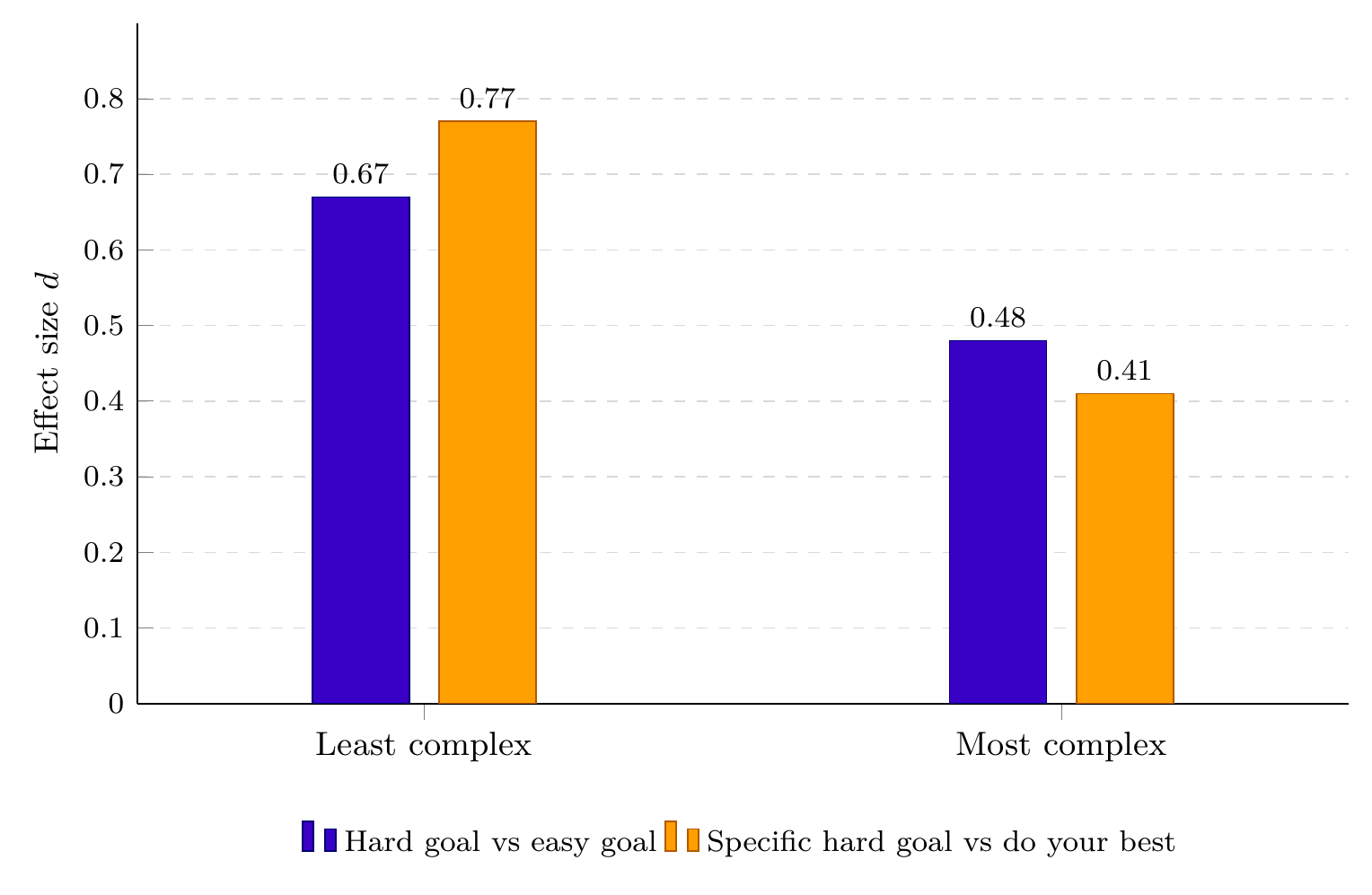
Source: Data from Wood Mento and Locke 1987 as reported in Locke and Latham 2002. Chart by Mindomax.
The gap in that chart is the argument, and it is the reason this section exists. The effect does not vanish on hard tasks, it shrinks, and it shrinks furthest for the comparison that matters most. Goal setting is strongest on work people already know how to do.
Ruth Kanfer and Phillip Ackerman found the point where it flips. In a 1989 study using an air traffic controller simulation, about as complex as a laboratory task gets, a performance outcome goal interfered with acquiring the knowledge the task required [13]. Participants did better when told to do their best. Their 1994 follow-up called this resource allocation: attention spent monitoring your score is attention not spent learning [15].
Locke and Latham accept the finding and reject the conclusion, and the study that settles it is elegant. In 1996 Dawn Winters and Gary Latham gave 114 students a scheduling task in either a simple or a complex version [17].
On the simple task, an outcome goal produced significantly more correct schedules than do-your-best, as the theory predicts. On the complex task, a specific difficult learning goal beat both the outcome goal and do-your-best, and produced significantly higher self-efficacy and more effective strategies.
The fault was not the goal. It was what the goal was about.
That distinction is the most practical thing in the literature, and it is why a student and a manager need different advice from the same theory.
A learning goal names a number of strategies to find rather than a level of output to reach. Discover three ways to structure this argument, rather than write a first-class essay.
Seijts and Latham built the rule from there, showing in 2001 that proximal outcome goals set alongside a distal one help on a moderately complex task [24], and setting out plainly in 2005 and again in 2012 when each goal type should be used [29] [41].
The same split shows up beyond individual work. Nahrgang and colleagues took the comparison to teams in 2013, where learning and performance goals changed the team's process and not only its output [42].
If you already understand the material, set a performance goal. If you do not, set a learning goal and expect your marks to move later than your understanding does.
That diagram is a summary, not a prescription. The question at the top is the one worth answering honestly, and it is easy to answer too generously.
The Same Sentence Explains The Scandal
Go back to the first mechanism. A goal directs attention toward goal-relevant activity and away from everything else. That is the theory's central claim and it is why the theory works.
It is also, word for word, the description of its worst failure mode.
In 2009 Lisa Ordonez, Maurice Schweitzer, Adam Galinsky and Max Bazerman published a paper in Academy of Management Perspectives arguing that goal setting had been prescribed like a benign over-the-counter remedy when it needed a warning label [36].
Their charge sheet was long. Narrowed focus, distorted risk preference, corroded ethics, damaged culture, reduced intrinsic motivation. Their cases were the Ford Pinto, the Sears Auto Centers upselling scandal, the 1996 Everest season and Enron.
Cases are illustrations, not evidence, and the theory's authors said so at length. The experiments underneath are more interesting.
Locke and Latham replied in the same 2009 issue, under a title that tells you the temperature of the exchange [35]. Their argument was that these are bad goal choices made without moral constraints, not defects in the theory, and that the critique misread the record. Ordonez and colleagues returned later in 2009 with a rejoinder [37].
All three are short. Reading them in order is the fastest way to see what is actually in dispute.
What the critique has, and the case studies obscure, is direct experimental evidence.
In 2004 Schweitzer, Ordonez and Douma showed that specific hard goals increased misreporting of performance, concentrated among people who fell just short [27]. Just short is the dangerous place. Welsh and Ordonez extended this in 2014, linking consecutive high goals to depletion of self-regulatory resources and from there to unethical behaviour [43]. Niven and Healy found in 2015 that moral justification moderates whether goals produce that behaviour at all [45].
The argument did not come from nowhere.
People had been uneasy for years before anybody wrote it up as an attack. Adam Barsky had already argued in 2007 that goal setting shifts moral responsibility away from the person pursuing the goal [33], and Ordonez and Welsh restated the case compactly in 2015 [46].
If you recognise yourself in that last one, the relationship between high standards and self-punishment is a separate literature worth reading.
There is a cost the corporate cases never capture, and it is the one that applies to a person revising alone.
In 2021 Jessica Hopfner and Nina Keith ran two experiments, the first with 185 participants and the second with 86 participants, on what failing a hard goal does to you [54].
In the first, feedback told people they had attained or failed an assigned high specific goal. In the second, failure was induced through task difficulty, with task choice measured afterwards as an index of motivation. In both, the people who failed showed lower affect, self-esteem and motivation than those who attained.
Permzadian and Zhao pushed further into the emotional side of this in 2024, arguing that affective states shape the goals people set rather than merely following from them [68].
A hard goal is a bet, and the downside is rarely priced.
That matters more for somebody working alone than for an employee. There is no manager to renegotiate with when the target turns out to have been too hard.
An Argument That Was Settled Properly
One dispute here was resolved in a way worth copying.
Erez and Latham disagreed about whether letting people participate in setting a goal makes any difference. Rather than exchanging papers indefinitely, in 1988 Latham, Erez and Locke jointly designed crucial experiments with the antagonists on both sides involved in the design [11].
Participation as such mattered less than how the goal was communicated. A curt assignment and an explained assignment are not the same intervention.
That method is rare, cheap, and it produced an answer both camps accepted.
The Current Challenge: Open Goals
The liveliest argument in the field is not about difficulty. It is about specificity.
Christian Swann and colleagues argued in a 2020 conceptual review that goal setting practice in physical activity promotion had not kept up with the theory [52]. Standard practice is a specific performance goal such as 10,000 steps, matching the theory as it stood in 1990. The theory has since distinguished performance from learning goals, and for someone new to a behaviour a performance goal can work against the outcome you want. Most people starting a programme are new to it. Jeong and colleagues reached a similar verdict in a 2021 review of how the theory has been applied in sport [55].
Their alternative is an open goal: see how many steps you can do today, rather than reach 10,000. It sounds like do-your-best rebranded, and the objection deserves a straight answer.
The difference is in what stays vague. Do your best leaves the dimension undefined, so nothing gets counted and there is no record to check yourself against. An open goal names the dimension and the measurement exactly, steps taken today, and leaves only the threshold open. You keep direction and you keep feedback. What you give up is the line you can fall below.
Whether that trade is worth making is an empirical question, currently answered in small trials.
That is an argument about mechanism. Here is what the trials found.
Goddard and colleagues ran a 10-week step programme in 2024 with 15 healthy adults, 13 of them women, mean age 42.53, all with low to moderate activity [67]. Retention was high, activity rose, and the psychological experience was positive. One participant in that programme, quoted in the 2026 expert statement [72], said open goals "took away the trauma of failing. There was no fail[ure] ... on a good day, it's a good day; on a bad day, it's a better day tomorrow. I think that's really motivating".
That is one person, not evidence. It is also a plain description of the cost Hopfner and Keith measured under controlled conditions.
The pilot randomised trial followed. Goddard and colleagues compared open goals against specific goals and a control condition across a walking programme running 6 weeks, with 30 healthy adults, 26 of them women, mean age 52.07 [71]. Both goal conditions raised activity to a similar extent. Open goals produced the largest within-group increase, at 2,965 steps, and also the steepest decline over the 4 weeks of follow-up [71].
Participants in the open goals group reported more positive experiences.
That is not a rout. Both conditions raised activity by a similar amount, the open-goal advantage was in how the programme felt rather than how far people walked, and the open-goal group fell back fastest. A 15-person feasibility trial and a 30-person pilot are where this evidence sits.
An Exercise and Sports Science Australia statement formalised the compromise in 2026 [72].
Match the goal type to the person and the stage, minimise the chance of failing, and stop treating one specific number as the only respectable form a goal can take.
Sixty years in, the theory is still being revised by the people testing it. The 1990 version is not the current one.
This Is Not The Same As Mastery Versus Performance Goals
Two literatures share the word goal and get merged constantly.
Goal setting theory asks what shape of goal produces performance. How specific, how hard, about what. Achievement goal theory asks a different question: what are you trying to do by pursuing it. Master the material, or look competent.
Andrew Elliot and Marcy Church set out the influential structure of that second literature in 1997, splitting it further into approach and avoidance forms [18].
The two do interact. Don VandeWalle, William Cron and John Slocum showed in 2001 that goal orientation changes how people respond to performance feedback [25]. Seijts, Latham, Tasa and Latham attempted an explicit integration in 2004 [28], and Cheng reviewed how both are used in language learning in 2023 [63].
They remain different questions with different evidence bases. For the orientation side, mastery goals versus performance goals answers a question this article does not.
SMART Is Not The Theory Either
SMART goals come from a 1981 article by George Doran in Management Review, volume 70, issue 11, pages 35 to 36. It is a management mnemonic published in a trade magazine, and it is not a research finding.
The overlap is partial. Specific and measurable line up with goal specificity, and time-bound is defensible. Achievable and realistic point the opposite way from the difficulty principle, which says the goal should be hard enough that you might not reach it. Two of the five letters argue against the best-supported claim in the field.
The mnemonic is not useless. A 2023 pilot found a structured goal-setting format helped coaches working with doctors moving into residency [65].
That tests having a structured conversation about goals, not the achievability criterion, so it does not rescue the letter that contradicts the difficulty principle.
But an acronym invented for business planning is not a theory tested across six decades, and treating the two as the same object is why so many people believe the research says keep your goals realistic.
What This Looks Like If You Are Studying
Most of this research was done on people being given goals by somebody else. The evidence on people setting their own is smaller and more interesting.
The reference case is from 2010. Dominique Morisano, Jacob Hirsh, Jordan Peterson, Robert Pihl and Bruce Shore recruited 85 undergraduates in academic difficulty and randomly assigned them to an intensive online written goal-setting programme or a control task built to look equally plausible [38].
Four months later the goal-setting group had significantly better academic performance. The control task matters. This was not a comparison against doing nothing.
Schippers, Morisano, Locke and Scheepers replicated the approach at scale in 2020 and found something the original could not have shown.
Writing about personal goals and plans boosted academic performance in 2020 regardless of goal type [51]. Hudig and colleagues followed 748 students through their first university year in 2022 and found 58 percent had shifted motivational mindset by follow-up, with a goal-setting intervention helping a low-impact group move toward a stronger one [60].
The largest picture of where goals sit among everything else a learner does comes from a 2011 meta-analysis by Traci Sitzmann and Katherine Ely covering 430 studies and 90,380 people.
Of sixteen self-regulation constructs, goal level, persistence, effort and self-efficacy had the strongest effects, together accounting for 17 percent of the variance in learning after controlling for cognitive ability and prior knowledge [40].
Four constructs showed no significant relationship with learning at all: planning, monitoring, help seeking and emotion control.
That null sits awkwardly beside the progress-monitoring meta-analysis five years later, and the two are reconcilable. Sitzmann and Ely measured how much people said they monitored, a poor proxy for how much they did. Harkin and colleagues randomly assigned people to monitor more. The likeliest reading is that self-reported monitoring predicts little while manipulated monitoring works, though nobody has compared the two directly.
Digital learning research has spent five years on a narrower question: how much scaffolding a goal needs.
Li, Johnsen and Canelas ran an experiment inside massive open online courses in 2021 and found learners whose written responses contained either a learning or a performance goal achieved more and stayed engaged longer than those whose responses contained neither [56].
In that experiment the kind of goal mattered less than having written one down at all.
Radovic and colleagues went looking for the optimal level of regulation support in 2024 and found there is one, which means more support is not always better [69].
Support that sets the goal, watches it and reminds you about it is doing the part you were meant to be learning.
And eventually the goals stop mattering.
David, Biwer, Crutzen and de Bruin studied the role of habits in university students' self-regulated learning in 2024 and found that established study behaviour runs on cues rather than on intentions [66].
Once a behaviour has become automatic, something goal setting theory does not describe is doing the driving.
Everything above is about the goal itself. What follows is about the distance between having one and acting on it, a different problem with a different literature behind it.
A Goal Is Not An Action
The theory has a boundary it does not pretend to cross, and it is where most personal goals die.
Thomas Webb and Paschal Sheeran assembled 47 experimental tests in 2006 meeting a strict criterion: the intervention had to significantly change intention, and behaviour had to be measured afterwards [32]. A medium-to-large change in intention, d = 0.66, produced a small-to-medium change in behaviour, d = 0.36 [32].
Roughly half the movement is lost between deciding and doing.
Peter Gollwitzer's answer, set out in 1999, is an implementation intention, a plan of the form if situation X arises, I will do Y [20].
It does not change what you want. It hands the start of the behaviour to a cue, so you are not relying on deciding again in the moment. Greenan tested this on the transfer of management training in 2023 and found the plans helped the training reach the job [64]. Implementation intentions are a separate and well-tested literature.
Gabriele Oettingen approaches the same gap from the other side.
Her work on mental contrasting, with Pak and Schnetter in 2001 and Honig and Gollwitzer in 2000, shows that turning a fantasy into a binding goal means holding the desired future and the present obstacle in mind together [23] [22]. Imagining success on its own does the opposite of what people expect.
Health behaviour research has worked this seam since Strecher, Seijts, Kok and Latham proposed goal setting for health behaviour change in 1995 [16]. Hawkes, Warren, Cameron and French evaluated how it was delivered in the NHS England diabetes prevention programme in 2021 and found practice diverged from the theory behind it [53].
What a theory says and what a programme delivers are different things, and the gap is where a lot of the effect goes.
Where This Leaves It
Goal setting theory is one of the best-supported findings in applied psychology, and one of the most casually misused.
What is settled: specific difficult goals beat do-your-best across hundreds of studies and many task types. The difficulty-performance relationship is close to linear while the goal is accepted and within reach. Feedback is not optional. Commitment gates everything.
Effects shrink as tasks get harder, and the 2019 half-century retrospective still says so [50].
What is not settled: whether the side effects belong to the theory or to the people applying it, whether specificity is the right default for beginners, and whether confidence helps or hurts within a person on any given day.
Those three arguments are live, and all three are being worked on now.
For a person setting their own study goal, the research reduces to something smaller than five principles. Make it specific enough that you cannot argue with the result. Make it hard enough that you might miss. Build in a way to see progress. And when the material is new, count strategies rather than outcomes, and accept that the marks move later than the understanding does.
If motivation itself is the question rather than goals, self-determination theory asks a different and equally well-evidenced one. If you know the goal and cannot start, procrastination as mood repair is the better literature. And if you want to know why difficulty feels good up to a point and terrible past it, that boundary sits under flow and optimal difficulty.
The 1975 truck drivers did not just try harder. They built themselves a way to see where they stood. That was an observation in an uncontrolled field study, not a measured result, so treat it as illustration rather than proof. It is a very good illustration.
Frequently Asked Questions
What is goal setting theory in simple terms?
Goal setting theory says that a specific and difficult goal produces better performance than a vague instruction to do your best. Edwin Locke set out the theory in 1968 and developed it with Gary Latham over the following decades. The core claim is quantified: across the meta-analyses summarised in 2002, harder goals beat easier ones at effect sizes of d = .52 to .82, and specific difficult goals beat do-your-best at d = .42 to .80. Those come from controlled task studies. The most conservative field estimate, from randomised trials of real behaviour change, is smaller at d = 0.34. The theory explains this through four mechanisms rather than a checklist. A goal directs attention toward goal-relevant activity, mobilises effort in proportion to its difficulty, sustains persistence, and pushes the person to find or invent a strategy.
Why do specific and difficult goals beat "do your best"?
Because "do your best" has no external referent. You define it yourself after the fact, so a very wide range of outcomes can honestly be called your best, and there is nothing to check your performance against. A specific goal removes that freedom. It is worth separating two things that get merged here. A 1989 study by Locke and colleagues found that goal specificity reduces the variance in performance by removing ambiguity, while the level of performance comes from difficulty. So a specific easy goal is still an easy goal. Precision buys you consistency; difficulty buys you height.
When does goal setting backfire?
Three well-documented conditions. On a complex unfamiliar task, a specific hard performance goal can make performance worse than doing your best, because monitoring your score competes with learning the task. Kanfer and Ackerman showed this in an air traffic controller simulation in 1989, and Winters and Latham showed in 1996 with 114 students that the fix is a specific hard learning goal rather than no goal. Second, hard goals raise unethical behaviour, and a 2004 study by Schweitzer, Ordonez and Douma found misreporting concentrated among people who fell just short of the target. Third, failing a hard goal has a real cost: two experiments in 2021 with 185 and 86 participants found lower affect, self-esteem and motivation after failure than after attainment.
Is a SMART goal the same thing as goal setting theory?
No. SMART comes from a 1981 article by George Doran in Management Review, a trade magazine. It is a mnemonic for writing management objectives, not a research finding, and it has no DOI. The overlap is partial: specific, measurable and time-bound line up reasonably with goal specificity. Achievable and realistic point the other way from the difficulty principle, which says the goal should be hard enough that you might not reach it. Two of the five letters argue against the best-supported claim in the literature, which is why so many people believe the research says keep your goals realistic.
Should students set learning goals or performance goals?
It depends on whether you already know how to do the task. If the material is familiar and there is a countable outcome, a specific hard performance goal is the stronger choice. If the material is genuinely new, set a learning goal that names a number of strategies to discover rather than a level of output to reach, and expect your marks to move later than your understanding does. Winters and Latham demonstrated this split directly in 1996: on a simple version of a scheduling task the outcome goal won, and on a complex version the learning goal beat both the outcome goal and do-your-best while also producing better strategies. Whichever you choose, build in a way to see progress. A 2016 meta-analysis of 138 studies with 19,951 people found that progress monitoring raised goal attainment at d+ = 0.40, and that the effect was larger when progress was physically recorded.


