Introduction
Level three of the same parking garage. Same concrete pillars, same yellow paint, same sodium lights. You have parked here roughly two hundred times. And right now, standing by the elevator with your keys out, you cannot retrieve today. You can retrieve the garage. You just cannot retrieve which slot, on which day, out of two hundred nearly identical versions of the same event.
That failure has a name in neuroscience. It is a failure of pattern separation, the computation that takes overlapping inputs and pushes them apart into non-overlapping neural codes before they are stored [8]. Without it, similar experiences would smear together into a single averaged memory, and old versions would constantly hijack new ones. The technical term for old memories interfering with new ones is proactive interference, and its mirror image, new memories degrading old ones, is retroactive interference. Two labels, one underlying problem: overlapping traces compete.
The parking garage is the friendly version. There are less friendly ones. Did you lock the front door this morning, or are you remembering yesterday morning? Did you already take the pill, or are you recalling the identical act from twenty four hours ago? In hospitals, look-alike and sound-alike drug names are a recognised category of error precisely because two labels sharing most of their letters produce two memory traces sharing most of their features.
This article follows one idea across fifty years: that a small structure buried in the temporal lobe performs two opposite jobs on the same wiring, and that the tension between those jobs explains both the sharpness and the failures of everyday memory. It is also, in places, an unresolved argument. Some of the most cited human evidence for pattern separation has been publicly challenged, and the challenge has been answered, and the answer has been answered again.
Two Opposite Jobs on One Piece of Wiring
Start with the problem the brain has to solve, because the anatomy only makes sense once you see the bind it is in.
Episodic memory, the kind that stores particular events rather than general facts, has to do two contradictory things. It has to keep this morning distinct from every other morning. And it has to rebuild the whole of this morning when you get only a fragment of it, a smell, a song, a street corner. The first job is pattern separation. The second is pattern completion, the reconstruction of a full stored pattern from a partial or degraded cue. The distinction between remembering a specific event and knowing a general fact is the episodic and semantic split, and pattern separation belongs squarely to the episodic side.
Here is the bind. Pattern completion needs richly interconnected neurons, so that activating part of a stored pattern drags the rest of it back into activity. But rich interconnection is exactly what causes patterns to bleed into each other. Turn up completion and you get confabulation, where a partial cue drags back the wrong memory or a blend of several. Turn up separation and you get a system that stores everything distinctly and retrieves nothing from partial cues.
David Marr saw this in 1971. Working at Cambridge, he wrote a theoretical paper on the archicortex, the evolutionarily old cortex that includes the hippocampus, and proposed that it worked as a fast, simple memory store built on sparse codes [1]. He had already applied similar reasoning to the cerebellum two years earlier [56]. Marr did not use the modern vocabulary. But the architecture he sketched, expand the input onto a much larger population, keep activity sparse, then store associations in a recurrent network, is the architecture the field still argues about.
Bruce McNaughton and R. G. M. Morris named the two operations explicitly in 1987 [2]. Alessandro Treves and Edmund Rolls then built the quantitative version, modelling area CA3 of the hippocampus as an autoassociative network, meaning a network whose neurons connect back onto themselves as a population so that a fragment can regenerate the whole [3], [4].
Then in 1994, Randall O'Reilly and James McClelland did something more useful than picking a side. They showed mathematically that hippocampal anatomy is arranged to minimise the trade-off rather than resolve it [5]. The multi-stage path from cortex into the dentate gyrus and onward compounds separation at each step, while the direct, sparse, powerful connections into CA3 preserve the ability to complete. Different stages, different jobs, one circuit.
Nine years later, Kenneth Norman and O'Reilly formalised how this division shows up in recognition memory, with the hippocampus supplying sharp, separated detail and the cortex supplying graded familiarity [7].
What does this mean in practice? It means the parking garage failure and the déjà vu feeling of a place you have never been are not two unrelated glitches. They are the same dial, set too far in opposite directions.

The Circuit: Fan Out, Then Stay Quiet
The hippocampus is not one thing. It is a chain of stations, and the chain matters more than any single station.
Information arrives from the entorhinal cortex, the main gateway between the neocortex and the hippocampus. It travels along the perforant path into the dentate gyrus, a thin curved sheet of tightly packed granule cells. From there, granule cell axons called mossy fibres run to CA3. CA3 projects to CA1, and CA1 sends the result back out toward cortex. That loop is the substrate for what the hippocampus keeps.
The first trick is expansion. In rats, the dentate gyrus holds roughly a million granule cells while the entorhinal population projecting into it is roughly two hundred thousand cells, giving an expansion ratio of roughly five to one [13], [11]. A smaller population fans out onto a much larger one. Treat these figures as canonical estimates from rodent anatomy rather than precise measurements.
Expansion alone does not separate anything. Sparseness does. In rats, only a few percent of granule cells are active in any given environment, and studies using activity-dependent gene expression, which labels neurons that recently fired by detecting the messenger RNA they produce, found this sparse and environmentally selective firing directly in the dentate gyrus [17].
The intuition is arithmetic, not mysticism. Suppose two experiences each activate half the available neurons. The odds that they share a lot of active neurons is high. Now suppose each activates two percent. The odds of heavy overlap collapse. Spread the code thinly across a large population and near-identical inputs land on almost non-overlapping sets of cells.
Sparseness is enforced, not hoped for. Inhibitory interneurons, especially fast-spiking cells expressing the calcium-binding protein parvalbumin, silence neighbouring granule cells when one fires. That is lateral inhibition, and modelling of the full-scale entorhinal to dentate to CA3 network in rodents indicates both externally driven and internally generated inhibition contribute substantially to how well the circuit separates [20]. If you want the underlying mechanics of how one cell suppresses another, that is basic synaptic signalling.
Then comes the strangest part of the wiring. Each rat granule cell contacts only roughly fifteen CA3 pyramidal neurons, and each CA3 pyramidal neuron receives only roughly fifty mossy fibre inputs. Absurdly few connections. But they are enormous, and recordings from rat hippocampal slices show that a single granule cell burst can be sufficient to discharge its CA3 target, a property nicknamed detonation [14]. Few, strong, and sparse. Exactly what O'Reilly and McClelland's analysis predicted you would need to write a separated pattern into a network without smearing it.
CA3 then does the opposite job. Its pyramidal neurons connect back onto each other through recurrent collaterals, forming the attractor network Treves and Rolls modelled. Paired recordings in rat CA3 have since mapped the synaptic mechanisms that let this recurrent network complete a pattern from a fragment [15]. Edmund Rolls' later synthesis lays out how sparse representations, mossy fibre randomisation, and diluted recurrent connectivity interact to set the storage capacity of that network [12].
Here is the circuit in outline.
One caution before moving on. This diagram is a simplification of rodent anatomy, and CA3 is not uniform. Recordings along its transverse axis in rats show that the distal end, with heavy recurrent connectivity, behaves like a completer, while the proximal end behaves more like the dentate gyrus [16]. The division of labour is a gradient, not a wall.

Watching a Rat's Brain Pull Two Rooms Apart
Theory is cheap. In 2007, a team at the Norwegian University of Science and Technology in Trondheim made it measurable.
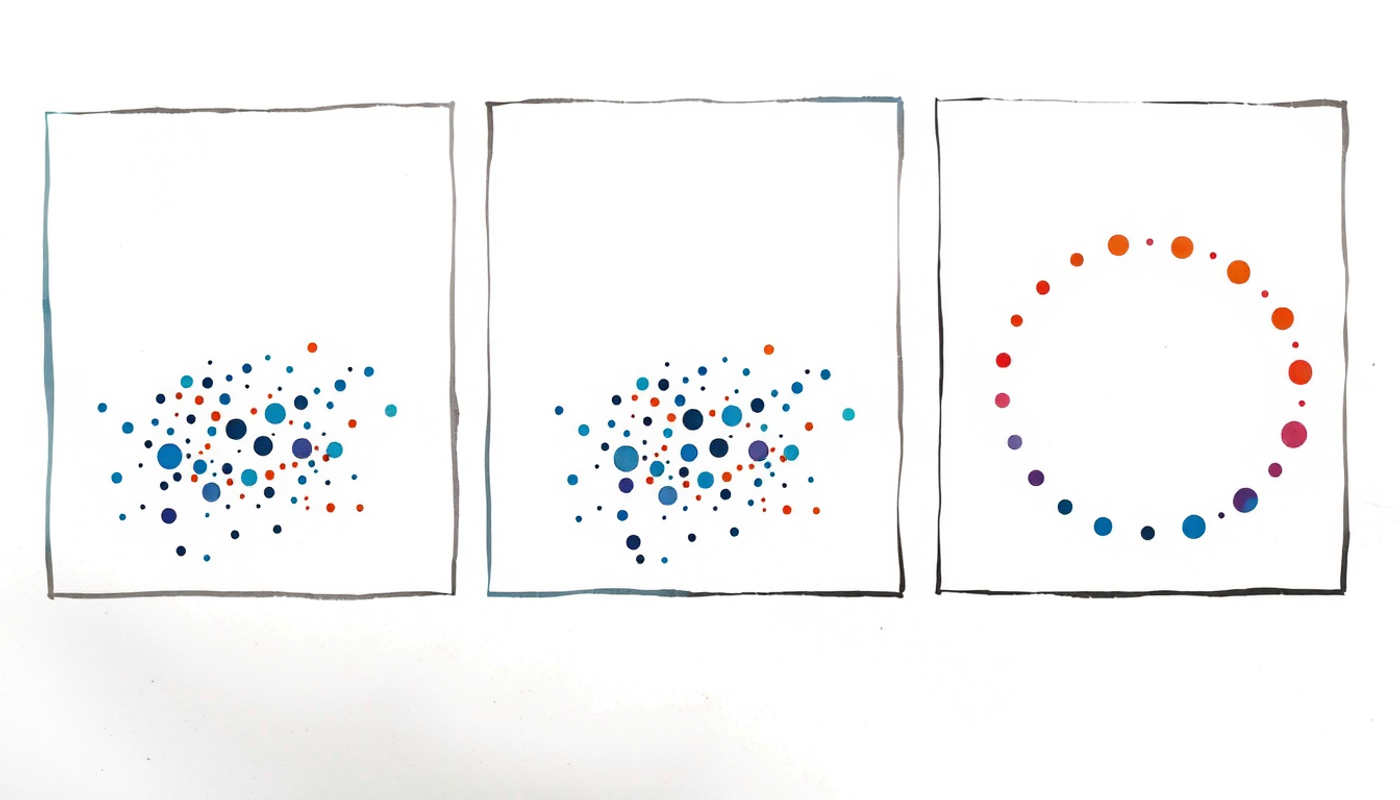
Jill Leutgeb, Stefan Leutgeb, May-Britt Moser and Edvard Moser recorded from place cells, neurons that fire when an animal occupies a particular location, in rats exploring enclosures whose shape was gradually morphed from a square to a circle in small steps [9]. The question was simple. As the room changes slightly, what happens in each hippocampal subregion?
The answer split the circuit in two. In the dentate gyrus, tiny changes in enclosure shape produced large changes in granule cell firing patterns. The population decorrelated fast. In CA3, small changes produced little change, and only larger differences between environments recruited genuinely different cell populations. Two mechanisms, not one. The dentate gyrus separated by changing how strongly its cells fired, and CA3 separated by recruiting different cells entirely.
This is a rodent finding. It should be read as one.
Seven years later, James Knierim's laboratory at Johns Hopkins closed the other half of the loop. Joshua Neunuebel and Knierim recorded simultaneously from dentate gyrus and CA3 in rats, then degraded the input the circuit received [10]. If CA3 completes patterns, its output should be closer to the originally stored representation than the degraded input it received. That is exactly what they found. CA3 output resembled the stored pattern more than the dentate input did. Separation upstream, completion downstream, in the same animals, in the same recording session.
The picture kept getting finer. Antoine Madar, Laura Ewell and Mathew Jones at the University of Wisconsin-Madison used mouse brain slices, stimulating dentate afferents while recording the output of individual granule cells, and showed that separation happens even in the timing of spikes, not only in which cells fire [18]. Their companion analysis showed the same circuit performs separation through several different neural codes at once, depending on what you define as similarity [19].
That last point matters more than it looks. Pattern separation is not one computation. It is a family of computations, and which one you measure depends on what you decide counts as two patterns being alike.
What does this mean for the parking garage? In a rat, this circuitry is doing the work of assigning today's spatial context its own sparse code. When the codes stay distinct, you retrieve today. When they overlap, you retrieve an average of two hundred Tuesdays.
The Task That Made It Testable in Humans
You cannot put electrodes into a healthy person's dentate gyrus to see whether their morning commute is being separated from yesterday's. So the field built a behavioural substitute.
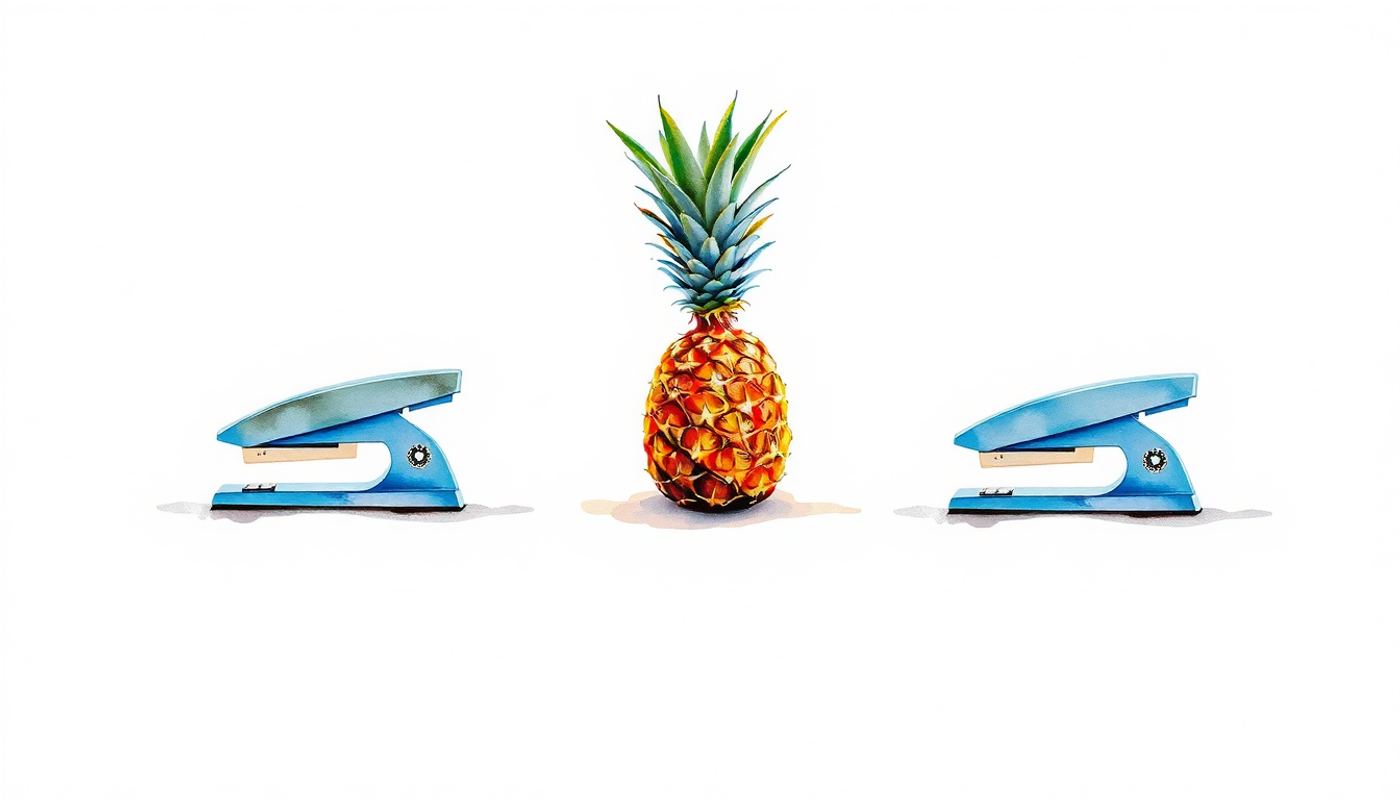
The Mnemonic Similarity Task works like this. Participants first view a stream of everyday object images, a stapler, a pineapple, a bicycle helmet. Later they see a second stream and label each item as old, similar, or new. That second stream contains three item types. Targets are exact repeats. Foils are entirely new objects. And lures are the interesting ones: a different stapler, photographed at a different angle, in a slightly different colour. Highly similar, but not the same.
Calling a lure "old" means the memory was not sharp enough to reject it. Calling it "similar" means it was.
Shauna Stark, Michael Yassa, Craig Stark and colleagues formalised the scoring with the Lure Discrimination Index, which subtracts the rate of saying "similar" to a genuinely new foil from the rate of saying "similar" to a lure [28]. That subtraction is the whole point. It strips out people who simply like the word "similar" and leaves behind actual discrimination. A later methods paper reworked the task to make it faster and more widely usable, and reported the parameters that keep it sensitive [29].
The task earned its place because it behaves the way theory says it should. Simple recognition, distinguishing an old stapler from a brand new pineapple, is easy and stays easy. Lure discrimination is hard, and it degrades under exactly the conditions that damage the hippocampus. Craig Stark's group summarised the accumulated evidence and its limits in a 2019 review [27].
Now the caveat that most popular accounts skip.
The Lure Discrimination Index is a behavioural score. Pattern separation is a neural computation. These are not the same thing, and treating them as interchangeable is the single most common error in writing about this topic. Rejecting a similar lure requires attention, perceptual discrimination, decision criteria, and cognitive control, none of which live in the dentate gyrus. Michael Hunsaker and Raymond Kesner made this case at length, arguing that much of the behavioural literature had drifted into treating the two as synonyms and that this drift produced avoidable confusion [66]. Adam Santoro raised a parallel concern specifically about how dentate findings get interpreted [67].
A behavioural proxy is still useful. It is just not a microscope.
The Fight Over the Human Evidence
In 2008, Arnold Bakker, Brock Kirwan, Michael Miller and Craig Stark published a study in Science that became the reference point for human pattern separation [21]. Using high-resolution functional MRI, which measures blood oxygenation as an indirect proxy for neural activity, they scanned people performing a lure task and found that a combined dentate and CA3 region responded to similar lures much as it responded to entirely new items. The interpretation: the circuit was treating "almost the same" as "different", which is what a separator should do.
A companion study mapped how this transfer function differed between CA3 with dentate and CA1 [23]. Then in 2016, David Berron and colleagues pushed the resolution further using a 7 tesla scanner and multivariate pattern analysis, which compares whole patterns of activity across voxels rather than average signal strength. They reported that activity patterns for similar scenes overlapped less in the dentate gyrus than in neighbouring subregions, and argued this was representational-level evidence rather than an indirect novelty signal [22].
For over a decade, that was the settled story in most textbooks.
Then in 2020, Rodrigo Quian Quiroga published a paper in Trends in Cognitive Sciences under a title that left nothing ambiguous: no pattern separation in the human hippocampus [24]. Quian Quiroga is best known for recording from single neurons in the medial temporal lobe of neurosurgical patients who have electrodes implanted for clinical monitoring of epilepsy. What those recordings show, repeatedly, are cells that respond to a particular person or concept across wildly different images, names, and contexts. Invariant. Context-independent. The opposite of what a pattern-separating code is supposed to look like.
His argument had two parts. First, human single-neuron data do not show the orthogonalised, context-bound codes the theory predicts. Second, and more forcefully, functional MRI measures the pooled activity of enormous numbers of neurons, so a difference in population signal cannot license a conclusion about whether individual neurons are orthogonalising anything.
The reply came the following year. Nanthia Suthana, Arne Ekstrom, Michael Yassa and Craig Stark argued that the critique set an unreasonable bar, overlooked converging evidence across species and methods, and mistook the coexistence of separation and completion for the absence of separation [25]. Quian Quiroga answered again later that year, restating that population-level measurements cannot settle a single-neuron question and framing human hippocampal coding as genuinely different from the rodent case [26].
Three rounds. No winner.
It is worth being clear about what is and is not in dispute. Nobody in this exchange denies that people discriminate similar memories, or that the hippocampus is involved. The argument is about whether a specific neural computation, demonstrated in rodents, has been demonstrated in humans, or whether an indirect measurement has been read as more than it can carry.
That distinction is not academic hair-splitting. It is the difference between a mechanism and an inference about a mechanism.
It Was Never Only the Dentate Gyrus
While that argument ran, a quieter shift was happening in how broadly the field defined the problem.
In 2023, Tarek Amer and Lila Davachi published a review in eLife proposing what they called the cortico-hippocampal pattern separation framework [30]. Their argument is that separating overlapping experiences is a multi-stage process distributed across many brain regions, not a computation performed in one subregion and then handed downstream.
The logic is straightforward once stated. The hippocampus does not receive raw reality. It receives the output of sensory and association cortex, already filtered, already partly disambiguated. If visual cortex and perirhinal cortex have already pulled two similar objects apart, the hippocampus receives a less overlapping input to begin with. And regions involved in cognitive control can bias hippocampal processing according to what the task demands, ramping up the demand for precision when precision matters.
Two routes, then. Resolve interference before it reaches the hippocampus, or modulate what the hippocampus does with it.
This reframing does something useful for the human debate. If separation is distributed, then finding invariant concept cells in the hippocampus does not by itself refute the existence of separation elsewhere in the chain. It also predicts that behavioural lure discrimination should depend on frontal and parietal function as well as medial temporal function, which is precisely why the Lure Discrimination Index cannot be treated as a pure index of dentate activity.
Development adds another wrinkle. In 2025, Samantha Cohen, Chi Ngo, Ingrid Olson and Nora Newcombe tested young children on both processes and found no correlation between the behavioural signatures of separation and completion [63]. If the two were simply opposite ends of one dial, you would expect them to trade off against each other. They did not. The authors read this as evidence that the two are independent rather than reciprocal, at least early in life.
What does this mean? It means the tidy story of one structure with one job, handing off to another structure with the opposite job, is a teaching simplification. The real system is messier and more redundant, which is probably why it works as well as it does.

What Changes With Age
Ageing does something specific to this system, and the specificity is the interesting part.
Older adults typically perform close to younger adults on straightforward recognition. Shown an object they saw an hour ago alongside an object they have never seen, they do fine. But on lure discrimination, performance drops substantially, and it drops across variations of the task rather than being an artefact of one particular version [28]. The system has not lost memory. It has lost precision. That selectivity is one of the more informative facts about what ageing does to memory.
Two anatomical findings sit alongside this. First, using ultra-high-resolution diffusion imaging, which tracks the movement of water molecules to infer the integrity of nerve fibre bundles, Yassa and colleagues documented degradation of the perforant path in older adults [32]. That is the main input road into the dentate gyrus. Degrade the road and the sparse recoding downstream has less to work with.
Second, and more counterintuitively, functional imaging in non-demented older adults with poorer lure discrimination showed increased activity in the dentate and CA3 region, not decreased [31]. More signal, worse performance.
For years the obvious reading was compensation: the ageing brain working harder to achieve the same result. Then in 2012, Bakker and colleagues tested that assumption directly. Using an anti-epileptic compound that dampens neuronal excitability, they reduced the excess dentate and CA3 activation in adults with amnestic mild cognitive impairment and observed improved performance on the memory task [33]. If the hyperactivity had been compensatory, suppressing it should have made things worse. It did not.
That single reversal changed the interpretation of a whole literature. The excess activity looks less like effort and more like noise, a circuit that has lost its sparseness and is therefore no longer separating well.
Sparseness, remember, was the mechanism. A dentate gyrus in which too many cells fire is a dentate gyrus in which two similar experiences land on overlapping populations.
There is a clinical parallel worth noting without overreaching. Reduced lure discrimination has also been reported in schizophrenia, where it has been interpreted as a signature of dentate dysfunction [64]. The pattern is consistent across quite different conditions: when this circuit degrades, the first thing to go is not memory itself but the resolution of memory.
The New Neurons Argument
Now the section that requires the most hedging, because the popular version of this story is far more confident than the evidence.
In rodents, the case is strong. The dentate gyrus is one of very few brain regions where new neurons are generated in adulthood, and in mice, adult-generated cells make up roughly ten percent of the granule cell population [38]. In 2009, Clelland and colleagues showed that suppressing neurogenesis in mice impaired their ability to discriminate between closely spaced locations while leaving widely separated locations intact [34]. A selective deficit, exactly where theory predicted.
Two years later, Amar Sahay and colleagues ran the experiment in the other direction, genetically increasing the survival of adult-born neurons in mice and finding improved discrimination between similar contexts [35]. Necessary and sufficient, in mice, for a specific kind of discrimination.
The proposed mechanism is elegant. Young granule cells are more excitable and more plastic than mature ones, so they may act as a source of variability that helps assign distinct codes to similar inputs. Sahay, Donald Wilson and René Hen argued this might be a shared function of new neurons in both hippocampus and olfactory bulb [36]. In the same issue, James Aimone, Wei Deng and Fred Gage published a pointed caution that the field was collapsing distinct computational claims into one loose phrase [37].
Then the human question.
In 2013, Kirsty Spalding and colleagues used an ingenious method: carbon-14 from atmospheric nuclear testing incorporated into the DNA of dividing cells acts as a birth date stamp. Their estimate was that roughly seven hundred new neurons are added to each adult human hippocampus per day, corresponding to an annual turnover of about 1.75 percent within the renewing population, with a modest decline across the lifespan [39].
For a while that seemed to settle it. It did not.
In 2018, Shawn Sorrells and colleagues examined human hippocampal tissue and reported that markers of new neurons dropped sharply during childhood and were essentially undetectable in adults [40]. Within the same year, Maura Boldrini and colleagues examined human tissue and reported the opposite, that neurogenesis persists into old age [41]. In 2019, Elena Moreno-Jiménez and colleagues reported abundant immature neurons in neurologically healthy adults with a sharp decline in Alzheimer's disease [42], and Matthew Tobin and colleagues also found persistence in aged adults [43].
The disagreement is not sloppiness. It is methodological. How quickly tissue is fixed after death, how long the postmortem interval runs, and which proteins are accepted as reliable markers of immature neurons all shift the answer. Groups reaching opposite conclusions are often looking at differently handled tissue.
The dispute continued into the genomics era. Julia Terreros-Roncal and colleagues reported in 2021 that neurodegenerative disease disrupts adult human neurogenesis, and the paper drew a formal published Comment in the same journal challenging its marker interpretation [44], [68]. Daniel Franjic and colleagues, using single-nucleus RNA sequencing, found a neurogenic trajectory in pig and macaque but not in adult human [45]. Yi Zhou and colleagues, using the same broad approach, reported molecular signatures of immature human neurons across the lifespan [46].
So what can be said honestly? That adult neurogenesis supports fine discrimination in rodents is well supported. That it occurs in the human infant hippocampus is not seriously disputed. Whether it continues at a functionally meaningful rate in adult humans remains genuinely open, and any account that presents this as settled is presenting a preference as a finding.

What Happens When the Circuit Goes Offline
Separation happens at encoding. But what gets stored is not left alone afterward.
In 1994, Matthew Wilson and Bruce McNaughton recorded hippocampal place cells in rats running mazes and then recorded the same cells during subsequent sleep. The firing sequences from the maze reappeared [49]. The brain was re-running the route offline.
That replay rides on sharp wave ripples, brief bursts of very fast oscillation in the hippocampus that occur during non-REM sleep and quiet rest. In 2009, Gabrielle Girardeau and colleagues selectively disrupted these ripples in rats and impaired spatial memory, establishing that the ripples were not a byproduct [48]. In 2016, Gido van de Ven and colleagues showed in mice that offline reactivation during sharp wave ripples consolidates recently formed cell assembly patterns [47].
Now the tension. Consolidation does two opposing things.
Repeated replay stabilises individual traces, which preserves their distinctness. But replay also feeds the cortex, and the cortex learns slowly by extracting what is common across many episodes. That is generalisation, and generalisation is separation's opposite. Robert Stickgold and Matthew Walker argued that sleep does not consolidate everything equally but triages, selectively strengthening some information and extracting gist from the rest [50].
Both outcomes are useful. You want to remember that this particular meeting happened on Thursday. You also want to build a general schema of what meetings are like. The system has to do both from the same replayed material.
Which brings us to the framework that ties the whole article together.
In 1995, James McClelland, Bruce McNaughton and Randall O'Reilly proposed complementary learning systems theory [6]. Their starting point was a failure in artificial neural networks. Michael McCloskey and Neal Cohen had shown in 1989 that training a network on one task and then a second task caused the first to be erased, a phenomenon they named catastrophic interference [58]. French later reviewed why this happens: the same distributed, overlapping representations that let a network generalise are what let new learning overwrite old [59].
Sound familiar? It is the same trade-off, in silicon.
The proposed biological solution: two systems. A fast learner using sparse, separated codes, and a slow learner using overlapping codes that extract structure across many experiences, with replay from the fast system interleaving old material into the slow one so nothing gets overwritten. Dharshan Kumaran, Demis Hassabis and McClelland updated the theory two decades later in light of what machine learning had learned in the interval [60].
The Same Computation, in a Fly's Brain
If expansion plus sparseness plus inhibition is a good way to pull overlapping inputs apart, evolution should have found it more than once. It did.
In 2019, Alex Cayco-Gajic and Angus Silver reframed the whole problem as dimensionality expansion, arguing that the dentate gyrus, the cerebellar cortex, and the insect mushroom body are all built on the same principle: project inputs into a much higher dimensional space where patterns that were entangled become easier to tell apart [51].
The cerebellum was where Marr started in 1969 [56], and James Albus published a closely related theory in 1971 [57]. Cerebellar granule cells vastly outnumber their inputs and each receives only a handful of connections. Same shape as the dentate gyrus, different animal, different function.
The insect example is the cleanest. In fruit flies, olfactory information reaches the mushroom body, where Kenyon cells respond to odours very sparsely. Glenn Turner, Maxim Bazhenov and Gilles Laurent documented this sparse odour coding directly [55]. Sophie Caron, Vanessa Ruta, L. F. Abbott and Richard Axel then showed something almost philosophically satisfying: the connections from olfactory inputs onto individual Kenyon cells appear to converge essentially at random [54]. Random expansion is not a bug. For separating overlapping inputs, randomness is close to optimal.
Andrew Lin and colleagues supplied the causal test. Disrupting the inhibition that keeps Kenyon cell firing sparse impaired the flies' ability to discriminate between similar odours, while leaving discrimination of dissimilar odours intact [53]. The exact selective deficit seen when rodent dentate function is compromised. Different phylum. Same signature.
Ashok Litwin-Kumar and colleagues then worked out the mathematics of why the observed connectivity degrees are close to what maximises coding dimensionality [52]. The anatomy is not arbitrary. It sits near an optimum.
A fly separating two similar smells and a rat separating two similar rooms are running the same algorithm on different hardware. That convergence is arguably stronger evidence that the computation is real and important than any single mammalian study.
Fifty Years of an Idea
The history helps, because it shows how much of this was theory long before it was measurement.
Notice the gap. The core theory was essentially complete by 1994. The first direct rodent measurement came thirteen years later. The first human imaging claim came a year after that, and the first serious published challenge to it came twelve years after that.
Which is a reasonable point to be blunt about what is actually known.
That last row deserves its caveat stated out loud rather than buried. Kazuya Suwabe and colleagues reported that a brief bout of moderate intensity exercise improved discrimination of highly similar lures in a small sample of young adults [65]. Small sample, single session, and the broader exercise literature contains null results alongside positive ones. Interesting. Not established.

Five Things People Get Wrong
Some corrections, because this topic has accumulated a confident folklore.
The first is that pattern separation happens in the dentate gyrus and nowhere else. The dentate gyrus is where it was first localised and where it is best characterised in rodents. But cortical regions upstream already reduce overlap before the hippocampus sees anything, and control regions modulate the process according to demand [30].
The second is that the Mnemonic Similarity Task measures pattern separation. It measures mnemonic discrimination, which is behaviour. The neural computation is an inference from that behaviour, and the inference passes through attention, perception and decision making on the way [66].
The third is that human neurogenesis is a settled foundation for any of this. It is not. Competing high-quality studies reach opposite conclusions using differently handled tissue, and the disagreement is live [40], [41].
The fourth is that more hippocampal activity means better memory. In ageing, the opposite relationship has been observed, and suppressing the excess activity improved rather than degraded performance [33].
The fifth is subtler. It is the assumption that separation and completion sit on a single dial, so that impairing one automatically improves the other. Hunsaker and Kesner identified this as the most common misconception in the behavioural literature [66], and the developmental data from Cohen and colleagues found no correlation between the two in young children [63].
There is one more failure mode worth naming, because it is the everyday face of all this. When memory traces overlap heavily, retrieval can return something that was never encoded at all. In the classic list-learning paradigm developed by Henry Roediger and Kathleen McDermott, participants who studied lists of strongly related words falsely recalled a related word that had never been presented at rates around forty percent, compared with roughly fourteen percent for any other unpresented word, and false recognition of that critical item ran high across experiments [61]. Overlapping traces do not merely blur. They fabricate. That is one route by which false memories are built.
In anxiety research, a related failure has been proposed as a mechanism for overgeneralised fear, where a memory formed in one dangerous context stops being confined to that context [62]. The circuit that keeps this Tuesday separate from that Tuesday is the same circuit that keeps this room separate from that room.
Conclusion
The parking garage is not a trivial example. It is the whole problem in miniature.
Every day the brain receives experiences that overlap almost completely with experiences it already holds. Same route, same office, same faces, same coffee. If those experiences were stored as they arrive, they would merge, and within a month you would have one generic composite of your own life rather than a sequence of days. Pattern separation is the operation that prevents that merge, and its price is a system that must also be able to run backwards, rebuilding a whole experience from a fragment, which is exactly the operation that causes the merge in the first place.
Fifty years of work has produced a mechanism that is convincing where it has been measured directly, in rodent and insect circuits, and contested where it matters most to us, in the human brain. The dentate gyrus fans a small input onto a large sparse population and keeps almost all of it quiet. CA3 pulls the whole back from a fragment. Sleep replays what was stored and simultaneously begins dissolving its specificity into general knowledge. And a substantial part of the process may never happen in the hippocampus at all.
What makes this topic worth the effort is not that it is solved. It is that the disagreements are precise. Nobody argues about whether humans distinguish similar memories. They argue about whether a particular measurement can see a particular computation, and whether a behavioural score is entitled to a neural name. That is what a healthy field looks like from the inside.
The next time yesterday and today refuse to separate, the failure is not laziness or age or inattention. It is a two hundred million year old circuit running out of room to keep two nearly identical things apart.
Frequently Asked Questions
What is the difference between pattern separation and pattern completion?
Pattern separation pushes overlapping inputs apart into distinct neural codes so similar experiences are stored separately. Pattern completion does the reverse, rebuilding a full stored memory from a partial cue. In rodents the dentate gyrus is associated with the first and CA3 with the second, though the division is a gradient rather than a strict split.
Does pattern separation get worse with age?
Human studies consistently show that discriminating highly similar items declines with age while straightforward recognition holds up well. Imaging in older adults has linked this to increased dentate and CA3 activity and to degradation of the perforant path, the main input route into the dentate gyrus. The deficit is one of precision rather than capacity.
Is pattern separation the same thing as the Mnemonic Similarity Task score?
No. The task measures mnemonic discrimination, a behaviour. Pattern separation is a neural computation inferred from that behaviour. Rejecting a similar lure also requires attention, perceptual discrimination and decision making, so the Lure Discrimination Index reflects more than one brain region and should not be read as a direct neural measure.
Do adults really grow new neurons in the hippocampus?
This remains genuinely unresolved. Carbon dating work estimated roughly seven hundred new neurons per hippocampus per day in adults, but subsequent tissue studies have reached opposite conclusions, some finding neurogenesis absent in adults and others finding it persisting into old age. The disagreement centres on tissue handling and which markers count as reliable.
Does pattern separation happen anywhere besides the hippocampus?
Yes. The same computational strategy of expanding inputs onto a larger sparsely active population appears in the cerebellar cortex and in the insect mushroom body. In fruit flies, disrupting the inhibition that keeps this coding sparse selectively impairs discrimination between similar odours while leaving dissimilar odours unaffected.