
INTRODUCTION
The short answer: Gemini Notebook, the new name for NotebookLM, is the best free Turbo AI alternative. Knowt is the closest free match that also schedules your reviews. Laxu AI is the cheapest paid option that schedules reviews and exports to Anki. The other 19 apps are below, each with a dated price and one thing it does badly.
Every price comes from the vendor's pricing page or US App Store listing, checked in September 2026; where none is published, we say so. Mindomax, which publishes this page, is one of the 22 and gets the same treatment as the rest.
What Turbo AI Costs, and Why People Leave
Turbo AI, called TurboLearn until it shortened its name in late 2025, records a lecture or reads a PDF, slides or a YouTube link and turns it into notes, flashcards, quizzes and a podcast. It is popular: 4.75 stars from 33,360 ratings on the App Store and more than a million installs on Google Play.
The price is the reason most people look elsewhere. Turbo's own blog puts it at $20 a month billed monthly, or $120 a year (checked 2026-09-14). There is no public pricing page, and the free plan's limits are not published. One hands-on review hit the paywall after two recordings.
The second reason is what happens after the notes are made. Turbo's student page promises "smart spaced repetition", but we found no help page or store description showing it scheduling your flashcards for review on later days, and no documented way to export them to Anki or a CSV file.
Turbo AI Alternatives at a Glance
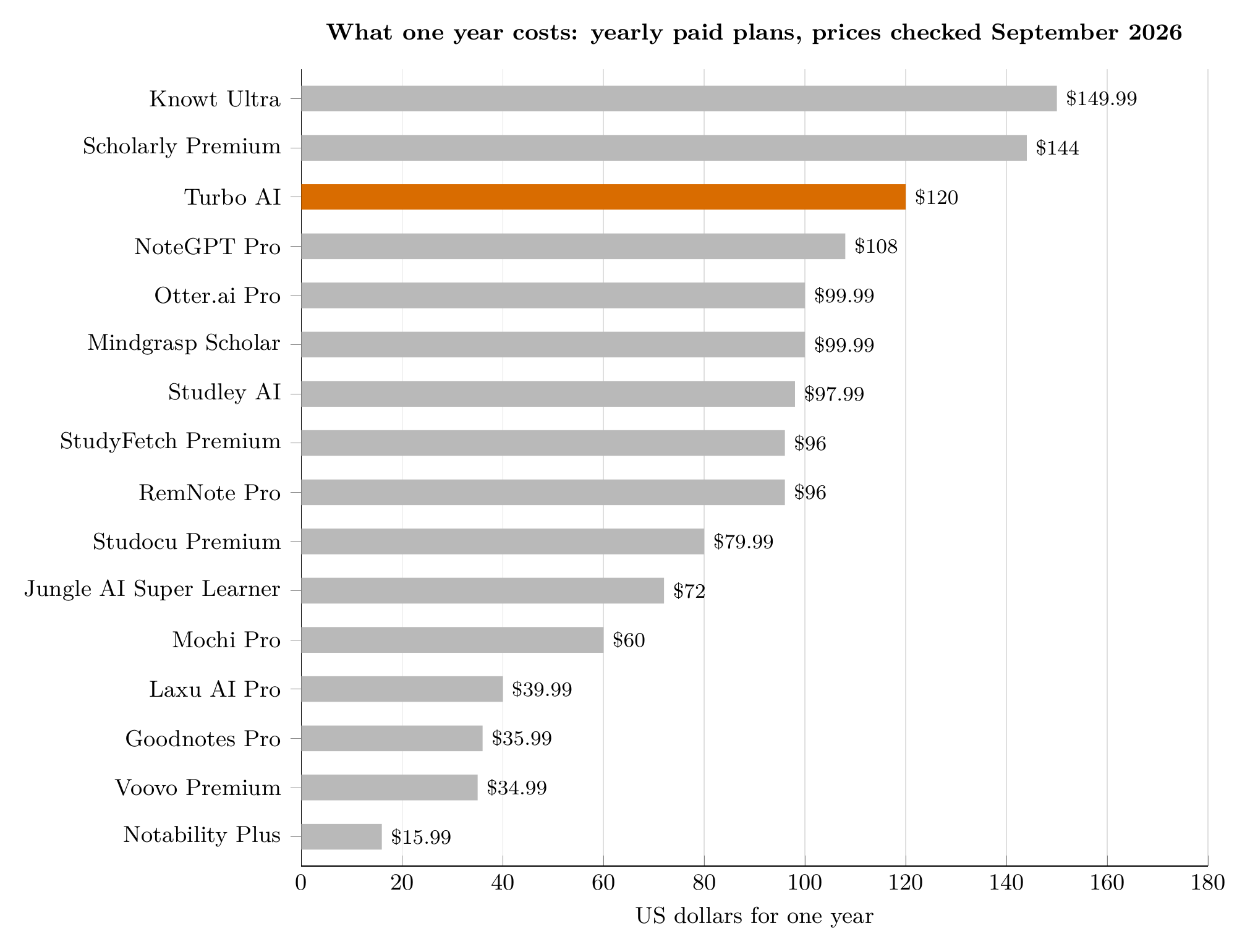
Yearly cost of each paid plan in the table, from vendor pricing pages and US App Store listings (checked 2026-09-14; RemNote and Mochi 2026-09-13). Chart by Mindomax.
1. Gemini Notebook (formerly NotebookLM) - The Best Free Alternative
Google renamed NotebookLM to Gemini Notebook on July 16, 2026. It does most of what people pay Turbo for, for free: upload PDFs, slides, YouTube links or notes, then ask questions, get an audio overview, and generate flashcards and quizzes grounded in your own sources.
Price: free, with higher limits in Google AI Plus at $4.99/month or AI Pro at $19.99/month (checked 2026-09-14). US college students can get AI Pro free for a year. The free plan allows 100 notebooks, 50 sources each, and 10 flashcard sets a day.
Limitation: it does not schedule reviews. You decide what to re-study, and flashcards export only as a CSV file.
2. Knowt - The Closest Free Match With Real Review Scheduling
Knowt turns notes, PDFs, slides and lecture recordings into flashcards and practice tests, and imports Quizlet sets in one click (we compared the two in Knowt vs Quizlet). Unlike Turbo, its help centre documents a review schedule: new cards each day, and later reviews set by your Again, Hard, Good and Easy ratings.
Price: free plan; Ultra is $24.99/month or $149.99/year (checked 2026-09-14). The free plan's AI limits are not published.
Limitation: the Android app shows ads, and cards export only to PDF, not to Anki or CSV.
3. StudyFetch - The Most Similar All-in-One
StudyFetch is the app most like Turbo: upload lectures, PDFs or slides, then study with flashcards, quizzes and an AI tutor. It can import Anki decks.
Price: on the App Store, Premium is $19.99/month or $96/year (checked 2026-09-14).
Limitation: month to month it costs the same as Turbo, and there is no documented way to export your cards.
4. Mindomax - AI Flashcards From Audio, PDFs and Photos, With Scheduling
Mindomax is our own app, so judge this entry with that in mind. It makes flashcards from an audio file, a PDF, a photo or pasted text, then schedules them in review boxes so each card comes back when it is due. It runs on iOS, Android, Mac and the web and has 450,000+ ready-made cards.
Price: the free plan is $0 and includes review scheduling, an AI assistant and CSV export; Premium, which adds the AI card creation, is listed at $0 until 2028 (checked 2026-09-14).
Limitation: it cannot import Anki .apkg decks, and it is new: the US App Store listing has no ratings yet. The price after 2028 is not published.
5. Laxu AI - The Cheapest Option That Schedules and Exports
Laxu AI turns PDFs, photos of notes and lecture audio into flashcards, notes, quizzes and podcasts. Its site says it schedules reviews at growing intervals, and it exports cards to Anki (.apkg) or PDF.
Price: free plan; Pro $4.99/month or $39.99/year (checked 2026-09-14).
Limitation: the free plan allows one document upload, YouTube links are not supported, and the app is small: 22 US App Store ratings.
6. Jungle AI - Exam-Style Questions, Not Just Cards
Jungle AI makes flashcards plus multiple-choice, free-response, case and diagram questions from PDFs, slides, videos and YouTube. It gives you a daily spaced-repetition review.
Price: on the App Store, Super Learner is $12/month or $72/year (checked 2026-09-14). The website hides the amount until its page script loads.
Limitation: the free plan allows 3 generations a month and 30 pages per document, and Anki export is paid only.
7. Scholarly - A Web Study Suite That Exports to Anki
Scholarly makes flashcards, quizzes, practice exams and podcasts from documents and recordings, schedules reviews, and exports to Anki on paid plans.
Price: Premium $12/month billed yearly ($144), or $30 month to month (checked 2026-09-14).
Limitation: the free plan is a sample, not a plan: 3 chat messages and 1 creation credit for life. It is web only; App Store apps called "Scholarly" come from other companies.
8. Voovo - Diagram Cards and a Named Algorithm
Voovo makes flashcards from photos of diagrams, voice and text, with twelve exercise types. It is one of the few apps here that names its scheduler (DolphinSR).
Price: on the App Store, Premium is $4.99/month, $34.99/year or $89.99 for life (checked 2026-09-14).
Limitation: decks leave only through a share code, with no Anki or CSV export. The old voovo.ai address no longer loads.
9. Notability - Handwritten Notes With AI Quizzes
Notability is a note app first: write or type, record the lecture alongside your notes, then turn notes, PDFs or recordings into AI quizzes and flashcards. Its flashcards use spaced repetition, and it imports Anki and Quizlet text files.
Price: Plus is $15.99/year on its yearly offer, shown against $19.99 (checked 2026-09-14). Pro is $79.99/year.
Limitation: the AI study tools need a paid plan, Plus caps them at 400 quizzes and flashcards a month, and the free plan holds 5 notes.
10. Goodnotes - Handwriting and Flashcards You Make
Goodnotes is the other big handwriting app. Its Study Sets are flashcards you write or import from CSV, and Smart Learn tells you when to come back to them.
Price: free; Essential $11.99/year; Pro $35.99/year; an AI Pass adds $9.99/month (checked 2026-09-14). The free plan allows 3 notebooks and 20 minutes of audio.
Limitation: Smart Learn is documented as iOS only, and cards export only in Goodnotes' own format.
11. Otter.ai - When You Only Need the Transcript
Otter.ai records in-person and online lectures, writes a live transcript, and summarises the class.
Price: free plan with 300 minutes a month; Pro $16.99/month or $99.99/year on the App Store, and $79.99/year for students with a .edu email (checked 2026-09-14).
Limitation: no flashcards or quizzes at all, and free recordings stop at 30 minutes, shorter than most lectures.
12. Coconote - Lecture Recording, Now Owned by Quizlet
Coconote records a lecture and turns it into notes, study guides, flashcards, quizzes and podcasts. Quizlet bought it in February 2026.
Price: no pricing page; the App Store lists "Coconote Pro" at $9.99 to $152.99 without saying which is monthly or yearly (checked 2026-09-14).
Limitation: free-plan limits are not published, and we found no Anki or CSV export.
13. Genio Notes (formerly Glean) - Class Notes for Accessibility
Genio Notes records a class, links your notes and slides to the audio, builds an AI outline and quizzes you on it. Some universities provide it free through their disability services.
Price: from £12/month for individuals, with no US dollar price published, and a 30-day trial without a card (checked 2026-09-14).
Limitation: no flashcards, and the new iPhone app is rated 1.79 from 24 US ratings.
14. NoteGPT - Summaries of YouTube and PDFs
NoteGPT is a web tool and browser extension that summarises YouTube videos and PDFs and makes flashcards and quizzes from them.
Price: Pro $9.99/month or $108/year; the free plan gives 15 quotas a month (checked 2026-09-14).
Limitation: it rates 1.9/5 on Trustpilot, with complaints about quota errors, and refunds only within 24 hours. Store apps named "NoteGPT" are not made by NoteGPT.
15. Mindgrasp - Lecture Notes and Quizzes, Paid Only
Mindgrasp takes lecture recordings, PDFs, slides and videos and makes notes, flashcards and quizzes, on the web, iPhone and a Chrome extension.
Price: no free plan, only a trial; on the App Store, Scholar is $12.99/month or $99.99/year (checked 2026-09-14).
Limitation: no official Android app, and a 2.3/5 Trustpilot score driven by billing and cancellation complaints.
16. Studley AI - Tests and Tutor Lessons
Studley AI makes flashcards, quizzes, written tests and tutor lessons from PDFs, slides, notes and YouTube.
Price: $14.99/month or $97.99/year on its website; the App Store also sells weekly plans at $7.99 to $8.99 (checked 2026-09-14).
Limitation: the free plan allows one study set, and we found no card export.
17. ScrollToStudy - Study as a Scrolling Feed
ScrollToStudy turns PDFs, slides, photos and YouTube into a social-media-style feed of cards and questions.
Price: no public price list; the App Store sells the same plan names at $6.99 to $19.99/month and $39.99 to $99.99/year (checked 2026-09-14).
Limitation: the feed picks what you see next, but we found no review calendar, and export is not mentioned anywhere.
18. Algor Education - Concept Maps From Your Material
Algor Education turns text, PDFs, audio and video into concept maps, flashcards and quizzes.
Price: the website shows euros only (€2.99 to €7.99/month); the US App Store lists Pro at $9.99 and $95.90 without labelling the periods (checked 2026-09-14).
Limitation: the free plan makes 2 AI study sets, and cards export only as PDF.
19. Studocu - A Library of Other Students' Notes
Studocu gives you a library of 50 million+ shared notes, plus AI quizzes, flashcards, mock exams and a lecture recorder.
Price: on the App Store, Premium is $79.99/year or $34.99/quarter (checked 2026-09-14). There is no monthly plan, and the price depends on your country.
Limitation: we found no review scheduling and no card export.
20. Anki - Free, and the Strongest Scheduler
Anki is the reference for review scheduling. It offers FSRS, which sets each card's next review from your own recall history. The desktop app and AnkiDroid are free; AnkiMobile for iPhone is $24.99 once (checked 2026-09-14), the only paid version (why the iPhone app costs money).
Limitation: it makes no cards for you. Pair it with a generator that exports to Anki, such as Laxu AI, Jungle AI or Scholarly above.
21. RemNote - Notes and Flashcards in One Place
RemNote lets you write notes and turn any line into a flashcard, reviewed with FSRS. It imports Anki decks.
Price: free; Pro $8/month or $96/year; Pro with AI $18/month or $216/year (checked 2026-09-13).
Limitation: the free plan caps PDF annotation at 3 documents and AI at 250 credits a month.
22. Mochi - Plain, Fast Markdown Cards
Mochi is a Markdown flashcard app with FSRS scheduling that imports Anki decks with their review history.
Price: free forever for offline use; Pro $5/month billed yearly for sync and AI (checked 2026-09-13).
Limitation: without Pro, your cards stay on one device.
Checked and Left Out
Monic.ai closed on March 7, 2026. Cramberry is iPhone only with no US ratings yet. TurinQ and Unstuck AI have not updated their apps since February 2026. Raena and Revisely publish no confirmable price, and StudyX is mainly a homework-answer tool.
Why Scheduling Matters More Than Generation
Turbo AI and most apps above are good at turning a lecture into material; they differ on what happens next. A 2013 review by Dunlosky and colleagues rated ten study techniques and gave the top grade to only two: testing yourself and spreading study over time. A meta-analysis of 254 studies by Cepeda and colleagues found that the same study time, spread out, beats one long session. So ask of any alternative not only how good its cards are, but whether it tells you when to review them. We compare the scheduling apps in AI flashcard apps with spaced repetition.
How to Choose in Two Minutes
If you record lectures, start with Otter.ai, Coconote or Notability, and check the free minutes first (more options in our note-taking apps for students). If you study from PDFs, use Gemini Notebook to understand the material and a scheduling app to memorise it. If your exam is months away, pick an app with "Yes" in the scheduling column. If price is why you are leaving, compare yearly prices, not monthly ones. If you already have Turbo AI cards, check that the new app imports CSV or Anki files.
CONCLUSION
Most Turbo AI alternatives copy Turbo's first half, turning a lecture into cards; fewer bring the cards back on time or let them leave. Gemini Notebook is the best free way to understand your material, Knowt the best free all-rounder, and Laxu AI the cheapest way to get scheduled AI cards that can move to Anki. If AI cards from a recording or a PDF that come back on a schedule are what you need, Mindomax is free to try on the web, iOS and Android.
Frequently Asked Questions
What is the best free Turbo AI alternative?
Gemini Notebook, the new name for Google's NotebookLM. It makes notes, audio overviews, flashcards and quizzes from your own files for free. It does not schedule reviews, so pair it with Anki or another scheduling app for long-term memory.
Is Turbo AI worth the price?
Turbo's own blog puts it at $20 a month billed monthly, or $120 a year (checked 2026-09-14). That can be fair if you record many lectures and only need notes. For flashcards that come back on a schedule, Laxu AI and Jungle AI cost less.
Which Turbo AI alternatives use spaced repetition?
Knowt, Laxu AI, Jungle AI, Scholarly, Voovo, Notability, Goodnotes (iOS), Mindomax, Anki, RemNote and Mochi all schedule reviews. Anki, RemNote and Mochi use FSRS.
Can I move my Turbo AI flashcards to another app?
We found no documented flashcard export in Turbo AI. If moving cards matters, choose an app that exports to Anki or CSV from the start, such as Laxu AI, Jungle AI, Scholarly, Gemini Notebook or Mindomax.
What is the cheapest Turbo AI alternative?
Gemini Notebook, Anki on desktop and Android, and Mindomax are free for their core features. The cheapest paid plans we found were Notability Plus at $15.99 a year, Voovo at $34.99 a year and Laxu AI at $39.99 a year (checked 2026-09-14).


