
Introduction
A medical student sits down with a pharmacology textbook and opens to chapter twelve. The page lists forty-seven drug names. Esomeprazole. Atorvastatin. Clopidogrel. Aripiprazole. Evolocumab. Each name looks like it belongs to an alien language. By the end of the week, the student has a practical exam. By the end of the year, the total count will pass a thousand [1].
This is not a problem of motivation. It is a problem of biology.
The human brain evolved to learn words through social interaction, repetition in context, and emotional association. Drug names offer none of that. They arrive as dense clusters of unfamiliar syllables, stripped of meaning, disconnected from anything the learner already knows. And yet the stakes could not be higher. Confuse hydroxyzine with hydralazine and a patient gets the wrong medication. Mix up vincristine and vinblastine and the consequences can be fatal.
Pharmacology consistently ranks among the most difficult subjects in medical and pharmacy curricula. A 2024 survey of medical students at the University of Jeddah found that 56.7 percent felt overwhelmed by the sheer volume of pharmacology content [2]. In Australia, only 39 percent of medical graduates felt adequately prepared in pharmacology upon entering clinical practice [3]. Something about how drug names are taught, and how students try to learn them, is broken.
But the science of memory has answers. Over the past five decades, cognitive psychologists, neuroscientists, and medical educators have tested specific techniques for learning unfamiliar vocabulary. Some of those techniques double retention rates. Others cut study time by a third. And the World Health Organization has built a naming system into every drug on earth that most students never learn to read. This article tells the story of why drug names are so hard to remember, what the brain actually does when it encounters one, and what the research says about fixing the problem.

Why Drug Names Break Your Brain
The first question is simple. Why are drug names harder to learn than ordinary words?
The answer lives in a structure that Alan Baddeley and Graham Hitch proposed in 1974: working memory. Specifically, a component Baddeley called the phonological loop. This is the part of working memory that temporarily holds sound-based information. When someone tells you a phone number, the phonological loop keeps it alive long enough for you to dial. When you encounter a new word, the phonological loop holds its sound pattern while the brain tries to build a more permanent record [4].
Baddeley, Susan Gathercole, and Costanza Papagno argued in a landmark 1998 paper that the phonological loop evolved primarily as a language-learning device. Its main job is storing unfamiliar sound patterns while the brain constructs lasting memory representations. Children with larger phonological loop capacity learn new vocabulary faster. Adults with phonological loop impairments struggle to learn foreign words [4].
Here is the problem. The phonological loop has two well-documented weaknesses.
The first is the word-length effect. Longer words take longer to rehearse in the loop, which means fewer of them fit. Try holding "metoprolol" in memory at the same time as "esomeprazole" and "atorvastatin." Each name eats up rehearsal time. Compare that to remembering "cat, dog, fish." The loop handles short, familiar words easily. Long, unfamiliar drug names choke it.
The second weakness is the phonological similarity effect. Words that sound alike interfere with each other. This is exactly why look-alike, sound-alike drug pairs cause so many clinical errors. Valacyclovir and valganciclovir. Hydroxyzine and hydralazine. Prednisolone and prednisone. When names share phonological structure, the loop confuses them. Benjamin Lambert demonstrated in 1997 that drug-name pairs exceeding certain orthographic similarity thresholds were 25 to 523 times more likely to be involved in a medication error than control pairs [5].
So the biology is stacked against learners from the start. Drug names are long (high rehearsal cost), unfamiliar (no existing memory hooks), and often similar to each other (high interference). The phonological loop is the bottleneck. Any memorization strategy that ignores this bottleneck will fail.
But there is a way around it. The phonological loop is not the only route into long-term memory. Deeper processing, through meaning, can bypass the bottleneck entirely.
The Hidden Code Inside Every Drug Name
Most students treat drug names as random strings of letters. They are not.
In 1950, the World Health Assembly passed resolution WHA3.11, creating a system for assigning International Nonproprietary Names to pharmaceutical substances. The system became operational in 1953 and has been maintained by the World Health Organization ever since. As of 2024, more than 8,000 INNs have been published, with 120 to 150 new names added every year [6].
The key feature of this system is stems. Pharmacologically related substances share a common word fragment. The stem tells you what class the drug belongs to and, by extension, how it works. The WHO publishes a complete Stem Book that catalogs hundreds of approved stems [7].
Consider some examples. Every beta-blocker ends in -olol: propranolol, atenolol, metoprolol, bisoprolol. Every ACE inhibitor ends in -pril: lisinopril, enalapril, ramipril, captopril. Every statin ends in -statin: atorvastatin, rosuvastatin, simvastatin. Every proton-pump inhibitor ends in -prazole: omeprazole, esomeprazole, pantoprazole. Every benzodiazepine ends in -azepam or -azolam: diazepam, lorazepam, alprazolam.
The system extends to biologics. Monoclonal antibodies end in -mab, with substems indicating origin: -ximab for chimeric, -zumab for humanized, and -umab for fully human antibodies. Small-molecule kinase inhibitors end in -nib: imatinib, erlotinib, osimertinib.
Why does this matter for memorization? Because learning the stem system transforms drug names from phonological garbage into semantically transparent compounds. Instead of memorizing "atorvastatin" as a meaningless eleven-letter string, the student recognizes "-statin" and immediately knows: HMG-CoA reductase inhibitor, cholesterol synthesis pathway, liver target. The phonological loop no longer bears the full load. Meaning does the heavy lifting.
This connects directly to one of the most replicated findings in cognitive psychology: Fergus Craik and Robert Lockhart's levels of processing framework, published in 1972 [8]. Their research showed that deeper, semantic processing produces more durable memory traces than shallow, phonemic processing. Encoding a drug name by its meaning (what it does, why it is named that way) creates a stronger trace than simply repeating the syllables.
Bryan, Aronson, and colleagues analyzed 7,987 INNs against WHO guidelines in a 2015 study published in PLOS ONE. They found that compliance with naming conventions has been inconsistent over the decades, and older names from before 1970 often lack clear stems [9]. This means the stem system is not perfect. But for the vast majority of modern drugs, it is an effective decoding tool that most students are never explicitly taught.
The Keyword Method That Doubled Vocabulary Scores
In 1975, Richard Atkinson and Michael Raugh at Stanford University ran an experiment that changed how psychologists think about vocabulary learning [10]. They wanted to know if there was a faster way to learn foreign words than simple repetition.
Their method was straightforward. Take the foreign word. Find an English word that sounds like part of it (the "keyword"). Then create a vivid mental image linking the keyword to the English meaning. For example, to learn the Russian word "zvonok" (meaning "bell"), the student might use "oak" as the keyword and imagine a bell hanging from an oak tree.
The results were dramatic. Students using the keyword method scored 88 percent on a vocabulary test. The control group, using standard free study, scored 28 percent [11]. Raugh, Schupbach, and Atkinson extended this to a large Russian vocabulary in 1977 and found similar results [10].
The method translates cleanly to pharmacology. Take "lisinopril." The keyword could be "listen." Imagine a giant ear listening to a blood pressure cuff deflating. Now you have an acoustic hook ("listen") linked to a visual image (blood pressure) linked to the drug class (ACE inhibitor). Three encoding pathways instead of one.
Take "atorvastatin." Split it: "ator" sounds like "a store." Imagine a store where the shelves are stacked with cholesterol, but a lock (the statin) prevents anyone from restocking them. The vivid image binds the name to the mechanism.
This works because of what Allan Paivio called dual coding theory [12]. Paivio proposed in 1971 that verbal and visual information are stored in separate but interconnected systems. When both systems encode the same item, the learner gets two independent retrieval routes instead of one. If the verbal route fails, the visual route can still retrieve the memory. Fritz and colleagues confirmed in 2007 that the effects of keyword mnemonics and retrieval practice are additive. Combining both produces stronger retention than either alone [13].
A 2025 paper in JMIR Medical Education by Elabd and colleagues took this a step further. They showed that medical students could use large language models to generate personalized multimodal mnemonics, combining verbal keywords with AI-generated images, achieving an 85 percent initial success rate that improved to 95 percent after refinement, in two to five minutes per concept [14]. The method is ancient. The tools are new.
Memory Palaces in the Pharmacy Aisle
The method of loci, better known as the memory palace technique, dates back to ancient Greece. The poet Simonides of Ceos, according to legend, remembered the names of guests at a banquet by associating each person with their position at the table. When the building collapsed and the bodies were unrecognizable, Simonides identified each guest by mentally walking through the room.
The technique works by placing items to be memorized at specific locations along a familiar route. To recall them, you mentally walk the route and "pick up" each item. The spatial scaffold provides retrieval cues that pure rote memorization lacks.
In 2014, Qureshi, Rizvi, Syed, Shahid, and Manzoor at Rawal Medical College in Islamabad conducted a randomized controlled trial testing the method of loci in medical education. Students learning insulin types and diabetes management through memory palaces significantly outperformed students who received only standard didactic instruction [15]. The study was small and single-center, so the results should be interpreted with that caveat. But the direction was clear.
Khan and colleagues extended this in 2024, describing what they called "evolving palaces" for pharmacology retention. Instead of static placements, students updated and enriched their palace locations as they learned more about each drug, turning the palace into a living knowledge structure rather than a frozen list [16].
What does this look like in practice? Imagine your own kitchen. At the stove, picture a massive heart-shaped pot boiling over with blocked beta receptors. That is your beta-blocker station (propranolol, atenolol, metoprolol). At the refrigerator, imagine an enormous pair of lungs made of ice, frozen open by bronchodilators. At the sink, picture blood vessels being rinsed clean by ACE inhibitors. Each station holds a drug class. Each class contains specific drugs with their own vivid sub-images.
The palace works because it exploits the brain's spatial memory system, which is among the most durable memory systems humans possess. The hippocampus, which is critical for forming new memories, is also the home of place cells and spatial maps. When memorization piggybacks on spatial encoding, it gets access to neural machinery that evolved for navigation, not rote learning. That machinery is strong.

Test Yourself or Fool Yourself
Rereading notes feels productive. It is not.
In 2006, Henry Roediger and Jeffrey Karpicke published a study in Psychological Science that challenged the most common study habit in education. They gave students passages to learn. One group studied the material four times. Another group studied it once and then took three practice tests. On a test given five minutes later, the study-only group performed better. But on a test given one week later, the testing group scored roughly 50 percent higher [17].
This is the testing effect, also called retrieval practice. The act of pulling information out of memory strengthens the memory trace more than the act of putting information back in. Larsen, Butler, and Roediger confirmed this specifically in medical education in 2008 [18]. A 2025 state-of-the-art review in the health professions confirmed that retrieval practice consistently outperforms restudy across medical and health science populations [19].
Pastötter and Bäuml identified an additional benefit in 2014: the forward effect of testing. Retrieval practice on one set of material actually improves learning of subsequent, new material [20]. For pharmacology students cycling through drug classes, this means that self-testing on beta-blockers before studying ACE inhibitors should make the ACE inhibitors easier to learn, not harder.
There is also Slamecka and Graf's generation effect, demonstrated in 1978. Information that the learner generates (produces actively) is remembered better than information merely read [21]. This argues for active production of drug names. Instead of reading "lisinopril = ACE inhibitor," close the book and write: "The ACE inhibitor ending in -pril needed for the cardiovascular block is ______." That blank forces generation. Generation strengthens the trace.
What does this mean practically? Every study session for pharmacology should involve testing, not rereading. Cover the answer. Write the drug class from memory. Name three drugs in the class without looking. Spell the generic name from the brand name. This feels harder than rereading. That difficulty is the point. Robert Bjork calls it "desirable difficulty." The struggle during retrieval is what builds durable memory.
Spacing, Sleeping, and Forgetting on Purpose
Hermann Ebbinghaus sat alone in his study in 1885 and memorized lists of nonsense syllables. He timed how quickly he forgot them. His results produced the forgetting curve: without review, roughly half of learned material fades within an hour, and within a week, the vast majority is gone [22].
But Ebbinghaus also discovered something else. Each time he reviewed the material, the forgetting curve flattened. Memories lasted longer after each review. And the optimal strategy was not to review immediately, but to wait until the memory had partially decayed and then retrieve it. This is the spacing effect, and it remains one of the most replicated findings in all of psychology.
Jape, Zhou, and Bullock tested spaced repetition specifically for pharmacology in a 2022 study at Monash University. They built a curriculum-aligned digital flashcard system containing 1,208 cards across 156 drug classes and integrated it into the medical pharmacology course. Students rated spaced repetition as the most-engaged-with revision mode, and the tool received a 3.8 out of 5 global satisfaction rating [3]. The study was observational, not randomized, but it demonstrated feasibility at scale.
John Dunlosky and colleagues reviewed ten popular study techniques in their influential 2013 assessment published in Psychological Science in the Public Interest. Only two received a "high utility" rating: distributed practice (spacing) and practice testing (retrieval). Highlighting, rereading, and summarization all received "low utility" ratings [23].
Now add sleep. Matthew Davis and M. Gareth Gaskell adapted the complementary learning systems framework to explain how the brain consolidates new vocabulary. Their model proposes that new words are initially stored as fragile hippocampal traces. During subsequent sleep, these traces are replayed during slow-wave sleep and gradually integrated into neocortical networks [24]. Dumay and Gaskell demonstrated in 2007 that sleep-dependent consolidation is necessary for new words to become fully integrated into the mental lexicon [25].
Marc Züst and colleagues at the University of Bern showed in a 2019 study published in Current Biology that implicit vocabulary associations can form during sleep, specifically bound to the up-states of slow oscillations [26]. Mirković and Gaskell demonstrated that sleep preferentially consolidates arbitrary form-meaning mappings, which is precisely what new drug-name-to-class associations represent [24].
The practical implication is direct. Study new drug names in the evening. Sleep. Review in the morning. The sleep between sessions is not wasted time. It is the consolidation engine. All-night cramming sessions before pharmacology exams destroy the very mechanism that drug-name acquisition depends on.

When Similar Names Kill
Drug-name memorization is not just an academic exercise. It is a patient safety issue.
The United States Pharmacopeia recorded 26,604 medication errors attributed to look-alike, sound-alike (LASA) drug confusion between 2003 and 2006 [27]. Of those, 1.4 percent caused patient harm and seven may have contributed to deaths. The Institute for Safe Medication Practices and USP estimate that approximately 25 percent of all nationally reported medication errors involve LASA confusion. A 2024 hospital case study in Pharmacy Practice found drug-name confusion responsible for 64.62 percent of LASA-related errors in that institution [28].
The problem is built into the naming system itself. Lambert's 1997 analysis showed that drug names sharing high orthographic similarity had error rates 25 to 523 times higher than control pairs [5]. Celebrex and Cerebyx. Lamictal and Lamisil. Zyprexa and Zyrtec. The names look similar on paper, sound similar when spoken aloud, and share enough phonological structure to confuse the phonological loop.
This reframes the entire memorization challenge. Learning drug names accurately is not a study trick. It is a clinical skill that protects patients. Every pharmacology student who confuses two drug names in an exam may one day confuse them at a bedside. Techniques that build durable, distinct memory traces for similar-sounding drugs are not academic luxuries. They are professional necessities.
The WHO INN system helps here too. When a student knows that -prazole means proton pump inhibitor and -pramine means tricyclic antidepressant, the risk of confusing omeprazole with imipramine drops. Stem knowledge creates categorical boundaries that reduce cross-class confusion.
Interleave Your Drug Classes
Most students study pharmacology in blocks. Cardiovascular drugs for a week. Then antibiotics. Then CNS drugs. This feels logical. It is suboptimal.
Doug Rohrer, Robert Dedrick, and Kelli Burgess published a study in Psychonomic Bulletin and Review in 2014 that tested interleaved practice against blocked practice. Students practiced math problems either by type (all of one kind, then all of another) or interleaved (mixed types in random order). On an unannounced test two weeks later, the interleaved group scored 72 percent. The blocked group scored 38 percent. The effect size was 1.05, considered large by any standard [29].
In medical education specifically, Dobson and colleagues tested a 2x2 factorial design with 80 first-year medical students at McMaster University, evaluating distributed versus massed instruction crossed with interleaved versus blocked practice for ECG interpretation skills. Interleaving improved acquisition of diagnostic classification [30].
Applied to pharmacology, this means shuffling drug classes during practice rather than studying one class exhaustively before moving to the next. Review a beta-blocker, then an ACE inhibitor, then an antibiotic, then a benzodiazepine. The constant switching forces the brain to discriminate between categories, strengthening the boundaries between drug classes and reducing the kind of cross-class confusion that causes LASA errors.
Interleaving feels harder than blocking. Students often report feeling less confident during interleaved practice. This is another desirable difficulty. The subjective sense of difficulty does not predict long-term retention. In fact, conditions that feel easy during study often produce poor long-term memory. The difficulty of interleaving is precisely what drives better discrimination and stronger encoding.
Building the Complete Stack
John Sweller introduced cognitive load theory in 1988 to explain why some instructional designs work and others fail [31]. The theory distinguishes three types of cognitive load. Intrinsic load comes from the complexity of the material itself. Extraneous load comes from poor instructional design. Germane load comes from the mental effort of building schemas and understanding.
Pharmacology is inherently high in intrinsic load. A single drug connects name, class, mechanism, indications, contraindications, adverse effects, drug interactions, and pharmacokinetics. Each connection is an element. The interaction between elements is what makes the material difficult. Young and colleagues applied cognitive load theory to medical education in 2014 and argued that the solution is not to simplify the material but to sequence it strategically [32].
The sequencing principle for drug-name memorization looks like this. Start with stems. A student who knows forty stems can decode hundreds of drug names on first encounter. That is a massive reduction in intrinsic load. Then add mechanisms. Connect each stem to its pharmacological target. Then add clinical context. Why is this drug prescribed? What happens when it fails? Each layer builds on the previous one, and each layer deepens the encoding.
Mahan and Stein recontextualized cognitive load theory for clinical practice in 2020 [33]. Their argument is relevant here: the goal is not to minimize all cognitive load, but to redirect load from extraneous sources (poorly organized study materials, inconsistent naming logic) toward germane sources (building conceptual drug-class schemas that connect to physiology).
Egan and Schwartz showed in 1979 that expert encoding of large symbolic sets depends on chunking. Instead of memorizing 1,069 individual drugs as separate items, grouping them by stem and class reduces the effective number of items to a much smaller set of schemas. The element interactivity drops by an order of magnitude [34].
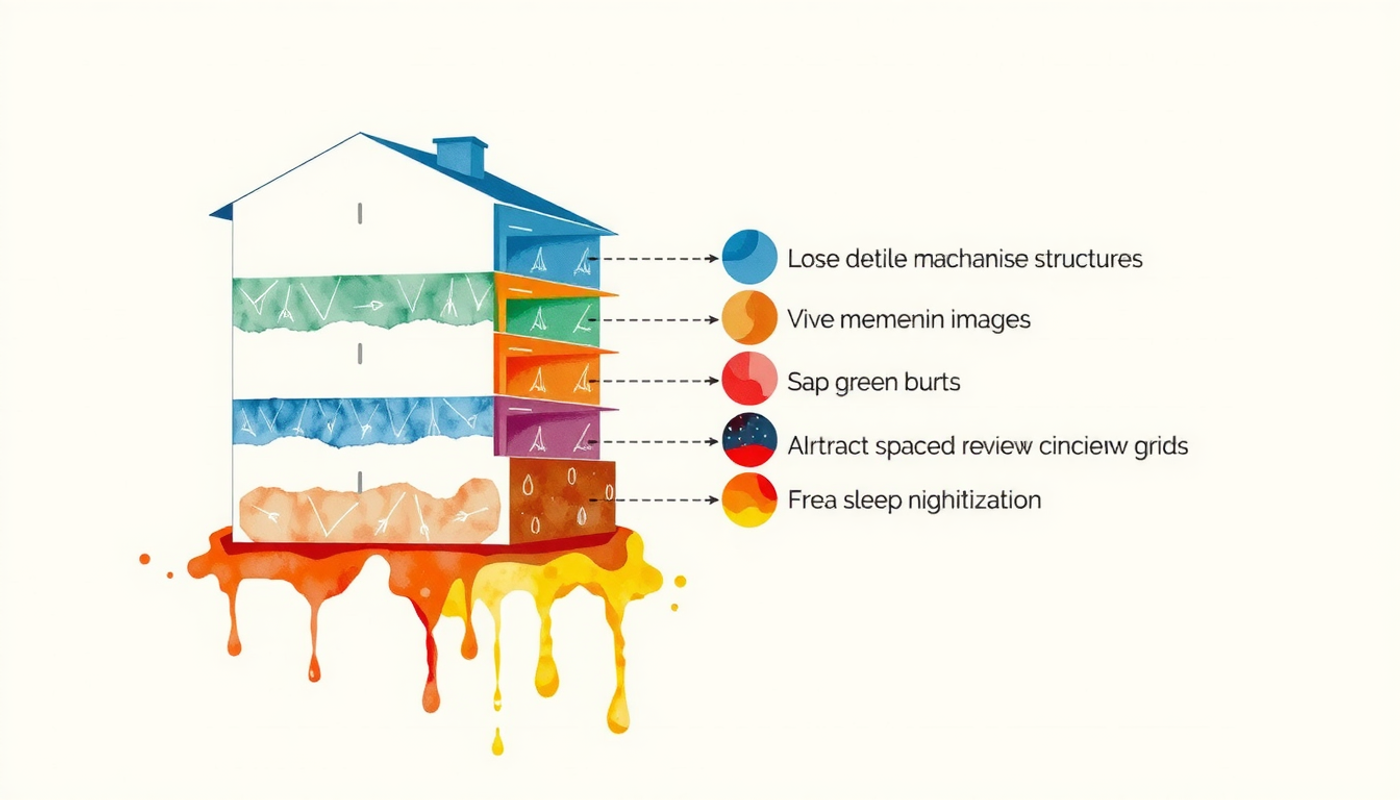
Consider the complete evidence-based stack, in order:
Step one: learn the stem system. This converts phonological gibberish into transparent compounds.
Step two: pronounce each name aloud. Engage the phonological loop actively instead of relying on silent reading.
Step three: encode the mechanism. Ask why the stem implies a specific action. This deepens processing from phonemic to semantic. Dunlosky and colleagues rated elaborative interrogation as a "moderate utility" technique that adds only about 15 percent to study time [23].
Step four: build retrieval cues. Create keyword mnemonics with vivid images. Place them in a memory palace. Use dual coding to create both verbal and visual traces.
Step five: test yourself with interleaved retrieval practice. Mix drug classes. Space reviews over days and weeks. Sleep between sessions.
This is not one technique. It is a layered system where each technique addresses a different bottleneck in the memory pipeline.
The Exercise Connection
The relationship between physical exercise and memory is not metaphorical. It is biochemical.
Bernadette Winter and colleagues published a study in Neurobiology of Learning and Memory in 2007 testing vocabulary acquisition after three conditions: intense running, low-impact exercise, and rest. Vocabulary learning was 20 percent faster after intense running compared to the other conditions [35]. The proposed mechanism involves brain-derived neurotrophic factor (BDNF), a protein that supports the growth and survival of neurons. Exercise increases circulating BDNF levels, and BDNF is concentrated in the hippocampus, the same structure critical for encoding new vocabulary.
Hötting and colleagues tested the dose-response relationship in 2016, and Schmidt-Kassow and colleagues showed in 2013 that light-to-moderate cycling during encoding improved vocabulary retrieval, particularly in initially low-performing participants [36]. Kirk Erickson and colleagues at the University of Pittsburgh demonstrated in a randomized trial published in PNAS that twelve months of aerobic exercise actually increased hippocampal volume by approximately two percent, reversing age-related volume loss [37].
For pharmacology students, the implication is practical: a 20-minute run or brisk walk before a study session may meaningfully improve encoding of new drug names. This is not wellness advice dressed up as science. It is a direct prediction from the BDNF-hippocampal pathway that has been tested in vocabulary-learning paradigms.
What the Evidence Does Not Say
Honest science requires stating what remains uncertain.
The memory palace evidence in pharmacology comes primarily from one well-known RCT by Qureshi and colleagues in 2014. It was a small, single-center study conducted in Pakistan with endocrinology content, not pharmacology specifically [15]. The direction of the effect is promising, but large-scale, multi-center, pharmacology-specific trials of the method of loci have not been published.
The keyword mnemonic method has strong evidence for receptive recall (hearing the foreign word and producing the meaning) but weaker evidence for productive recall (hearing the meaning and producing the foreign word). Some studies show keyword-generated memories decay faster than conventionally learned ones over long delays unless combined with spaced retrieval practice [13].
The Ebbinghaus forgetting curve percentages commonly cited (50 percent loss in one hour, 70 percent in a day, 90 percent in a week) vary substantially across replications and materials. They should be treated as illustrative rather than precise.
LASA error statistics also vary widely depending on the reporting system and denominator used. Some sources cite 6.2 to 14.7 percent of all medication errors [38]. Others cite approximately 25 percent [27]. The 64.62 percent figure from the 2024 hospital study applies only to the LASA-specific subset, not to all medication errors [28].
Several mnemonics-in-medical-education studies are small, single-institution, and possibly underpowered. The largest body of evidence supports spaced retrieval practice. But even this evidence is mostly based on self-selected student populations in observational designs. Randomized controlled trials of spaced repetition in pharmacology are rare. The Monash study by Jape and colleagues was not randomized [3].
None of this invalidates the techniques. It means that the evidence is strong for the general principles (spacing beats massing, testing beats rereading, meaning beats rote) but thinner for the specific application of some techniques to pharmacology memorization. Students should use the full stack, but should also recognize that no single method is guaranteed to work for every learner or every type of drug information.

Conclusion
Drug names are hard to remember because they exploit every weakness of the human memory system. They are long, unfamiliar, phonologically similar to each other, and stripped of the semantic context that makes ordinary words stick. The phonological loop chokes on them. Rote repetition fails because it never gets past surface-level processing.
But the problem is solvable. The WHO built a naming system into every drug on earth that converts meaningless syllables into transparent class indicators. Cognitive psychologists have tested techniques that double or triple vocabulary retention. Neuroscientists have mapped the sleep-dependent consolidation pathways that stabilize new word memories overnight. And medical educators have confirmed that retrieval practice, spaced repetition, and elaborative encoding all work in clinical training contexts.
The complete stack is not complicated. Learn the stems first. Pronounce the names aloud. Ask why each drug works the way it does. Build vivid keyword images and anchor them in a memory palace. Test yourself with interleaved retrieval. Space your reviews. Sleep between sessions. Move your body before you study. Each step addresses a different bottleneck in the encoding-consolidation-retrieval pipeline.
The strongest argument for taking drug-name memorization seriously is not the next exam. It is the patient who will one day depend on the accuracy of what that student remembers. Lambert showed in 1997 that similar-sounding drug names multiply error risk by orders of magnitude. Every distinct, durable memory trace a student builds is a small contribution to patient safety. The stakes are real. The science is ready. The stems are waiting to be decoded.
Frequently Asked Questions
Why are drug names so difficult to memorize?
Drug names are functionally foreign words with no pre-existing meaning for the learner. They overload the phonological loop in working memory because they are long, unfamiliar, and often phonologically similar to other drug names. The brain lacks semantic hooks to anchor them, unlike everyday vocabulary learned through social context and emotional association.
What is the fastest way to learn drug names for an exam?
Learn the WHO INN stem system first. Recognizing stems like -olol (beta-blockers) or -pril (ACE inhibitors) converts rote memorization into pattern recognition. Then combine keyword mnemonics with spaced retrieval practice. Research shows this combination produces the strongest long-term retention, with the keyword method alone tripling recall in controlled studies.
Do memory palaces really work for pharmacology?
A 2014 randomized controlled trial at Rawal Medical College showed students using the method of loci outperformed a didactic-only group in medical content recall. The evidence is promising but limited to small, single-center studies. Memory palaces work best when combined with spaced retrieval practice to prevent decay of the placed associations over time.
How many drugs does a medical student need to memorize?
A 2024 UK curriculum audit found that 1,069 drugs or drug classes were introduced in the first two years of medical school alone. The WHO INN cumulative list exceeds 8,000 names with 120 to 150 new names added annually. Pharmacy students face similar or greater volumes depending on their program and jurisdiction.
Does sleep affect how well you remember drug names?
Sleep is critical for consolidating new vocabulary. During slow-wave sleep, the hippocampus replays recently learned word patterns and integrates them into cortical networks. Research by Davis and Gaskell shows that sleep-dependent consolidation is necessary for new words to become part of the permanent mental lexicon. Studying drug names before sleep improves next-day recall.


