
Introduction
In 1879, a twenty-nine-year-old German philosopher named Hermann Ebbinghaus sat in his apartment in Berlin and started doing something no one had done before. He invented 2,300 nonsense syllables (DAX, BUP, ZOL) and memorized lists of them, testing himself at precise intervals over months [1]. No laboratory. No funding. No assistants. Just one man, a metronome, and an obsession with measuring something everyone assumed could not be measured: how to memorize something fast, and why the brain forgets what it just learned.
What Ebbinghaus discovered was the forgetting curve. Within twenty minutes, he had lost 42% of what he memorized. Within an hour, 56%. Within a day, 66%. The curve was steep, ruthless, and consistent. But it also contained a secret. Each time he relearned the same material, it came back faster. The brain had not truly erased the information. It had simply made it harder to reach. This distinction between something being gone and something being inaccessible turned out to be one of the most important ideas in the history of memory science.
Nearly 150 years later, the internet is flooded with articles promising "10 tricks to memorize anything fast." Most of them recycle the same advice: chunk information, build a memory palace, sleep on it. None of them explain why these techniques work at the molecular level. None trace the research back to real experiments with real scientists. And none mention that some of the most repeated claims about memory (learning styles, the 60,000× image-processing myth, the 10% brain myth) have been thoroughly debunked by the very researchers who study how to memorize something fast.
This article tells a different story. The story of what actually happens inside a neuron when a memory forms. The story of a sea slug that won a Nobel Prize. And the story of why the hardest way to study turns out to be the best.
The Man Who Memorized Nonsense
Hermann Ebbinghaus had no institutional support. He was not affiliated with any laboratory. He was his own experiment [1].
The reason he used nonsense syllables was precision. Real words carry meaning, association, emotion. If you try to memorize a list that includes "mother" and "war," your brain treats those differently from "table" and "shoe." Ebbinghaus wanted to strip memory down to its bare mechanism. No emotional shortcuts. No semantic anchors. Just raw encoding and retrieval.
His results, published in 1885 as Über das Gedächtnis, produced the forgetting curve: 58% retention at twenty minutes, 44% at one hour, 36% at nine hours, 34% at one day, 28% at two days, 25% at six days, and 21% at thirty-one days. In 2015, Jaap Murre and Joeri Dros at the University of Amsterdam replicated this curve with modern methods and confirmed it almost exactly, noting a small upward bump at the 24-hour mark that Ebbinghaus himself had observed but could not explain [1]. That bump, it turned out, was sleep.
But Ebbinghaus discovered something else. Something the forgetting curve overshadows in most textbooks. He found the spacing effect. When he spread his memorization sessions across multiple days instead of cramming them into one sitting, he needed dramatically fewer repetitions to reach the same level of recall. The same material. The same brain. The same syllables. But distributed across time, the learning stuck better.
What does this mean? It means the most intuitive approach to fast memorization (sit down and repeat until it sticks) is precisely the least efficient one. The brain does not store information like a hard drive. It stores information like a garden. Seeds need time between waterings to grow roots.
The Sea Slug That Won a Nobel Prize
If Ebbinghaus showed what memory does, Eric Kandel showed what memory is.
Kandel, a Vienna-born neuroscientist who fled the Nazis as a child, spent forty years studying a creature most people would not look at twice: Aplysia californica, a sea slug the size of a shoe. The reason was practical. Aplysia has about 20,000 neurons (compared to the human brain's 86 billion), and some of those neurons are large enough to see with the naked eye. Kandel could poke a single identifiable neuron with an electrode and measure what happened when the animal learned something [2].
The experiment was elegant. Touch the slug's siphon gently. It retracts its gill (a defensive reflex). Do it repeatedly, and the slug habituates. The reflex weakens. Now give it a shock on its tail before touching the siphon. The gill-withdrawal reflex becomes exaggerated. The slug has been sensitized. It has learned.
What Kandel found at the molecular level was this: a single tail shock triggered the release of serotonin at the synapse. Serotonin activated an enzyme called adenylyl cyclase, which produced cyclic AMP. Cyclic AMP activated protein kinase A (PKA), which phosphorylated potassium channels, keeping them closed longer. This meant the presynaptic neuron stayed depolarized longer, releasing more neurotransmitter. The synapse got stronger. The memory lasted minutes.
That was short-term memory. A functional change in an existing connection. No new structures. Just a temporary chemical tweak.
Long-term memory was different. Five tail shocks, spaced over time, triggered sustained PKA activation. The PKA traveled into the cell nucleus and activated a transcription factor called CREB-1 (while simultaneously suppressing its inhibitor, CREB-2). CREB-1 turned on genes. Those genes produced proteins. Those proteins built new synaptic connections. The number of connections between the sensory neuron and the motor neuron literally grew. The memory was now structural [2], [3].
Here is the critical insight for anyone who wants to memorize something fast: short-term memory is a temporary chemical signal. Long-term memory requires gene activation, protein synthesis, and the physical growth of new synaptic connections. And the switch between the two requires repeated stimulation spaced over time. Not one marathon session. Spaced repetitions.
This is not a study tip. This is molecular biology. Kandel won the Nobel Prize in Physiology or Medicine in 2000 for this work [4]. And the most remarkable part is that the same molecular pathway (cAMP, PKA, CREB) operates in the human hippocampus. The machinery that builds memory in a sea slug is the machinery that builds memory in a medical student cramming for an exam.
The Molecules That Build Your Memories
Kandel's sea slug work established the foundation. But the story of how the human brain encodes memories involves a parallel discovery that happened across the Atlantic.
In 1973, Timothy Bliss and Terje Lømo, working at a laboratory in Oslo, stimulated a neural pathway in a rabbit's hippocampus with a high-frequency burst of electrical pulses. The strength of the synaptic connection increased and stayed increased for hours, then days [5]. They called this long-term potentiation, or LTP. It was the first direct evidence that synapses in the mammalian brain could strengthen in a lasting way after stimulation.
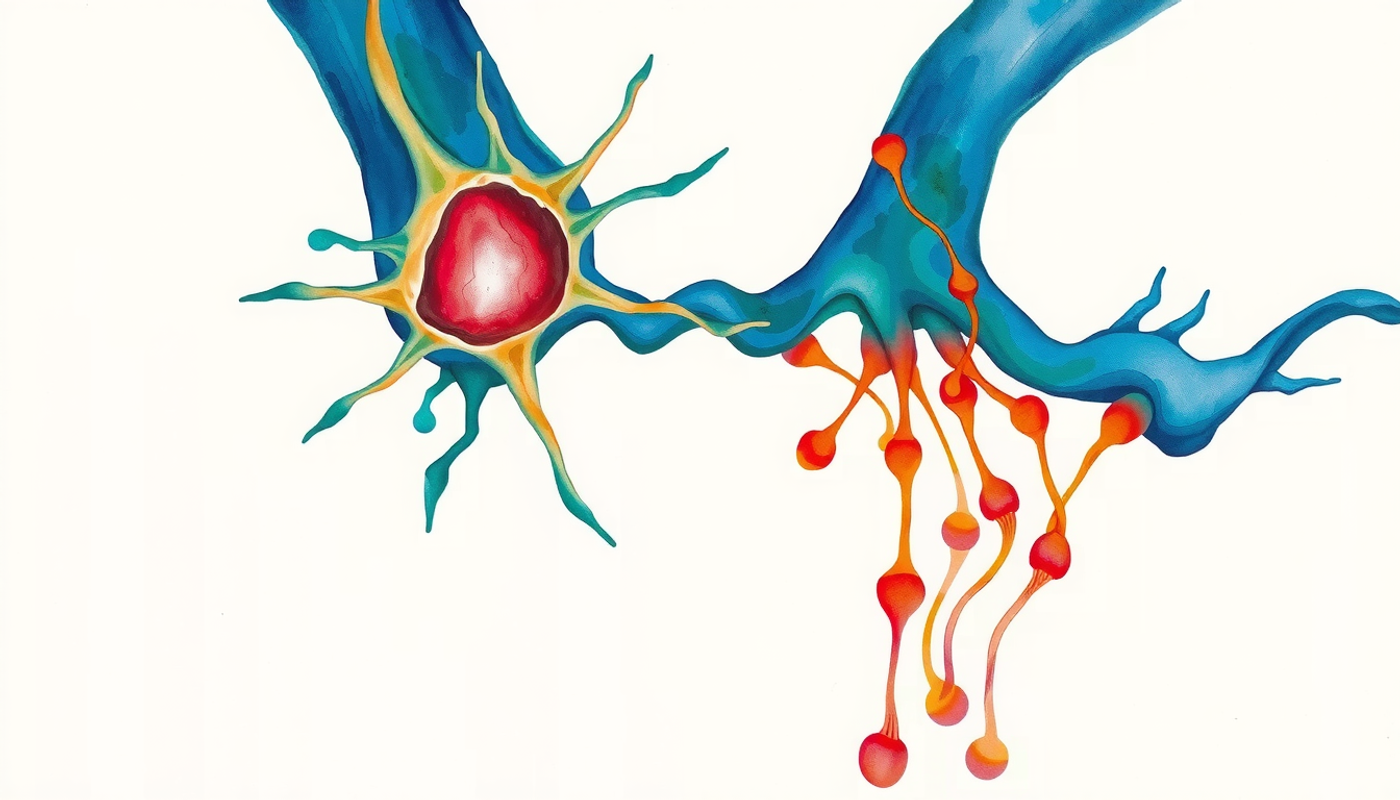
The mechanism works like this. Glutamate, the brain's primary excitatory neurotransmitter, binds to two types of receptors on the postsynaptic neuron: AMPA receptors and NMDA receptors. AMPA receptors mediate normal signaling. NMDA receptors are special. They are blocked by a magnesium ion and only open when the postsynaptic membrane is already partially depolarized. This means NMDA receptors function as coincidence detectors. They only activate when the presynaptic neuron fires and the postsynaptic neuron is already active. This is the molecular basis of associative learning. Two things happening together.
When the NMDA receptor opens, calcium floods in. Calcium activates CaMKII, which triggers the insertion of additional AMPA receptors into the synaptic membrane. More receptors means a stronger response to the same amount of glutamate. The synapse has been potentiated. This is early LTP, lasting hours.
For late LTP, lasting days to weeks, the same CREB-dependent gene transcription that Kandel discovered in Aplysia is required [6]. And here enters another critical molecule: Brain-Derived Neurotrophic Factor, or BDNF. BDNF binds to TrkB receptors, activating signaling cascades (MAPK/ERK and PI3K/AKT) that converge on CREB phosphorylation [7]. Without BDNF, late-phase LTP fails. Mice engineered without the BDNF gene show severely impaired hippocampal memory.
What does this mean? It means that regular exercise, which upregulates BDNF production, is not a lifestyle recommendation. It is a molecular intervention in the memory-formation pathway. And it means that genetic variation in the BDNF gene (the Val66Met polymorphism, carried by roughly 25-30% of the general population) is associated with poorer episodic memory and reduced hippocampal volume [8].
What Actually Works: The Evidence
The internet tells people to use mnemonics, chunking, and visualization to memorize something fast. This is not wrong. But it is incomplete and unquantified. The actual research literature ranks study techniques by measured effect sizes, and the results are surprising.
In 2013, John Dunlosky and four colleagues published what became one of the most cited papers in educational psychology. They reviewed hundreds of studies on ten common study techniques and rated each for effectiveness [9]. Their findings: only two techniques earned a "high utility" rating. Practice testing (retrieving information from memory) and distributed practice (spacing study sessions over time). Highlighting, rereading, and summarization, the three most popular strategies among students, were rated low utility. In a survey by Karpicke, Butler, and Roediger, 83.6% of students reported rereading as their primary study strategy, while only 18% chose self-testing [10].
A 2021 meta-analysis by Donoghue and Hattie, covering 242 studies, 1,619 effect sizes, and 169,179 participants, confirmed the same ranking [11]. The overall mean effect was d = 0.56, roughly a half standard deviation improvement. Practice testing and distributed practice remained at the top.
Here are the specific effect sizes for the techniques that actually accelerate memorization:
The most effective single combination is spaced retrieval practice: testing yourself on material at increasing intervals [12]. The Latimier meta-analysis found this produced an effect size of g = 0.74, the largest single boost in the memorization literature. This means a student using spaced retrieval practice would outperform roughly 77% of students using massed study.
Retrieval practice alone is remarkable. Roediger and Karpicke's 2006 experiment at Washington University showed that students who studied a passage once and then took a practice test recalled 61% of the material one week later. Students who studied the same passage three additional times (but took no test) recalled only 40% [13]. The act of pulling information out of memory strengthens the memory trace more than putting information in. This is counterintuitive. Studying feels productive. Testing feels painful. But the pain is the point.

The Paradox of Difficulty
Robert Bjork at UCLA has spent decades studying something he calls "desirable difficulties." The core idea is deceptively simple: conditions that make learning feel harder during practice often make the learning more durable [14].
Bjork distinguishes between two types of memory strength. Storage strength is how well something has been learned (it only increases over time). Retrieval strength is how easily something can be accessed right now (it fluctuates). The key prediction: the lower the retrieval strength at the moment of successful retrieval, the greater the gain in storage strength [15]. In other words, the harder it is to remember something, the more the act of remembering strengthens it.
This explains why rereading fails. Rereading is easy. The material feels familiar. Retrieval strength is high. So the gain to storage strength is minimal. Students experience an "illusion of competence." They feel like they know the material because it is fluent and recognizable. But fluency is not learning [16].
Five desirable difficulties have been identified: spacing practice over time, interleaving different topics (instead of studying one topic in a block), varying the conditions of practice, generating answers rather than reading them, and testing yourself rather than restudying. Every one of these makes the study session feel harder and less productive. And every one of them produces superior long-term retention.
Interleaving is a particularly striking example. Taylor and Rohrer taught fourth graders to calculate the volume of geometric shapes. One group practiced each shape type in a block (four prism problems, then four wedge problems). The other group practiced the same problems in a mixed, interleaved order. During practice, the blocked group performed better. On a delayed test one day later, the interleaved group scored 77% while the blocked group scored 38% [17]. Performance during practice predicted the opposite of performance on the test. The technique that felt easier produced worse results.
What does this mean? The popular desire to know whether you truly understand something runs headfirst into a biological fact: the brain confuses recognition for recall, familiarity for competence. The most effective study strategy is the one that feels the most frustrating.

The Memory Palace Is Real
The method of loci, or memory palace technique, is ancient. Roman orators described it two thousand years ago. But it was not scientifically tested until recently.
In 2003, Eleanor Maguire at University College London scanned the brains of ten World Memory Championship competitors and compared them with matched controls. The competitors could memorize the order of a shuffled deck of cards in under two minutes. Yet their brains showed no structural differences and no IQ advantages. What they had was a technique. Nine of the ten used the method of loci [18]. During encoding, they activated the right posterior hippocampus, medial parietal cortex, and retrosplenial cortex, regions associated with spatial navigation and scene construction.
In 2017, Martin Dresler at Radboud University took this further. He recruited fifty-one people with no memory training and put them through forty sessions of method-of-loci training over six weeks. Before training, they recalled an average of 26 words from a 72-word list. After training, they recalled 62. Memory athletes recalled 71. The training had brought ordinary people within range of world champions. And the effects persisted four months later without further practice [19]. Brain connectivity patterns after training resembled those of memory athletes, suggesting that the technique reorganizes brain networks rather than simply teaching a trick.
Why does the method of loci work so well? Because it exploits the brain's most ancient and robust memory system: spatial memory. The hippocampus evolved to navigate environments. Place cells (discovered by John O'Keefe, Nobel Prize 2014) fire when an animal occupies a specific location. Grid cells in the entorhinal cortex create a coordinate system for space. The method of loci hijacks this navigation hardware and uses it to store arbitrary information. The brain remembers where something is more reliably than what something is.
Your Brain Replays the Day at Twenty Times Speed
Everything discussed so far concerns encoding: getting information into the brain. But encoding is only half the story. The other half happens while you sleep.
During slow-wave sleep (the deep sleep that dominates the first half of the night), the hippocampus generates sharp-wave ripples: fast oscillations at 150 to 250 Hz that last about 50 to 100 milliseconds [20]. During each ripple, neurons that were active during waking experience fire again in the same sequence, but compressed to roughly twenty times normal speed. The brain is replaying the day.
This replay is not random. In 2024, Yang and colleagues published a study in Science showing that sharp-wave ripples during reward consumption, while the animal is still awake, "tag" specific experiences for future replay. During subsequent sleep, the tagged experiences are preferentially replayed [21]. The brain selects what to keep.
These ripples are nested inside sleep spindles (11 to 16 Hz bursts in Stage 2 sleep), which are themselves nested inside slow oscillations (0.5 to 4 Hz in deep sleep). This triple oscillation coupling, slow oscillation then spindle then ripple, creates optimal conditions for transferring memories from the hippocampus to the neocortex [22]. Susanne Mednick at the University of California, Irvine, showed that pharmacologically boosting spindle density (using zolpidem) causally enhanced verbal memory consolidation [23]. Spindles are not just a side effect of sleep. They are a mechanism of memory.
And the consequences of skipping sleep are severe. Matthew Walker at UC Berkeley showed that a single night of total sleep deprivation reduced the ability to form new memories by approximately 40%, with the deficit localized to the hippocampus [24]. As research into how sleep consolidates learning has shown, pulling an all-nighter before an exam is not a tradeoff between sleeping and studying. It is neurological self-sabotage.
What does this mean? Studying right before sleep gives the material privileged access to the consolidation machinery. Gais, Lucas, and Born showed that vocabulary learned before sleep was retained significantly better than vocabulary learned in the morning followed by a day of wakefulness [25]. The 30-minutes-before-bed window is not folk wisdom. It has a synaptic basis.
Memories Are Not Files in a Cabinet
One of the most disruptive discoveries in modern memory science came from a postdoc at McGill University in 2000. Karim Nader did something that contradicted a century of orthodoxy. He retrieved a memory and then blocked protein synthesis. The memory vanished [26].
The prevailing theory at the time was that memories, once consolidated, were permanent. Retrieval was just reading a file. Nader showed that retrieval reopens the file and temporarily makes it editable. The memory must be re-stabilized through new protein synthesis within roughly six hours, or it degrades. This process is called reconsolidation.
In 2010, Daniela Schiller (whose father survived the Holocaust) and colleagues published the first demonstration of reconsolidation-based memory updating in humans [27]. They conditioned participants to fear a stimulus, then reactivated the fear memory and performed extinction training within the reconsolidation window. The fear response was erased. Not suppressed. Erased.
What does this mean for how to memorize something fast? It means every time you retrieve a memory, you are not just reading it. You are rewriting it. And if you retrieve it and then add new information or correct an error, the updated version can overwrite the original. This makes retrieval practice not just a way to strengthen memories but a way to edit them. Testing is rewriting.
The Myths That Will Not Die
The memorization advice industry is built partly on science and partly on persistent myths. Three deserve special attention because they appear in nearly every competitor article on this topic.
The learning styles myth. The idea that people learn best when instruction matches their preferred style (visual, auditory, kinesthetic) is one of the most widely believed claims in education. A 2008 review by Pashler, McDaniel, Rohrer, and Bjork examined over seventy learning-style instruments and concluded there was "no adequate evidence base to justify incorporating learning-styles assessments into general educational practice" [28]. A 2025 synthesis by Newton, covering seventeen meta-analyses, found that the matching hypothesis (teach to the style for better results) produced an effect size of d = 0.04, which is statistically indistinguishable from zero [29].
The "brain processes images 60,000× faster than text" claim. This number appears in competitor articles, marketing materials, and educational presentations worldwide. It has been traced by multiple researchers (Alan Levine, Clark Quinn, Jonathan Schwabish) to a 1982 Business Week advertisement and an unsourced 3M promotional brochure. Doug Vogel, the 3M researcher whose work was cited, confirmed his research had no connection to the figure [30]. Real numbers from MIT (Potter et al. 2014) show images can be categorized in about 13 milliseconds, compared to 100-200 milliseconds for word recognition. A real advantage exists, but it is on the order of 6 to 600 times, not 60,000.
The 10% brain myth. The claim that humans only use 10% of their brains has been falsified by every brain imaging technology developed in the last fifty years. PET scans and fMRI studies show metabolic activity across 100% of brain tissue even during rest. Barry Beyerstein catalogued six independent lines of evidence against the myth [31]. The attribution to Einstein is fabricated. Archivists at the Albert Einstein Archives found no record of Einstein ever making such a statement.
The persistence of these myths matters because they distort how people approach memorization. If a student believes they are a "visual learner," they may avoid retrieval practice (which is effortful and does not feel visual) in favor of color-coded highlighting (which feels aligned with their "style" but is rated low-utility by Dunlosky). The myth does not just fail to help. It actively directs people away from effective strategies.
Why the Brain Forgets (On Purpose)
Forgetting feels like a failure. It is not. Forgetting is an evolved feature of the memory system, not a bug.
In 1991, John Anderson and Lael Schooler at Carnegie Mellon University published a paper that changed how cognitive scientists think about forgetting [32]. They analyzed how often words appeared in the New York Times across different time periods and compared the pattern to the human forgetting curve. The match was almost perfect. Information that had not been encountered recently was statistically less likely to be needed. The brain's forgetting curve mirrors the statistical structure of the environment. Forgetting is not a flaw. It is rational resource allocation.
Simon Nørby at Aarhus University identified three adaptive functions of forgetting: emotion regulation (reducing the emotional intensity of painful memories over time), knowledge abstraction (stripping away irrelevant details to extract general principles), and context updating (replacing outdated information with current information) [33].
Daniel Schacter at Harvard described memory's imperfections as "The Seven Sins of Memory," but argued that each sin is a byproduct of an adaptive process [34]. Transience (forgetting over time) is adaptive because it ensures that recent, relevant information is more accessible than old, potentially irrelevant information. Absent-mindedness (forgetting where you put your keys) is the cost of an attention system that prioritizes meaningful information over routine details.
There is even evidence that the brain actively forgets competing memories when you retrieve a target memory. Michael Anderson's lab showed that goal-directed retrieval triggers the suppression of related but unwanted memories, a process called retrieval-induced forgetting [35]. The brain is not passively losing information. It is actively clearing space.
James Nairne at Purdue University demonstrated a related principle: information framed in terms of survival relevance is remembered better than information processed in any other deep-processing condition [36]. Imagine you are stranded in a grassland. Which of these items would help you survive? The survival processing advantage has been replicated more than fifty times. The brain is tuned by evolution to prioritize information that matters for staying alive.
What does this mean? Forgetting is not the enemy of memorization. It is the mechanism that makes memorization possible. Without forgetting, every trivial detail would compete for retrieval alongside critical knowledge. Solomon Shereshevsky, the Russian mnemonist documented by Alexander Luria, could not forget. He remembered everything, including contradictions, irrelevant details, and outdated information. His memory was perfect. His life was miserable.

Chunking and Working Memory: The Real Bottleneck
Every technique for fast memorization ultimately confronts one bottleneck: working memory.
In 1956, George Miller published what became one of the most famous papers in psychology: "The Magical Number Seven, Plus or Minus Two" [37]. Miller argued that the number of items a person can hold in working memory at once is approximately seven. This is why phone numbers are seven digits long. But Nelson Cowan at the University of Missouri later showed that when rehearsal and chunking are prevented, the true capacity drops to about four items [38]. The difference between Miller's seven and Cowan's four is explained by chunking: the brain groups items into meaningful units, allowing each "slot" to hold more information.
This is why chunking works for fast memorization. A ten-digit phone number occupies ten slots. Grouped as 3-3-4 (XXX-XXX-XXXX), it occupies three slots. A chess master does not remember the positions of 25 individual pieces. The master remembers four or five configurations of pieces that represent familiar strategic patterns [39].
But chunking has a deeper implication. It means that understanding accelerates memorization. When you understand the underlying structure of material, you can chunk it into fewer, larger units. An anatomy student who understands that muscles are named by their location, action, and shape does not need to memorize each name independently. The name itself becomes a compressed description.
The Brain That Rewrites Itself
The Dresler study from 2017 did not just show that memory training works. It showed that memory training physically changes the brain.
After six weeks of method-of-loci training, the functional connectivity patterns of ordinary participants shifted to resemble those of memory athletes [19]. This is neuroplasticity in action. The brain's wiring reorganized to support a new skill.
And the most remarkable finding came from Kitamura and colleagues in 2017, published in Science. Using optogenetics in mice, they showed that memory engram cells in the prefrontal cortex are generated at the time of initial learning, on day one. But these cells are "silent." They do not respond when the memory is recalled. It takes approximately two weeks of hippocampal-cortical dialogue, occurring primarily during sleep, for these prefrontal cells to mature and become the permanent storage site of the memory [40].
Think about what this means. The permanent copy of a memory is created at the moment of learning, but it does not become functional for two weeks. During those two weeks, the hippocampus and cortex conduct a conversation, mostly during sleep, that gradually transfers control of the memory from a temporary store (hippocampus) to a permanent one (prefrontal cortex) [41].
This is why cramming fails. Even if you force information into the hippocampus overnight, the two-week maturation process in the prefrontal cortex cannot be accelerated. The memory exists, but it is fragile and hippocampus-dependent. Remove the hippocampal support (which happens naturally as new memories compete for space), and the memory vanishes.
Conclusion
None of this means memorization is easy. Effect sizes describe averages across populations. Individual variation is substantial, depending on prior knowledge, working memory capacity, sleep quality, stress levels, and genetic factors like the BDNF Val66Met polymorphism. Spaced retrieval practice requires planning and discipline. The method of loci requires practice before it becomes fluent (the Dresler study used forty sessions over six weeks). Sleep consolidation research is robust for declarative memory but more nuanced for procedural memory [42]. And the science of memory is still evolving: the reconsolidation literature has produced inconsistent findings across laboratories, and some boundary conditions are poorly understood.
But the question of how to memorize something fast is older than psychology itself. Ebbinghaus asked it with nonsense syllables in 1879. Kandel asked it with a sea slug in the 1960s. Bliss and Lømo asked it with rabbit neurons in 1973. And today, researchers from dozens of laboratories around the world continue asking it with fMRI scanners, optogenetics, and meta-analyses covering hundreds of thousands of participants.
The answers converge on a few core truths. Memory is not a recording. It is a reconstruction, rebuilt each time from molecular traces. Short-term memory is a chemical tweak in existing synapses. Long-term memory requires gene activation, protein synthesis, and the growth of new connections. This growth requires repetition spaced over time, because the molecular switch from short-term to long-term memory (cAMP to PKA to CREB) demands repeated activation. Sleep is not optional. It is the phase during which the hippocampus replays the day's experiences at twenty times speed, transferring them to permanent cortical storage through a precisely timed symphony of slow oscillations, spindles, and sharp-wave ripples.
The most effective strategy for fast memorization is also the most counterintuitive: make it harder. Test yourself instead of rereading. Space your sessions instead of cramming. Mix different topics instead of studying one at a time. The difficulty is not an obstacle to learning. It is the mechanism.
And the most persistent myths (learning styles, the 10% brain, the 60,000× image-processing claim) are not just wrong. They actively misdirect people away from techniques that have effect sizes of 0.61, 0.74, and 1.50 in peer-reviewed meta-analyses.
Ebbinghaus could not have imagined that the forgetting curve he measured alone in his Berlin apartment would be replicated 130 years later and confirmed almost exactly. He could not have imagined that the spacing effect he observed would be traced to the activation of CREB transcription factors in hippocampal neurons. But his fundamental insight stands. Memory does not reward brute force. It rewards strategy, spacing, and the willingness to struggle.
Frequently Asked Questions
What is the fastest proven way to memorize information?
Spaced retrieval practice, which combines testing yourself on material at increasing time intervals. A 2021 meta-analysis of 29 studies found it produces an effect size of g = 0.74, meaning it outperforms massed study by a wide margin. The technique exploits the brain's molecular machinery for converting short-term memory into long-term structural changes.
Does sleep really help memorization?
Yes. During deep sleep, the hippocampus replays waking experiences at roughly twenty times normal speed through sharp-wave ripples. This replay transfers memories from temporary hippocampal storage to permanent cortical storage. One night of sleep deprivation reduces the brain's ability to form new memories by approximately 40%.
Are learning styles (visual, auditory, kinesthetic) scientifically valid?
No. A comprehensive review by Pashler and colleagues (2008) and a 2025 synthesis of seventeen meta-analyses both found no evidence that matching instruction to a student's preferred learning style improves outcomes. The matching hypothesis produces an effect size of d = 0.04, which is effectively zero.
Why does rereading notes feel effective but produce poor results?
Rereading creates an illusion of competence. The material feels familiar, which the brain misinterprets as having learned it. Research shows 83.6% of students rely on rereading as their primary strategy despite its low-utility rating. Retrieval practice (testing yourself) feels harder but produces dramatically better long-term retention.
How does the memory palace technique work in the brain?
The method of loci exploits the brain's spatial navigation system, including hippocampal place cells and entorhinal grid cells. By associating information with locations along a familiar route, the technique hijacks hardware that evolved for navigating physical environments. Brain scans of memory champions show activation of spatial navigation regions during encoding.


