Introduction
A phone buzzes on the desk. The screen lights up for two seconds. Nobody picks it up. But the damage is already done. According to a 2026 study published in Computers in Human Behavior, that single notification just triggered roughly seven seconds of measurable cognitive slowdown, confirmed by both reaction-time data and pupil dilation recordings [1]. Seven seconds sounds small. But those seven seconds interrupt a process that took the brain far longer to build: the fragile, attention-dependent act of encoding a new memory.
Distraction-free study and the brain is not a productivity slogan. It is a neuroscience problem. Decades of research have shown that memory formation depends on a chain of events that starts with focused attention and ends with long-term storage. Break the chain at the beginning, and nothing downstream can compensate. The retrieval strategies, the spaced repetition schedules, the active recall techniques — all of them work on whatever was encoded in the first place. If encoding was shallow because attention was split, the entire learning pipeline runs on a weaker signal [2].
This article follows the science of that chain. From the neural circuits that filter noise to the molecular events that write memories into synapses, from the dopamine loops that make notifications feel irresistible to the evidence that focus can be retrained. The story of how the modern digital environment collides with one of the oldest and most precise systems in biology.

The Brain's Noise Filter
Before asking what distraction does to learning, it helps to ask what the brain does with distraction normally. Because the brain is not defenseless. It has been filtering irrelevant information for hundreds of millions of years.
The filtering starts surprisingly early. Before a sensory signal even reaches the cortex — the part of the brain that does conscious thinking — it passes through a thin sheet of neurons wrapped around the thalamus called the thalamic reticular nucleus, or TRN. Francis Crick, the co-discoverer of DNA's structure, proposed in 1984 that the TRN acts as the brain's "attentional searchlight," selectively gating which sensory signals get through to higher processing [3]. It took decades to confirm this. In 2008, Kerry McAlonan, Jamie Cavanaugh, and Robert Wurtz at the National Institutes of Health recorded from TRN neurons in primates and showed they modulate thalamic activity based on where the animal is paying attention [4]. In 2015, a team led by Michael Bhatt at MIT mapped distinct TRN subnetworks that separately gate visual and somatosensory information [5].
Think of it this way. Every second, the brain receives an enormous flood of sensory data. Most of it is irrelevant. The TRN decides what gets through and what gets suppressed before you are even aware of it. It is a bouncer at the door of consciousness.
But the TRN is only the first layer. Once information reaches the cortex, a far more sophisticated system takes over: the attentional control network.
Michael Corbetta and Gordon Shulman at Washington University published a landmark model in 2002, identifying two distinct attention systems in the brain [6]. The first is the dorsal frontoparietal network — stretching from the frontal eye fields to the intraparietal sulcus — which handles goal-directed attention. When you decide to focus on a textbook and ignore the television, this is the network doing the work. The second is the ventral frontoparietal network, centered on the right temporoparietal junction, which acts as a "circuit breaker." When something unexpected happens — a loud crash, a phone buzz, a flash of movement — this network pulls your attention away from whatever you were doing, whether you want it to or not.
This is the fundamental tension. One system says: keep reading. The other says: something happened, look up. Both are necessary for survival. But in a modern study environment filled with digital stimuli, the circuit-breaker fires far too often.
Between these two networks sits the anterior cingulate cortex, or ACC. Matthew Botvinick and colleagues at Princeton showed through a series of influential studies in the late 1990s and 2000s that the ACC monitors for conflict — situations where competing signals demand incompatible responses [7]. The classic demonstration is the Stroop task: say the ink color of the word "RED" printed in blue ink, and the ACC lights up as it detects the conflict between reading and color-naming. Every time a notification competes with a study task, the ACC registers a conflict and demands resolution. That resolution costs time and energy.
Why Encoding Breaks First
Memory has three stages. Encoding — when new information enters the brain. Consolidation — when that information is stabilized and stored. Retrieval — when stored information is brought back into consciousness. Distraction can theoretically disrupt any of these. But the evidence is overwhelming: encoding is where the real damage happens.
The definitive experiments were run by Fergus Craik and colleagues at the University of Toronto. In 1996, Craik, Govoni, Naveh-Benjamin, and Anderson published a study in the Journal of Experimental Psychology: General that cleanly separated the effects of divided attention at encoding versus retrieval [2]. Participants studied word lists while simultaneously performing a secondary reaction-time task. When attention was divided during encoding, later recall dropped dramatically. When attention was divided during retrieval, performance barely changed.
Moshe Naveh-Benjamin, working with Craik, replicated and extended this in 2000 [8]. The asymmetry held across free recall, cued recall, and recognition. Encoding under distraction was catastrophic. Retrieval under distraction was almost free.
What does this mean in practical terms? It means the moment of learning matters more than the moment of testing. A student who studies in a distraction-free environment and then takes an exam in a noisy hall will likely do fine. A student who studies with Instagram open and then takes the same exam in perfect silence will struggle. The damage was done at input, not output.
An fMRI study by Bae and Yi, published in 2014 in Behavioral and Brain Functions, revealed what the brain does when it tries to encode memories despite distractors [9]. Participants studied images while letter or word distractors appeared simultaneously. When distractors were present and memory still succeeded, the brain showed increased activity in the left dorsolateral prefrontal cortex (DLPFC), bilateral fusiform cortex, and the left posterior hippocampus. These are extra control resources being recruited to compensate for the noise. The brain can form memories under distraction — but only by working much harder. And when those extra resources are unavailable — because you are tired, stressed, or already cognitively loaded — encoding fails.
Seven Seconds That Cost Twenty-Three Minutes
What happens when a phone buzzes during study?
The most precise measurement comes from a 2026 study at the University of Lyon. Hugo Fournier and colleagues tested 180 university students on a Stroop task while delivering smartphone-style notifications [1]. Each notification triggered a transient slowdown in cognitive processing lasting approximately seven seconds. Pupil dilation — a physiological marker of cognitive effort — mirrored the behavioral data. The researchers found that disruption scaled with notification frequency and habitual checking behavior, not with total screen time. A person who checks their phone 80 times a day but uses it for only 30 minutes total was more disrupted than someone who uses it for three hours in long stretches.
But seven seconds is only the immediate cost. The deeper cost is what Sophie Leroy at the University of Minnesota called "attention residue" [10]. In her 2009 study, Leroy showed that when people switch from Task A to Task B, part of their attention remains stuck on Task A. This residue reduces performance on Task B, even when Task A has been completed. The implication for notifications is direct: even a quick glance at a message — even deciding not to read it — leaves a cognitive residue that contaminates the study task.
Gloria Mark at UC Irvine measured the downstream consequence. In a field study published at CHI 2008, Mark, Gudith, and Klocke tracked knowledge workers through their daily routines and found it took an average of 23 minutes and 15 seconds to return to the original task after an interruption [11]. Not 23 seconds. Minutes. The interrupted task was usually resumed the same day — 81.9% of the time — but the recovery cost was enormous.
Now compound these effects across a two-hour study session. If a student receives just four notifications, the immediate costs alone consume 28 seconds. But the attentional residue and recovery costs can easily consume 30 to 60 minutes of effective focus time. The study session is not ruined in one dramatic moment. It is eroded, notification by notification, until the encoding window has quietly closed.
The Phone You Never Touch
One of the most counterintuitive findings in the distraction literature is this: you do not need to use your phone for it to damage your cognition. Its physical presence is enough.
Adrian Ward, Kristen Duke, Ayelet Gneezy, and Maarten Bos published the "Brain Drain" study in 2017 in the Journal of the Association for Consumer Research [12]. Across two experiments with roughly 800 participants, they tested working memory capacity and fluid intelligence under three conditions: smartphone in another room, smartphone in a pocket or bag, and smartphone face-down on the desk. Nobody was allowed to use the phone. No notifications were sent.
Results: cognitive performance dropped progressively as the phone moved closer. Participants with phones on their desks performed worst. Participants with phones in another room performed best. The effect was strongest in people who reported higher dependence on their smartphones.
The most striking part: participants in all conditions reported that the phone was not affecting them. The cognitive cost was entirely unconscious. The brain was spending resources monitoring the phone — suppressing the urge to check it, maintaining awareness of its presence — and those resources were unavailable for the task.
Cary Stothart and colleagues at Florida State University had shown something related two years earlier [13]. They had participants perform a sustained attention task while the researchers secretly triggered notifications on the participants' own phones. The participants were not told to check. Many did not check. But receiving the notification alone — a vibration or a ringtone — significantly increased errors on the attention task. The effect size was comparable to actually using the phone.
A 2022 ERP study added electrophysiological evidence: notifications disrupted the P3b component, a brain signal associated with attentional resource allocation, even when participants did not interact with their phones [14]. The brain registered the notification involuntarily, pulled resources away from the task, and then had to spend additional energy re-engaging.

The Dopamine Trap
Why is it so hard to ignore notifications? The answer is not willpower. It is brain chemistry.
Every notification activates the dopaminergic reward system. The pathway runs from the ventral tegmental area (VTA) deep in the midbrain to the nucleus accumbens and prefrontal cortex. Wolfram Schultz and colleagues showed in 1997 that dopamine neurons fire not in response to rewards themselves, but in response to reward predictions and, most powerfully, to unexpected rewards [15]. This is the key: notifications arrive unpredictably. Sometimes the message is exciting. Sometimes it is boring. The unpredictability is what makes them addictive.
B. F. Skinner identified this decades ago in animal behavior research. A reward that arrives on a variable-ratio schedule — unpredictable, sometimes after two lever presses, sometimes after twenty — produces the most persistent, extinction-resistant behavior known to psychology. It is the same schedule used by slot machines. And it is the same schedule used by notification systems.
Lauren Sherman and colleagues showed in 2016, using fMRI with adolescents, that receiving "likes" on social-media images activated the nucleus accumbens, VTA, and ventromedial prefrontal cortex [16]. The same reward circuit that evolved to guide survival decisions — food, social connection, mating — now fires dozens of times per day in response to notification chimes.
There is an irony here. Dopamine also has a legitimate and essential role in learning. The VTA-hippocampus pathway supports memory consolidation through reward-prediction-error signaling [17]. When something genuinely interesting is learned, dopamine helps tag that memory for long-term storage. The problem is not dopamine itself. The problem is that notification-driven dopamine bursts — fast, frequent, and disconnected from meaningful content — compete with the slower, integrative dopamine signaling that supports genuine learning. The brain's reward system is being hijacked by stimuli that feel important but carry no educational value.
What Chronic Multitasking Does to the Brain
The damage is not limited to individual study sessions. Chronic exposure to digital distraction appears to change brain function and possibly brain structure.
The most cited study is the Stanford multitasking experiment. In 2009, Eyal Ophir, Clifford Nass, and Anthony Wagner tested heavy and light media multitaskers on three cognitive tasks: filtering environmental distractors, filtering irrelevant memory representations, and task-switching [18]. The intuitive prediction: heavy multitaskers, with all their practice, should be better at all three. The actual result: heavy multitaskers were worse at all three. They were more distracted by irrelevant stimuli. They held more irrelevant information in working memory. And they switched tasks less efficiently.
Five years later, Kep Kee Loh and Ryota Kanai at University College London used structural brain imaging to look for anatomical correlates [19]. They found that individuals who scored higher on the Media Multitasking Index had smaller grey-matter density in the anterior cingulate cortex — the very region responsible for conflict monitoring and cognitive control. The authors were careful to note that the direction of causation is unknown. It could be that multitasking shrinks the ACC. It could be that people with smaller ACCs are drawn to multitasking. Both possibilities are concerning.
A 2021 meta-analysis by Douglas Parry and Daniel le Roux, examining 118 effect sizes across multiple studies, confirmed a small but consistent relationship between media multitasking and distractibility (d ≈ 0.17) [20]. The effect is not enormous. But it is persistent. And for adolescents whose prefrontal cortex is still developing — the ACC does not fully mature until the mid-twenties — chronic distraction during critical developmental windows carries risks that are harder to quantify.
Melina Uncapher and Anthony Wagner reviewed the cumulative evidence in 2018 for PNAS [21]. Their conclusion: heavy media multitaskers consistently underperform on working memory, sustained attention, and long-term memory tasks. The evidence base is large enough to be taken seriously, even if individual study effect sizes are modest.
The bar chart above shows approximate error rates from Ophir, Nass, and Wagner's 2009 study for heavy media multitaskers across three cognitive tasks: filtering distractors, updating working memory, and task-switching. In each case, heavy multitaskers performed worse than light multitaskers — the opposite of what practice-based intuition would predict.
The Google Effect and the Outsourced Memory
Distraction is not the only way digital environments undermine encoding. There is also the problem of motivation: why bother memorizing something when you can always look it up?
Betsy Sparrow, Jenny Liu, and Daniel Wegner published a landmark study in Science in 2011 [22]. Across four experiments, they showed that when people believe information will remain available through a search engine, they encode less of the information itself but more about where to find it. The brain shifts from internal storage to what Sparrow called "transactive memory" with the internet — treating Google as an external hard drive.
This is not inherently bad. Transactive memory is an ancient strategy. People have always relied on books, libraries, and other people to store information they do not carry in their own heads. What is new is the scale and the speed. When the entire sum of human knowledge is available on the device in your pocket, the incentive to encode anything deeply drops to near zero. And this matters because deep encoding is exactly what spaced repetition, active recall, and other evidence-based study methods work on. They strengthen traces that were encoded in the first place. If the initial encoding was shallow — because the brain anticipated being able to Google it later — there is less to strengthen.
The practical implication is that distraction-free study is not just about removing noise. It is also about creating conditions where the brain takes encoding seriously. A study environment where no phone is present and no quick search is possible signals to the brain that this information must be stored internally. The absence of a backup forces deeper processing.
The Brain Can Learn to Filter
The picture so far is alarming. But there is good news. The brain's attention system is not fixed. It can be trained. And new evidence shows it can learn to suppress distractors automatically.
A 2025 study from Leipzig University and Vrije Universiteit Amsterdam, published in the Journal of Neuroscience, provided some of the clearest evidence yet. Dock Duncan, Norman Forschack, Dirk van Moorselaar, Matthias Müller, and Jan Theeuwes used combined SSVEP and ERP recordings while participants performed visual search tasks with distractors that repeatedly appeared at the same location [23]. Over time, the brain developed proactive alpha-band lateralization at the expected distractor location — the visual system literally began pre-suppressing that region of space before the stimulus even appeared. Post-stimulus SSVEP responses to the distractor also weakened, and the Pd (distractor positivity) ERP component shifted.
This is not conscious effort. The brain learned, through statistical regularity, to automatically filter out predictable distractions at the very earliest stages of visual processing. The implication for study environments is direct: a consistent, predictable study space with controlled distractions allows the brain's filtering mechanisms to tune themselves. An unpredictable environment — notifications from different apps, variable sounds, shifting visual stimuli — prevents this tuning.
Mindfulness training offers another route. Amishi Jha, Jason Krompinger, and Michael Baime showed in 2007 that an 8-week mindfulness-based stress reduction course selectively improved the orienting component of attention, while a 1-month intensive retreat improved alerting [24]. Fadel Zeidan and colleagues showed in 2010 that just four 20-minute sessions of mindfulness training improved sustained attention and working memory capacity relative to an active control [25].
The most striking result came from Michael Mrazek and colleagues. In 2013, they published a study in Psychological Science showing that a two-week mindfulness course improved GRE scores by the equivalent of 16 percentile points and increased working memory capacity [26]. The mechanism was reduced mind-wandering — measured directly by experience-sampling probes during the task. Less mind-wandering meant more cognitive resources available for encoding.
What does this mean for students? Mindfulness is not mysticism. It is attention training. And attention, as the evidence above shows, is the bottleneck for memory formation. Strengthening that bottleneck — even with short daily practice — measurably improves learning outcomes.
Why Nature Restores What Screens Deplete
In 1995, Stephen Kaplan at the University of Michigan published a theory that has only gained relevance in the digital age. His Attention Restoration Theory distinguishes between two types of attention: directed attention, which is voluntary, effortful, and fatiguable, and fascination, which is involuntary, effortless, and restorative [27]. Studying uses directed attention. It is a finite resource. After prolonged use, it becomes depleted. What restores it? Environments that engage fascination without demanding directed attention. Natural environments.
Marc Berman, John Jonides, and Stephen Kaplan tested this directly. In 2008, they published a study in Psychological Science showing that a 50-minute walk in a park improved directed-attention performance significantly more than a 50-minute walk through downtown streets [28]. Nature did not merely provide a break. It actively restored the capacity for focused thinking. Urban environments, by contrast, demanded continued attentional control — avoiding cars, processing signs, tracking other pedestrians — and provided no restoration.
The connection to distraction-free study is straightforward. Study sessions that alternate focused work with genuine restorative breaks — walks outdoors, quiet contemplation, even viewing natural scenes — recover directed attention faster than breaks spent scrolling social media. Scrolling is not rest for the attention system. It is a different kind of attentional demand.
Context also matters for memory itself. In 1975, Duncan Godden and Alan Baddeley famously had scuba divers learn word lists either on land or underwater and then tested them in the same or different environment [29]. Words learned underwater were better recalled underwater. Words learned on land were better recalled on land. This context-dependent memory effect, though modest in size (meta-analytic estimates around d ≈ 0.25), supports the practical advice to maintain a consistent study environment. A dedicated, distraction-free study space creates contextual cues that later aid retrieval.
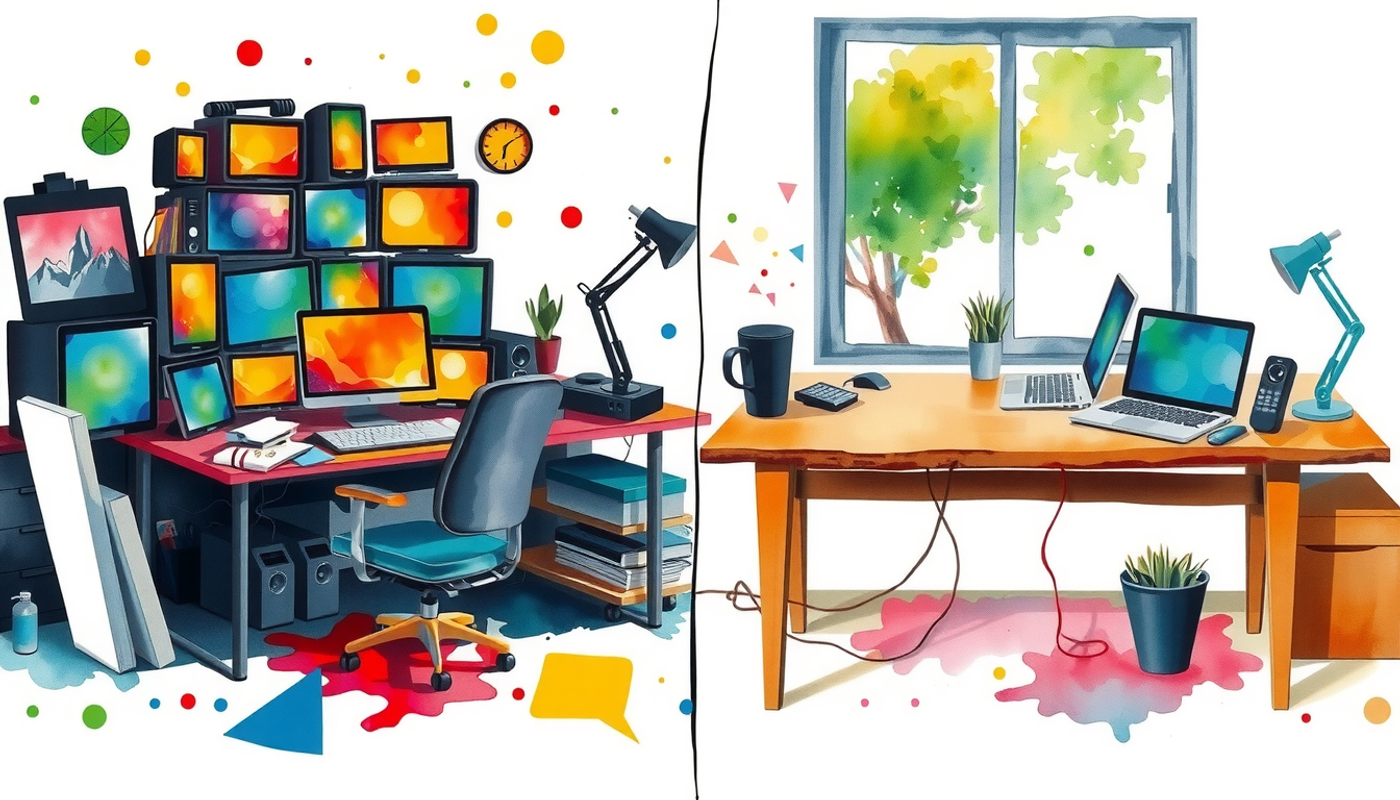
The Twenty-Three-Minute Rule in Practice
The converging evidence from all these lines of research points toward a set of practical principles for building distraction-free study environments. These are not productivity tips. They are neuroscience predictions.
First: physical separation from the smartphone. Ward et al.'s Brain Drain study [12] showed a graded effect. The further the phone, the more cognitive capacity recovered. Another room is better than a pocket. A pocket is better than the desk. This is not about willpower. It is about reducing the unconscious monitoring load that the brain imposes on itself when the phone is proximal.
Second: bounded focus blocks. Gloria Mark's 23-minute recovery finding [11] and Sophie Leroy's attentional residue research [10] both suggest that interruptions have costs far exceeding their duration. Study sessions should be structured as uninterrupted blocks long enough to enter deep encoding. The Pomodoro Technique's 25-minute focused blocks, followed by genuine breaks, align loosely with Nathaniel Kleitman's basic rest-activity cycle — roughly 90-minute ultradian rhythms of alertness and fatigue that continue through the waking day [30]. Four 25-minute Pomodoros approximate one full cycle.
Third: consistent study environments. Context-dependent memory research [29] and the Leipzig distractor-suppression study [23] both point in the same direction: predictable environments allow the brain to tune its filtering. A dedicated study desk — used only for study — trains both contextual retrieval cues and automatic distraction suppression.
Fourth: restorative breaks, not stimulating ones. Kaplan's Attention Restoration Theory [27] and Berman's nature-walk study [28] show that breaks spent in low-demand environments restore directed attention. Breaks spent on social media do not. The break should feel boring. Boredom is a signal that directed attention is resting.
Fifth: offline study wherever possible. Every digital connection is a potential interruption channel. Studying with airplane mode enabled, with printed materials, or with dedicated single-purpose study devices removes the possibility of notification-driven encoding failure. The absence of a phone is not just the absence of distraction. It is the presence of a signal to the brain: this information must be stored here, because there is no external backup.
What Remains Unknown
Science does not have all the answers yet. Several important questions remain open.
The direction of causation in the media-multitasking brain-structure studies is unresolved. Loh and Kanai's 2014 finding of smaller ACC grey-matter density in heavy multitaskers [19] is cross-sectional. It could mean multitasking changes the brain. It could mean certain brain types are drawn to multitasking. Longitudinal studies are needed and have not yet been published.
The Brain Drain "mere presence" effect, while replicated in the original study's two experiments, has shown inconsistent replication elsewhere. A 2023 meta-analysis found the effect is real but smaller than the original paper suggested and moderated by participant characteristics and cultural context. Not everyone is equally affected. Smartphone dependence level appears to be a key moderator.
The 23-minute figure from Gloria Mark's work is frequently cited as a universal law. It is not. It was measured in knowledge workers during naturalistic interruptions in an office setting. The recovery time for a student returning to a textbook after a brief notification may be different — shorter or longer — depending on task complexity, individual differences, and the nature of the interruption.
The long-term developmental consequences of chronic digital distraction on adolescent brains remain mostly unknown. The prefrontal cortex matures slowly through the mid-twenties [31]. If chronic distraction during this window permanently impairs attention-network development, the consequences would be significant. But the longitudinal data to confirm or deny this do not yet exist.
And perhaps most importantly: effect sizes in this literature are often small. The meta-analytic correlation between smartphone use and academic performance is approximately r = –0.12 to –0.16 [32]. This is real but modest. Distraction is one factor among many. It is not the only reason students struggle. But it is one of the most modifiable.
The Architecture of Focused Learning
The story of distraction-free study and the brain is, ultimately, a story about architecture. Not building architecture. Neural architecture.
The brain was built for a world where distractions were rare and dangerous — a predator, a storm, a rival. The circuit-breaker network that yanks attention away from the current task evolved to save lives. In that context, the cost of interrupted focus was justified by the benefit of survival. But in a world where the average person receives 80 to 120 notifications per day, the circuit-breaker fires constantly for stimuli that carry no survival value.
The encoding machinery — prefrontal cortex, hippocampus, fusiform cortex working in concert — requires sustained attention to bind new information into memory [9]. The dopamine system that should tag important memories for long-term storage is hijacked by variable-ratio notification schedules [15]. The ACC that should resolve learning-relevant conflicts is exhausted by the constant noise of digital interruptions [7].
But the brain is also plastic. It can learn to suppress distractions [23]. Mindfulness training can strengthen attention networks [26]. Nature can restore depleted directed attention [28]. And simple environmental changes — removing the phone, studying offline, maintaining a consistent study space — exploit the brain's own mechanisms for filtering and encoding.
The evidence is clear, even if effect sizes are modest. Every notification is a small wound to encoding. Every uninterrupted minute of focused study is a deposit into long-term memory. The cumulative effect, across weeks and months of study, is substantial.
Distraction-free study is not a luxury. It is the minimum condition the brain requires to do what it was built to do: learn.
For those interested in the neuroscience of how the brain processes learning at a deeper level, the article How We Actually Learn provides a detailed look at the neural mechanisms of encoding and retrieval. And for a related exploration of what happens when sleep supports or fails to support memory consolidation after a study session, see Sleep and Memory: The Brain That Stays Awake While You Sleep.

Frequently Asked Questions
How does distraction affect memory formation in the brain?
Distraction primarily disrupts encoding, the first stage of memory formation. Research by Craik and colleagues showed that dividing attention during learning dramatically reduces later recall, while dividing attention during retrieval has minimal effect. The brain requires sustained focused attention to bind new information into long-term memory through prefrontal-hippocampal circuits.
How long does it take to refocus after a distraction?
A field study by Gloria Mark at UC Irvine found it takes an average of 23 minutes and 15 seconds to return to the original task after an interruption. This includes not just re-finding the task but also rebuilding the mental context. Sophie Leroy's research on attentional residue shows that cognitive fragments of the interrupting task linger and reduce subsequent performance.
Can the mere presence of a smartphone affect studying?
Yes. The Brain Drain study by Ward and colleagues tested roughly 800 participants and found that having a smartphone face-down on the desk reduced working memory capacity and fluid intelligence compared to having it in another room. Participants were unaware of this effect. The brain unconsciously allocates resources to monitoring the device.
Does mindfulness training improve focus for studying?
Research supports this. Jha and colleagues showed an 8-week mindfulness course improved attentional orienting. Mrazek and colleagues found a 2-week course improved GRE scores by 16 percentile points and increased working memory capacity. Zeidan showed four 20-minute sessions improved sustained attention. The mechanism appears to be reduced mind-wandering during tasks.
Is studying with background music a distraction?
It depends on the type. The irrelevant sound effect, documented by Jones and colleagues, shows that acoustically changing sounds like speech or music with lyrics disrupt verbal memory tasks more than steady-state sounds. Instrumental music or white noise is generally less disruptive. For tasks requiring verbal encoding, silence or consistent low-level noise is safest.