
Introduction
Three lines are printed on a card. One of them is obviously the same length as a fourth line on a second card. Obviously. Not arguably, not on close inspection. A ten year old would get it right with the lights half off.
Seven people ahead of you look at the two cards and say, one after another, that it is the short one.
You are eighth. And the question you are now facing is not really about lines at all.
That situation is the most repeated setup in the history of social psychology, and the number attached to it has travelled further than almost any other finding in the field. Roughly a third of the answers given under that pressure went along with the group. About three quarters of the people tested went along at least once. Those figures appear in first year lectures, in management training slides, in newspaper columns about political tribalism, and in an enormous number of videos where the presenter says the words "people are sheep" with a little sigh.
Here is what almost never travels with them. Solomon Asch titled the 1956 monograph reporting the full series he ran on 123 participants "Studies of independence and conformity" [1]. Independence comes first. It comes first because that is what most of his participants did most of the time, and because the thing he found genuinely surprising was not that some people yielded. It was that so many did not, under conditions he had built specifically to make yielding easy.
The figure Asch reported across that series was a mean error rate of 36.8 percent among the 123 participants on the critical trials, which is the number Franzen and Mader compared their own 2023 replication against [2]. Turn it over and it says that 63.2 percent of responses were correct while the group was unanimously wrong [1].
If you learned about this experiment at school or university, take a second and check what you remember of it. Almost everyone remembers the number of people who went along with the group. Almost nobody remembers being told what the other two thirds did.
Two separate studies have now gone through the textbooks and measured what happened to that half of the result. Friend, Rafferty and Bramel looked at books published between 1953 and 1984 and found the independence finding getting quieter with every decade [3].
Griggs repeated the exercise in 2015 on 20 introductory psychology textbooks and 10 social psychology textbooks, and found the distortion had not been corrected but had grown, with only around 15 percent of those 30 books reporting the proportion of independent responses at all [4]. Six books out of 30. The rest taught the study without the result its own author put first in the title.
None of that makes the conformity finding less real. It makes it half of a finding.
So this article does two things. It tells you what actually happened in that room, with the numbers the original reports give and the control condition that makes them mean anything. And it follows the argument the field has been having ever since about what those numbers show, which is a much better argument than the one you have probably heard.
You will need to give up one thing to read it. The tidy version, where the experiment proves a sad fact about human weakness and you nod and move on, has to go. What replaces it is stranger and more useful.
The Task Was Easy on Purpose
Start with the design, because one feature of it does all the work and it is the feature everybody skips.
A participant arrived believing they were in a study of visual perception. They sat at a table with several other people who were, in fact, working for the experimenter. Two cards went up. The first showed a single vertical line. The second showed three lines of clearly different lengths, one of which matched the first card. Everyone said out loud which one it was, in seating order, and the real participant had been placed near the end.
On the first couple of rounds everyone said the right answer. Then the group started giving the same wrong answer, unanimously, with no hesitation and no explanation.
Nothing about that setup is subtle. There is no trick lighting, no time pressure, no clever wording. Just a card and a room.
Now the crucial part. How hard was this task?
Asch measured that separately, and it is the single number that licenses everything else in the study. When people judged the same cards alone, with nobody else in the room, they were wrong on under 1 percent of trials [1]. That is the control condition. It is why a third of responses going wrong under group pressure is a result rather than a rounding error.
Skip that number and the whole thing becomes ambiguous. A reader who has never seen it tends to assume the lines must have been close, that the judgement was a squint and a guess, that people were leaning on the group because they genuinely could not tell. They were not. If you want a sense of how far a perceptual judgement can be pushed by something other than the stimulus, the study of optical illusions is the place where the pushing happens inside the visual system. In the line task, it did not. The eyes were fine.
Asch also wrote about why he built it that way. He had come out of a research tradition where social influence was studied with deliberately ambiguous material. Sherif's autokinetic work in 1935 is the classic case: participants sat in a dark room watching a stationary point of light, which appears to drift because the eye itself is never quite still, and were asked how far it moved. There is no correct answer to that question. Groups converged on a shared estimate and individuals carried it with them afterwards. That is a real and important finding, but a sceptic can always say that people agreed because nobody had anything better to go on.
Asch removed the excuse. Make the answer obvious and there is no room to say that the group supplied missing information. Whatever moves the participant now, it is not the difficulty of the task.
It is worth sitting with how unusual that design decision was. Most experiments are built to find an effect, which usually means making conditions as favourable to it as possible. Asch did the opposite. He built the condition least likely to produce yielding and then measured how much yielding there was anyway. A result obtained that way is much harder to explain away, and it is also much harder to inflate, because there is no ambiguity left in the stimulus to hide behind.
That is why the control number is not a technical footnote. It is the reason the study has survived seventy years of methodological argument that has demolished plenty of its contemporaries.
What Actually Happened in the Room
The results get reported in two different currencies and they are constantly swapped for each other, so it is worth separating them once and holding them apart.
The first currency is responses. Across the critical trials, where the group gave a unanimous wrong answer, about a third of the responses given by real participants matched the group rather than the card. That is the headline of the 1956 monograph, which pulled a whole series of experiments together [1], and the mean error rate across the 123 participants in it was 36.8 percent [2].
Hold on to that word. Responses, not people.
Asch's own popular account of the work, written for Scientific American in 1955, gives the same picture and adds the texture of what the sessions actually felt like [5]. It is worth reading for the interviews alone.
The second currency is people. The figure usually quoted is that about three quarters of participants conformed on at least one critical trial. That is a completely different statement. A person who gives the group answer once out of twelve trials and then holds their ground for the rest is inside that 75 percent, and describing them as someone who conformed is technically true and practically misleading.
You will very often see the two spliced together into a single claim, usually as "75 percent of people caved". Nobody caved 75 percent of the time. About a third of answers went with the group, and about three quarters of people did it at least once, and the gap between those two sentences is where the actual finding lives.
Once you have the two currencies straight, most of the confusion around this study disappears.
The third number is the one that gets dropped. Roughly a quarter of participants never conformed on a single trial. Not once. Under a unanimous majority, in public, with no support and no explanation available to them, they said the true thing every time.
That is not a footnote. It is a quarter of the sample, and it sits alongside the two thirds of all responses that were independent and correct.
Fifteen entries and the last one is from 2023, which tells you this is not a closed file. Read it as a history, because the order matters. Almost everything interesting about this experiment was established by somebody arguing with the version that came before them.
The Word Asch Put First
Return to the title of the 1956 monograph, the one reporting the series that ran 123 participants through the line task. Studies of independence and conformity. Then the subtitle: a minority of one against a unanimous majority [1].
Read that as a sentence about what the experiment was for. Asch built a situation where a lone individual faced a wall of confident disagreement, and he wanted to know what would hold. What he reported was that a great deal held, and that the people who held were not obviously different in any simple way from the people who did not.
That is a description of a contest, and a contest has two possible outcomes.
Now look at what happened to that finding in transmission.
Friend, Rafferty and Bramel published their analysis in 1990 under a title that leaves little doubt about their view: a puzzling misinterpretation of the Asch conformity study [3]. They tracked textbook coverage across three decades and found a steady drift. Early accounts reported both halves. Later accounts foregrounded the conformity minority and let the independent majority fall away, until the study was being taught as a demonstration of yielding rather than a study of resistance.
Twenty five years later, Griggs checked whether the field had corrected itself. It had not. Working through 20 introductory psychology textbooks and 10 social psychology textbooks in 2015, he found the distortion had increased, and that only about 15 percent of those 30 books mentioned the proportion of independent responses at all [4].
Six books in 30. The other 24 taught the experiment without its own author's headline, which is a strange thing for a discipline that spends a lot of time worrying about how its findings are reported elsewhere.
There is a reason this is more than pedantry, and it has been measured too. Pronin, Berger and Molouki reported in 2007 that people consistently see more conformity in others than in themselves, a gap they traced to the fact that you have access to your own reasons and only to other people's behaviour [6]. The flattened version of Asch, in other words, lands on an audience already primed to believe it. It confirms something we were going to believe anyway, which is exactly the condition under which a claim stops getting checked. That is a mechanism the article on confirmation bias deals with directly, and it applies to psychology's own teaching as readily as to anything else.
Levine's 1999 review of what Asch left behind for group research makes a related point about the whole tradition: the experiment became a demonstration long before it stopped being a question [7]. Demonstrations are easier to teach. They are also finished, and this one is not.
What the Participants Said Afterwards
So the numbers are clear enough. The interesting question is what it felt like from the inside.
Asch interviewed people when the session was over. This is the material that turns the statistic into something you can reason about, and it is almost entirely absent from the popular accounts.
The people who had gone along with the group did not describe a single experience. They described at least two.
Some of them said they had genuinely started to doubt themselves. Not in a vague way. Among the 123 participants in the series, some reported wondering whether they had misunderstood the instructions, whether their eyesight was failing, whether the cards had been switched [1]. When several confident people say the same thing and you are the only one who disagrees, one available explanation is that they are right and something is wrong with you.
Others said nothing of the kind. They knew the group was wrong. They could see the lines perfectly well. They gave the wrong answer anyway, because saying the true thing out loud, alone, in front of a group of strangers who would all have to look at them afterwards, was a thing they did not want to do.
Two different psychological events, one identical behaviour. If you record only the answer, you cannot tell them apart. Deutsch and Gerard gave the two a name and a test in 1955, and their vocabulary has stuck for seventy years [8]. The first is informational influence: the group is treated as evidence. The second is normative influence: the group is treated as an audience.
The interviews also captured something less comfortable. The people who held out were not serene about it. They described the experience as unpleasant, tense, and in some cases genuinely distressing.
This is where the popular telling loses the most. In the version where people are sheep, the independent minority becomes a small group of naturally confident individuals who simply were not bothered. That is not what the interviews describe. They describe people who were bothered a great deal and answered correctly anyway, sometimes while assuming that everyone in the room now thought there was something wrong with them.
Independence was not free. It cost something to produce, and the fact that about a quarter of participants paid that cost on every single trial is the more remarkable half of the result, not the less. If you want a single sentence to carry out of this article, that is the one.
The Ally Who Could Not See
So far this has all been about what the group does to the individual. Now for the reverse, which is the practical half.
If you remember one experimental fact about conformity, make it this one.
Ask most people what makes a group harder to resist and they will say the same thing.
The obvious guess is that conformity scales with the size of the crowd. More people disagreeing with you, more pressure, more yielding. It is intuitive and it is not what happens. Conformity rises sharply as the majority grows from one to about three, and after that adding people does very little. Insko and colleagues examined the relationship directly in 1985 [9], and Bond's 2005 review of the accumulated literature described the same saturating shape rather than a straight line [10]. A unanimous group of twelve is not meaningfully more frightening than a unanimous group of four.
What does move the number, and moves it hard, is a break in unanimity. Put one person in the group who gives the correct answer and conformity falls away.
The natural explanation is that the ally supplies the missing evidence. You were alone against seven, now you have corroboration, now you can trust your eyes. Reasonable. Also wrong, and the experiment that shows it is wrong is one of the most elegant in the literature.
In 1971 Allen and Levine ran a version where the participant's supporter was visibly incompetent to make the judgement [11]. The supporter wore extremely thick glasses and said, in front of everyone, that they had serious difficulty with their vision. Their agreement carried no evidential weight at all. They could not see the card. Everyone in the room knew they could not see the card.
Conformity still fell.
What the ally provides is not information. It is company. The intolerable thing about the original setup is being the only one, and that stops being true the moment anybody else breaks ranks, regardless of whether they break ranks in a useful direction. Asch had already found something in the same family: a dissenter who gave a different wrong answer also reduced conformity [1]. That makes no sense at all if the mechanism is evidence and perfect sense if the mechanism is unanimity.
There is a second finding that belongs beside it. If the ally defects back to the majority partway through, conformity climbs again. Support is not a vaccination. It works while it is present, and it stops working the moment it stops.
This is the practical core of the whole literature, and it is the part with the shortest distance between a laboratory and a meeting room. A dissenting opinion held by 1 person out of 8 is not a weak version of a dissenting opinion held by 4. It is a different situation, and the difference is not arithmetic.
This is also the point where the conformity literature makes contact with the obedience literature. Milgram reported in 1965 that participants who saw peers refuse to continue were far more likely to refuse themselves, and he called the paper the liberating effects of group pressure, which is a nice reversal of what group pressure is usually assumed to do [12]. The year before, he had run it in the other direction and shown a group pushing an individual toward harming another person [13]. The group is not a force with a fixed sign.
And the influence runs upward too, not only downward. Moscovici, Lage and Naffrechoux showed in 1969 that a consistent minority can move a majority's colour judgements [14], and Moscovici and Lage extended the work through the 1970s [15]. Consistency is the key variable there. A minority that wavers is ignored. A minority that does not waver gets under the skin of the majority slowly, and the change it produces tends to be private rather than public, which is the exact opposite of the pattern majorities produce.
Every row above is a single manipulation and a single consequence, which makes the design look tidier than it was. In practice these were separate studies run over decades by people who disagreed with each other, and the tidiness is retrospective.
Saying It and Believing It
Everything so far has treated conforming as one thing. It is not.
There is a manipulation in the original design that separates the two kinds of conformer, and it takes about ten seconds to explain.
Have people write their answer down privately instead of saying it out loud.
Deutsch and Gerard did exactly this in 1955 and conformity dropped sharply [8]. If the group were functioning as evidence, a private answer should look much the same as a public one, because the evidence has not gone anywhere.
It does not look the same. A large part of what the group was producing was a performance for the group. The card had not changed and neither had the eyes. What changed was who would hear the answer.
Crutchfield made this practical the same year. He built an apparatus of individual booths where each participant saw a panel of lights supposedly showing the other participants' answers, which let one experimenter run several genuine subjects at once with no confederates at all [16]. It scaled the paradigm up, and it also quietly changed it: a booth is more private than a table, and the numbers came down accordingly.
A booth, it turns out, is a very different room from a table.
The distinction those studies draw is the difference between compliance and acceptance. Compliance is changing what you say. Acceptance is changing what you believe. Both look identical in the data unless you build a condition that pulls them apart.
Most of what happened in Asch's room was compliance. Participants told him so in the interviews. But not all of it was, and the ones who reported real doubt about their own perception had changed something more than their answer.
The reason this matters outside a laboratory is that public and private opinion can drift a very long way apart while everyone in the room believes the public version is the real one. Ye and colleagues built a formal network model of exactly that gap in 2019, tracking systems where expressed and private opinions diverge and asking what keeps the divergence stable [17]. Brown and colleagues took a psychological run at the same problem in Psychological Review in 2022, arguing that people sample the social world, prefer to be authentic, and simultaneously dislike appearing extreme, which produces systematic distortion in what gets said aloud [18].
None of that is Asch. All of it is the Asch situation running for years instead of twelve trials.
Tesser and colleagues added a useful complication in 1983 by pulling apart three things that had been travelling together: the social pressure itself, how much attention the participant paid to the actual stimulus, and how much self-doubt they arrived with [19]. Those are separable, and they do not always move together.
The last two rows of that table were not answerable for most of the seventy years this distinction has existed. They are answerable now, and the study that answered them is worth going through properly.
Two Reasons That Look the Same
Deutsch and Gerard's 1955 split is repeated in every textbook, and until recently it was mostly a story rather than a measurement. Both processes produce the same visible behaviour. Telling them apart inside one experiment is genuinely hard.
Mahmoodi and colleagues managed it in 2022 with 60 participants and a design that is almost annoyingly simple, 20 of them scanned and 40 of them in behavioural sessions [20]. Everyone estimated where a visual target had been, reported how confident they were, and then either revised their estimate after seeing a partner's, or watched the partner revise after seeing theirs. Participants were told that in half the blocks the partner was a computer. In fact every partner was simulated throughout, so the only thing that varied was what the participant believed they were dealing with.
Informational conformity showed up in both conditions. Across all 60 participants, people revised toward the partner when their own confidence was low, and they did it whether they thought the partner was a person or a machine [20]. That is what accuracy-seeking looks like: the source's humanity is irrelevant, only its apparent reliability matters.
Normative conformity showed up only with human partners, and it took a specific and rather touching form. Participants shifted further toward a partner who had previously shifted toward them. Reciprocity. Not accuracy, not evidence, just the social bookkeeping of a relationship that existed for twenty minutes and involved no conversation.
Notice what that second result would look like from the outside. You would see somebody agreeing with a partner, and you would call it conformity. What you could not see is that they were repaying something.
The imaging side lines up with that split. Across the 20 participants in the scanner, dorsal anterior cingulate cortex tracked confidence in both conditions, but it encoded the interaction between confidence and social influence only when the partner was believed to be human, and the temporoparietal junction and dorsomedial prefrontal cortex increased their coupling with it in the human condition [20].
Before you file that as settled, note the sample. 20 people in the scanner [20]. That is a normal size for this kind of work and it is not a large number, and the appropriate response to a single elegant study with 20 participants in the scanner is interest rather than conviction.
There is also a third reading of what conformity is, older than the imaging and still live. Turner and colleagues argued in 1989 that people are not simply trading approval against accuracy but working out what somebody like them ought to think, and that the group's influence depends on whether the participant categorises themselves as a member of it [21].
Abrams and colleagues tested that in 1990 with a title that states the thesis: knowing what to think by knowing who you are [22]. On that account an in-group majority and an out-group majority should not have the same effect, and they do not. It is a real difference from the two-process story, because it makes the identity of the majority part of the mechanism rather than a detail of the setup.
Cialdini and Goldstein's 2004 review in Annual Review of Psychology is where these strands get laid out beside each other [23]. Toelch and Dolan recast the whole distinction in computational terms in 2015 [24].
The two exits at the bottom of that diagram are the whole reason the public and private conditions exist. Everything above them is shared.
Did the Effect Survive Its Own Decade
So much for the mechanism. Now the question everybody asks next.
This is where the article you have probably read before takes a turn, and it takes the wrong one.
The standard modern caveat goes like this. Asch ran his studies in the United States in the early 1950s, during the McCarthy period, with young men who had grown up in a conformist culture. The results are a portrait of that moment rather than of human beings. And the evidence usually offered is Perrin and Spencer.
The evidence is real. Perrin and Spencer ran a procedural replication with British students in 1981 and reported conformity on 1 out of 396 critical trials [25]. Not 1 in 3. One in 396, or about 0.3 percent. Their phrase for it, that the Asch effect was a child of its time, is quoted everywhere, usually without the data attached.
So the effect died. Except that it did not, and the studies showing it did not are more recent than the study showing it did. The gap between 0.3 percent in Britain in 1981 [25] and 33 percent in Switzerland in 2023 [2] is not a gap that gets resolved by picking a favourite.
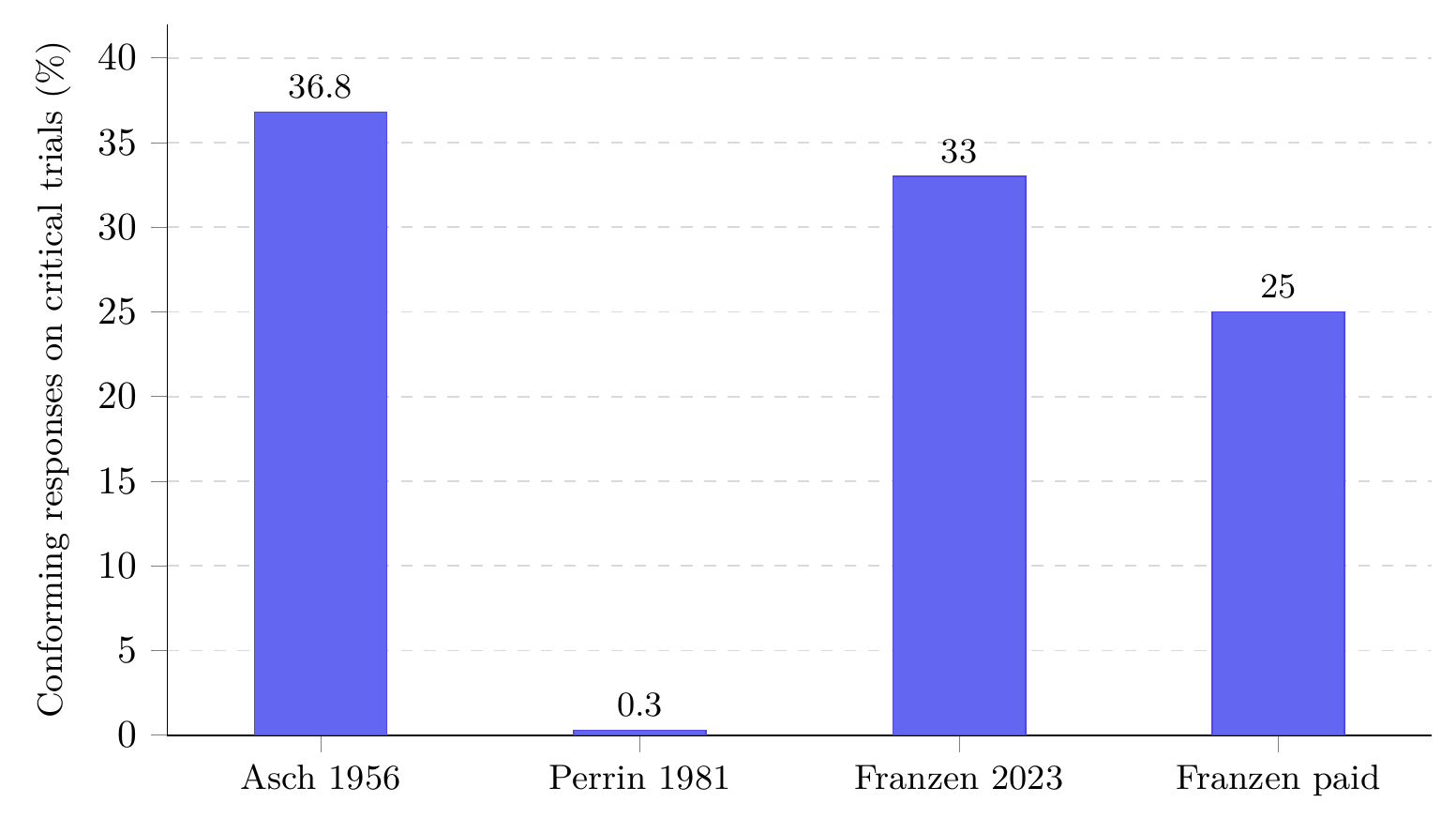
Data from Asch 1956. Perrin and Spencer 1981. and Franzen and Mader 2023. Chart by Mindomax.
Franzen and Mader ran the line task at the University of Bern and published it in 2023, recruiting 210 people and analysing 202 of them with 5 confederates per group across 10 line trials [2]. The error rate on critical trials was 33 percent.
That is not a diminished echo. That is Asch's 36.8 percent reproduced among 202 participants, 70 years and one continent later [2]. When correct answers were paid at one Swiss franc each, the rate fell to 25 percent, which is a real reduction and nowhere near an abolition. The same 202 participants conformed at 38 percent on five political statements, which is if anything the more disturbing figure, since a political opinion has no card to check it against.
If you have only ever heard the Perrin and Spencer result quoted as a takedown, that is worth sitting with for a moment. It is one study, in one country, in one decade, and it has been carrying an argument far heavier than a single replication can hold.
Mori and Arai had already removed the other standard objection in 2010, working with 104 undergraduates [26]. The usual complaint about the paradigm is that confederates are actors and participants may sense the setup.
So Mori and Arai got rid of the confederates entirely. Using filters that let two people looking at the same display see different images, they ran 104 undergraduates in Japan, 40 men and 64 women, in same sex groups of four, where one person in each group genuinely saw a different stimulus and the other three genuinely saw the standard one [26]. Nobody was acting. The minority participant faced a real, sincere, unanimous majority, and the effect was still there.
Now hold all three results at once and the picture stops being contradictory.
Baron, Vandello and Brunsman published the paper that resolves it in 1996, under a title that says what had been missed: the forgotten variable in conformity research [27]. The variable is task importance. When accuracy is made to matter, normative conformity goes down and informational conformity goes up. Those two move in opposite directions, so a replication's conformity rate depends on how much the participants think the answer is worth, and two honest replications can land in different places without either being wrong.
Bond and Smith supply the population-level version. Their 1996 meta-analysis pooled 133 studies from 17 countries using the line judgement task [28]. Two findings came out of it. Conformity was higher in more collectivist cultural contexts than in more individualist ones. And within the United States series, conformity declined steadily after the 1950s. That second result is what "child of its time" should have meant all along: not that the effect was an artefact, but that its size moves with the period. Larsen had reported the same downward direction from inside the intervening decade in 1974 [29]. Milgram had already found cross-national differences between Norway and France in 1961, well before anyone had the tools to meta-analyse them [30]. The decline is not a modern discovery. It was visible while it was happening.
So the honest summary is not that Asch was debunked. It is that the effect reproduces reliably and its size moves with period, culture, and how much the answer costs. Those are different claims and only the second one is supported.
Psychology has a habit of doing this to its own classics, and it usually happens the same way. A striking result gets a memorable name, the name gets taught, and the qualifications fall off in transit. The story of learned helplessness followed exactly that path, right down to the original authors publishing a correction that most people have never read.
One more variable belongs here because it gets stated carelessly more than almost anything else in the field. The claim that women conform more than men is common and the evidence is much weaker than the claim. Eagly and Chrvala argued in 1986 that the difference is better understood through status and gender role than through sex [31], and Bond and Smith's meta-analysis found any difference small and moderated by features of the design itself, including whether responses were made under surveillance [28]. Individual differences do exist. Strickland and Crowne showed as early as 1962 that people high in need for social approval conformed more under simulated group pressure [32]. Sex is simply not the variable it is usually reported as.
What Happens When the Group Disagrees With You
That is the psychology. The biology is younger and thinner and it is worth being careful with. Everything so far has been behaviour, and the last twenty years have added a layer underneath it. This section comes with a warning attached: the neuroscience of conformity is suggestive rather than settled, the samples are small, and exactly one result in it is causal.
Start with the causal one, because it is the strongest thing in the literature and it usually gets buried under the imaging.
In 2011 Klucharev and colleagues used transcranial magnetic stimulation to temporarily reduce activity in the posterior medial frontal cortex, and conformity dropped [33]. Not correlated with. Not associated with. Suppress the region and the behaviour changes. The paper does not report a sample size in its abstract and we are not going to invent one, but the design is an intervention rather than an observation, which puts it in a different evidential class from everything around it.
The account it was testing came from the same group two years earlier. In 2009 Klucharev and colleagues had participants rate faces, showed them a group's ratings, and scanned them [34]. Disagreeing with the group produced activity in the rostral cingulate zone and ventral striatum resembling the prediction error signal that turns up in reinforcement learning, and the size of that signal predicted how much the participant later adjusted their rating. The proposal is that social disagreement is processed like an error: something you expected did not happen, and the system updates.
If that framing sounds familiar, it is the same logic the article on predictive processing describes for perception generally. A mismatch between what you expected and what arrived is the currency the system runs on. Other people's opinions turn out to be one more thing you can expect.
Several results suggest the change reaches valuation rather than stopping at the mouth. Campbell-Meiklejohn and colleagues found in 2010 that learning other people's opinions shifted the neural signals associated with how much participants valued objects [35]. Nook and Zaki reported in 2015 that social norms shifted both behavioural and neural responses to food images [36].
That distinction matters more than it sounds. If conformity only changed the answer you gave, it would leave no residue. If it changes what the valuation system reports, it has altered the thing the answer was supposed to be about.
Chen and colleagues showed in 2024 that conformity updates the neural representation of facial attractiveness [37], and Berns and colleagues had looked at adolescents rating music in 2010 and found that being told a song was popular changed the response [38].
Think about what that means for your own preferences. The claim is not that you pretend to like what the group likes. The claim is that the machinery which reports how much you like it has already been adjusted before you say anything.
The timing work adds a further wrinkle. Shestakova and colleagues reported electrophysiological precursors of conformity in 2012, meaning signals that appear before the participant has committed to an answer [39].
And the state you are in matters. Yoder and Decety asked 170 participants in 2022 about their moral convictions and then watched how those convictions shaped several stages of processing during social decisions [40]. Zheng and colleagues found in 2021 that confidence modulated both conformity and its neural signature in an investment task [41].
Confidence keeps turning up as the pivot, which fits the behavioural picture exactly. Low confidence is the condition under which treating other people as evidence is the rational move.
Haihambo and colleagues proposed in 2025 that loneliness changes conformity through the precision the brain assigns to social information [42]. Izuma's 2013 review remains the readable overview of the whole area [43].
Read all of that as a research programme in progress. One causal result, a coherent computational story, and a lot of small studies pointing the same way. That is genuinely promising and it is not the same as knowing.
The Errors That Do Not Wash Out
Which brings us to the part of this that outlasts the session.
If conformity were purely a matter of what people say in a room, it would be a curiosity. The reason it is not is that some of what it changes stays changed.
Edelson and colleagues published the study that shows this in Science in 2011 [44]. Participants watched a documentary, took a memory test, and were then shown what they were told were the answers other people had given, some of which were wrong. They took the test again. Then they were told the truth: those answers had been fabricated. And they took it a third time.
Some of the errors disappeared once the influence was disclosed. Those were the socially compliant ones, given to fit in and abandoned as soon as fitting in stopped being relevant. Others survived. The participant had genuinely re-encoded the memory, and telling them the source was fake did not undo it. Crucially, the two kinds could be distinguished at the moment they were formed, and they were.
That is compliance and acceptance again, and this time acceptance has left a trace in a memory the person will carry around afterwards.
French and colleagues found a related effect in 2008 with intimate couples, who produced more false memories through collaborative remembering than pairs of strangers did [45]. The closer the relationship, the more readily one person's account is absorbed into the other's, which is not what most people would guess.
Social influence reaches further into the body than an experiment about lines would suggest. Koban and colleagues reported in 2016 that social information changed not only how much pain people reported but their physiological responses to it [46]. Von Mohr and colleagues found in 2023 that events presented at particular points in the cardiac cycle made people more suggestible to others' judgements [47].
That is worth pausing on if you have ever assumed your own memories are yours alone.
The eyewitness implication is the one that has cost real money and real years. Two witnesses discuss what they saw. One of them is confident and wrong. The other absorbs it, then reports it as their own memory in complete good faith. Nothing in that sequence involves anybody lying.
If you want the version of this that operates on beliefs rather than memories, cognitive dissonance covers what happens after somebody has said the thing they did not believe, which is often that they start believing it.
Children, Adults and Machines
Two questions here. Does conformity change as people grow up, and does the majority have to be human?
The developmental picture is less linear than the cliche about peer pressure suggests. Adolescence is the period where social information carries the most weight, and there is now a reasonable body of work on why. Mann and colleagues laid out the decision-making competence side in 1989 [48].
Reiter and colleagues showed in 2019 that risk-taking spreads between adolescent peers in a way that changes learning itself, not just behaviour in the moment [49]. That is a sharper claim than it looks. The peer does not merely push a choice. They alter the rate at which the adolescent updates from experience afterwards.
Hofmans and van den Bos modelled social learning across adolescence in Bayesian terms in 2022 [50]. Minich and colleagues scanned 153 participants across five studies in 2023 and reported the neural correlates of conformity in adolescent and young adult men [51], and Irani and colleagues separated behavioural and neural responses to peer opinion from responses to expert opinion in 2024 [52].
None of this makes teenagers uniquely gullible, and it is worth being careful with that word. A brain that weights social information heavily during the years you are working out where you belong is doing something sensible, not something broken.
The non-human question is more surprising and it is genuinely unresolved.
Vollmer and colleagues ran the Asch paradigm in Science Robotics in 2018 with a group of small humanoid robots giving the wrong answers [53]. Adults were influenced by human peers, as expected, and resisted the robots. Children aged seven to nine conformed to the robots. The paper reports no sample size in its abstract and we will not supply one. The title is the finding: children conform, adults resist.
Read on its own, that result is easy to file as a curiosity about robots. It is not really about robots.
Then Qin and colleagues published a paper in 2022 called adults still cannot resist, reporting that a social robot did induce normative conformity in adults [54]. Different robot, different manipulation, opposite conclusion.
Two studies, two answers. That is not a scandal, it is what an open question looks like before it closes, and the honest thing is to say so rather than pick the result that makes the better headline.
What is worth noticing is where the newer work keeps pointing, because it is pointing at your ordinary week rather than at a laboratory. Liel and Zalmanson published a study in 2025 about algorithmic conformity in artificial intelligence and human collaboration, and the phrase in the title is turning off your better judgement [55]. Bocian and colleagues found in 2024, with 103 participants in the first of their studies, that judgements of other people's moral character shifted under pressure from both human and virtual agents [56]. Paruzel-Czachura and colleagues had shown in 2023, running an Asch design over video calls with 120 participants answering sacrificial moral dilemmas, that a group of complete online strangers could move an individual's moral judgement [57].
The Asch situation required seven confederates, a room and a research budget. A comment thread supplies the same structure for free, and Postmes and colleagues were already documenting how norms form in computer-mediated groups in 2000 [58]. Winter and colleagues ran an online experiment with 197 participants in 2015 and found that the comments printed under a news article changed how readers evaluated the article itself [59]. The confederates are now unpaid and there are thousands of them.
The structure has not changed. Only the cost of assembling it has.
Whether other species do anything comparable is contested and worth one honest sentence. Claidiere and Whiten argued in 2012 for integrating human and non-human conformity as one phenomenon [60], and van Leeuwen and Haun replied in 2013 with a paper titled conformity in nonhuman primates: fad or fact [61]. Efferson and colleagues had given the evolutionary reason a copying bias might exist at all in 2008, in a study of conformists and mavericks [62].
What Conformity Costs
So it changes memory. The obvious next question is what else it changes when something is riding on the answer.
The line task has no stakes. Real ones do, and they run in both directions.
The interesting cost is not the one you would expect.
Start with the group, because the individual cost is the obvious one. Yang and colleagues published a model in 2021 predicting when social learners impair collective performance rather than improving it [63]. The logic is uncomfortable. A group is only smarter than its members if the members bring independent information. Every person who copies rather than judging removes one independent estimate and adds a duplicate. Past a threshold the group stops aggregating and starts echoing, and it does this while feeling more confident, because agreement is what confidence is usually built on.
That is the mechanism behind a lot of institutional failure. Lilly and colleagues analysed the Wells Fargo accounts scandal in 2021 explicitly through the pressure to conform [64]. Lord and Todd DeZoort had tested the same pressure on auditors back in 2001, and found that commitment and moral reasoning changed how they responded to it [65].
An auditor is an interesting test case, because the entire professional point of the role is to be the one person in the room who does not go along with it.
Kundu and Cummins took the paradigm itself into moral territory in 2013, applying the Asch design to moral decisions [66], and Jiang and colleagues found in 2023 that people conform to social norms when gambling with lives just as they do when gambling with money [67].
Then there is the version where nobody is pressuring anybody and the damage happens anyway, because everyone has misread the room. This one is probably closer to your own life than anything with confederates in it. Neighbors and colleagues assessed 164 students in 2006, 94 of them women, and found that students misperceive how much their peers drink and then drink toward the misperception [68]. Salvy and colleagues found in 2007 that how much people eat depends on who they are eating with, with couples, friends and strangers producing different amounts [69].
You can feel how that works. You are not copying what your friends do. You are copying what you believe your friends do, and the two are not the same thing, and nobody in the group ever compares notes.
The same lever works in the useful direction. Sparkman and colleagues laid out in 2020 how social norms block climate action and how they can be turned into a tool for it [70]. Arlidge and colleagues examined situational social influence in non-compliance with conservation rules in 2023 [71]. Freedman and Fraser had demonstrated the classic compliance technique in 1966, where a small request makes a later large one much easier to grant [72].
Emotion and social exits complicate it further. Heerdink and colleagues showed across five studies in 2013 that anger expressed by a majority made the deviant individual feel rejected while happiness made them feel accepted, and that the two emotions push toward conformity or deviance accordingly [73]. Prade and Saroglou found in 2023, across two online experiments with 593 participants, that awe increased both the endorsement of social norms and conformity to the majority opinion [74].
Nan and colleagues reported in 2023 that other people's rejections are more contagious than their choices, meaning we copy what others turn down more readily than what they take [75]. There is a certain logic to that. A rejection looks like information about a hazard and a choice looks like information about a preference.
Bolderdijk and Cornelissen examined in 2022 why people who make a morally motivated choice often decline to say so, which is the do-gooder's dilemma and a form of pre-emptive conformity [76].
If you want the group-level cousin of all this, the situation where the presence of other people changes what an individual does rather than what they say, the bystander effect runs on a different mechanism and produces a similarly counterintuitive result. And the observational route by which behaviour spreads without any pressure at all is the subject of social learning.
What the Experiment Is Actually About
Which leaves the question this article started with. What was the experiment actually measuring?
Come back to the room and the two cards.
There is a reading of the line experiment that has been available since 1976 and never quite took hold. Ross, Bierbrauer and Hoffman put it in American Psychologist under a title about revisiting the Asch situation [77]. Their argument is about attribution. From outside, a participant who agrees with an obviously wrong group looks weak. From inside, that participant is in a situation with no good explanation available. Seven confident strangers have just said something impossible. Whatever is going on, it is not a normal experiment about lines, and behaving cautiously in a situation you do not understand is not stupidity.
Hodges and Geyer pushed that much further in 2006, in a paper called a nonconformist account of the Asch experiments [78]. Their claim is that participants were managing three commitments at once. Tell the truth. Trust other people. Maintain the social fabric that makes conversation possible. Those three normally point the same way and in Asch's room they do not, and a participant who mostly tells the truth while occasionally going along with the group is not failing at one value. They are trading between three.
That reading is contested and should be labelled as contested. The standard normative and informational account is not dead and Deutsch and Gerard's private-response result is hard evidence for it. But the standard account also cannot easily explain why the interviews contain such different reports from people who produced identical behaviour, and Hodges and Geyer can.
That is the argument, and it is a genuinely open one. Here is the part that is not.
The task was easy, and the control condition proves it: alone, people were wrong under 1 percent of the time [1]. Under a unanimous wrong majority, about a third of responses went with the group, around three quarters of people did it at least once, and about a quarter of people never did it at all.
The rate collapses when one other person breaks ranks, and it collapses even when that person visibly cannot see the card [11]. It falls when the answer is written privately rather than said aloud [8].
It varies with culture and with the decade, across the 133 studies from 17 countries that have now been pooled [28]. And it was 33 percent among 202 participants in Switzerland in 2023 [2].
Read that list back and ask yourself which of those facts you already knew.
For most of the time this experiment has existed, it has been taught as though only the conforming third of it happened.
The moral usually attached to this experiment is that people are weak. A better one is available and it is closer to what Asch reported. Most people, most of the time, said the true thing. Doing it was unpleasant, and they did it anyway. A quarter of them did it every single time, with no ally, in public, against a wall of confident disagreement.
The other lesson is more practical than any advice about resisting pressure, and it comes out of Allen and Levine's ally with the thick glasses. What broke the situation open was not evidence. It was one other voice. If you have ever been the only person in a meeting who thought the plan was wrong, you already know how much heavier that is than being the second person to say so. The second person has a much easier job, and the first person is what makes the second one possible.
So the useful question is not how to be braver. It is how often you are the second voice when somebody else has already taken the risk, and how often you let a sentence you disagreed with pass because nobody else objected first. The first of those is cheap and it is worth an enormous amount to the person who went first. Most people never notice they had the chance.
Being right was never the hard part. Being the only one was.
Frequently Asked Questions
What was the Asch conformity experiment?
In the line judgement task, developed by Solomon Asch and reported in full in 1956, one real participant sat with a group of confederates and judged which of three comparison lines matched a standard line. The task was easy: judging alone, people were wrong on under one percent of trials. On the critical rounds the confederates gave a unanimous wrong answer, and the study measured whether the participant went along with them.
What percentage of people conformed in Asch's experiment?
Two different figures get quoted and they mean different things. About a third of the responses given on critical trials matched the wrong majority. Separately, around three quarters of participants conformed on at least one trial, and about a quarter never conformed at all. Saying that seventy five percent of people conformed is true only in the sense that they did it once, and it is usually meant to imply something much stronger.
Why did participants conform when the answer was obvious?
The post-session interviews found two different reasons behind the same behaviour. Some participants genuinely began to doubt their own perception and treated the group as evidence, which Deutsch and Gerard called informational influence in 1955. Others knew the group was wrong and answered wrongly anyway to avoid standing out, which is normative influence. Both produce an identical wrong answer, so only a design that separates them can tell them apart.
Does group size change how much people conform?
Less than most people assume. Conformity rises steeply as the majority grows from one person to about three, then flattens out, a saturating pattern rather than a straight line. What matters far more is unanimity. Allen and Levine showed in 1971 that a single supporter reduced conformity even when that supporter visibly could not see the stimulus, so what an ally supplies is company rather than information.
Has the Asch experiment been replicated, and does it still hold?
Yes, and it does. Perrin and Spencer reported conformity on one of three hundred and ninety six critical trials with British students in 1981, which is where the idea that the effect was a product of the 1950s comes from. But Mori and Arai reproduced it in Japan in 2010 with one hundred and four participants and no confederates at all, and Franzen and Mader got an error rate of thirty three percent with two hundred and two participants in Bern in 2023. Bond and Smith's meta-analysis of one hundred and thirty three studies from seventeen countries found that conformity varies with culture and has declined in the United States since the 1950s. The effect is real and its size moves with period, culture and stakes.


