
Introduction
In 2011, Betsy Sparrow at Columbia University ran a simple experiment that rattled the psychology world. She gave people trivia facts and told half of them the facts would be saved on a computer. The other half were told the facts would be erased. The group expecting digital storage remembered significantly less [1]. The brain had quietly decided: why bother encoding what a machine will hold for me?
Four years later, Matthew Fisher at Yale discovered something even stranger. People who searched Google for answers rated their own intelligence higher, even when the search returned nothing useful [2]. Internet access did not just reduce what people remembered. It inflated what they believed they knew.
These findings point to a question that matters for anyone who studies. If the brain downgrades its own encoding when connectivity is available, what happens when you remove that connectivity on purpose? What happens when you build a study routine without internet, forcing the brain to do its own heavy lifting? The answer, drawn from over a century of memory research and two decades of digital cognition studies, is that offline study protects nearly every stage of the memory pipeline. Encoding gets deeper. Attention stays intact. Consolidation runs uninterrupted. And habit formation anchors more firmly. This article traces the evidence across all four stages.
The Google Effect and the Brain That Stopped Trying
The story begins with a concept called transactive memory. Daniel Wegner introduced it in 1986 to describe how couples, families, and teams distribute knowledge among members. One person remembers birthdays. Another remembers directions. Nobody needs to remember everything because the group functions as a shared memory system.
Sparrow realized that the internet had become the newest member of this group [1]. Across four experiments published in Science, she showed that people who expected digital access encoded less content but encoded more about where the information was stored. The brain was not failing. It was being efficient. It had outsourced storage to a device it trusted.
The problem is that study is not about storing facts externally. Study is about building internal representations that can be retrieved, connected, and applied under pressure. An exam does not come with a search bar.
Fisher, Goddu, and Keil pushed this further in 2015 [2]. Nine experiments showed that the act of searching the internet inflated self-assessed understanding. Participants thought they knew more after googling, even when the search returned irrelevant results. In a later study, Fisher, Smiley, and Grillo found that internet search masked learning deficits by making information feel accessible, which discouraged genuine encoding into long-term memory [3].
What does this mean for a student building a routine? Every time you study with a browser open, your brain is making a silent calculation: is this worth encoding, or can I just look it up later? The answer it often reaches is the second one. Remove the browser, and the calculation changes. The brain invests more because it has no backup plan.
Your Phone Is Draining Your Brain by Sitting in the Room
In 2017, Adrian Ward and his colleagues at the University of Texas at Austin published a paper with a blunt title. They called it "Brain Drain" [4].
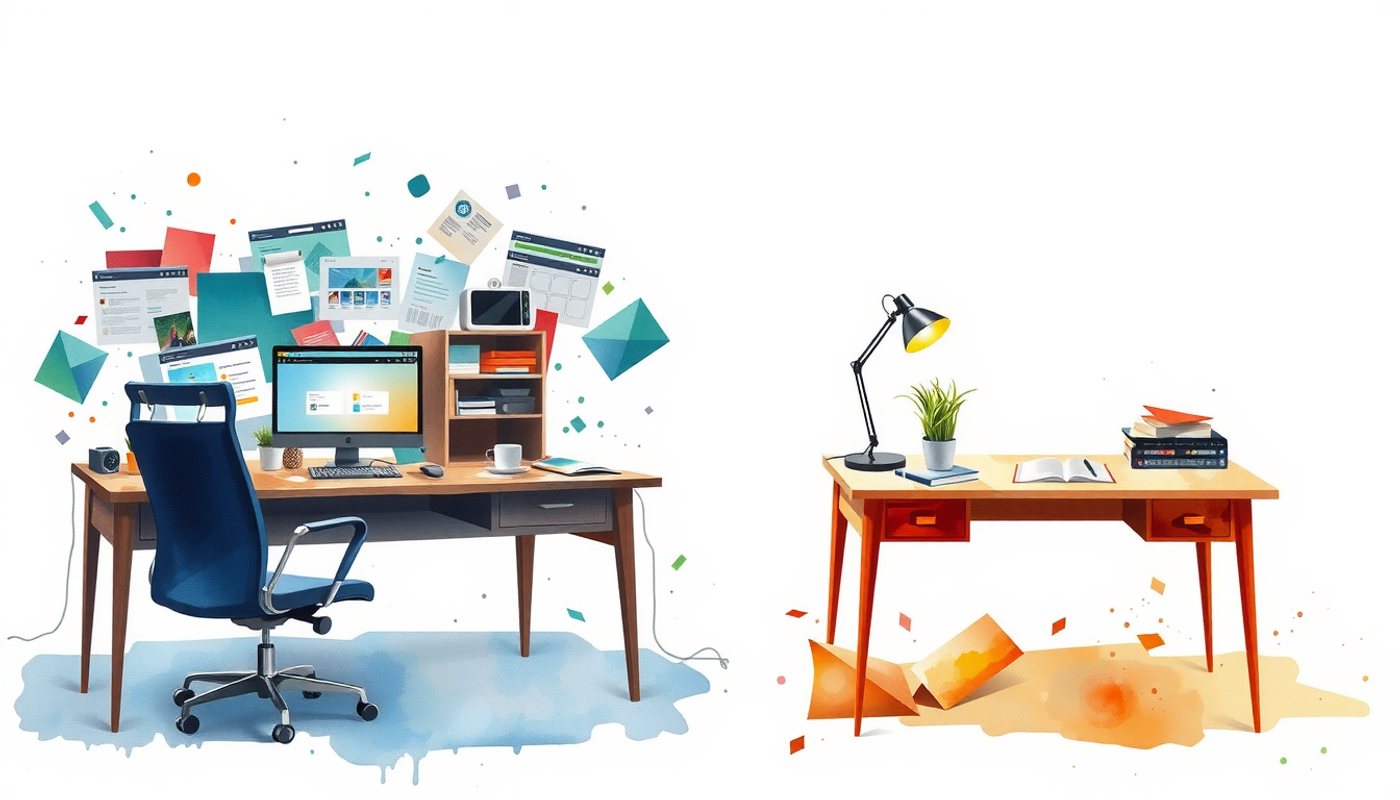
The study was elegant. 548 undergraduates took tests measuring working memory capacity and fluid intelligence. Some had their smartphones on the desk, face down. Some had them in a pocket or bag. Some left them in another room entirely. All phones were silenced. Nobody checked them during the test.
The results were striking. Participants whose phones sat on the desk performed worst. Those with phones in another room performed best. The difference was not about notifications or willpower. The phone was not buzzing. Nobody was fighting the urge to check it. The mere physical presence of the device consumed cognitive resources.
Ward proposed that the brain allocates a portion of its limited executive capacity to the ongoing task of not engaging with the phone. This suppression effort is automatic, below conscious awareness, and it leaves less processing power for the actual task. A 2023 meta-analysis by Skowronek, Seifert, and Lindberg in Scientific Reports confirmed the effect is real, though its size varies across populations and methods [5].
For students, the implication is clear and uncomfortable. Putting your phone on silent is not enough. Putting it face down is not enough. The phone needs to be in a different room. Building a study routine without internet means physically removing connected devices from the study environment, not just disciplining yourself to ignore them.
This connects to a broader finding about attention. Sophie Leroy at the University of Minnesota coined the term "attention residue" in 2009 [6]. When you switch from one task to another, cognitive activity from the first task lingers. Your mind is still partly processing the email you just read while you try to study pharmacology. Leroy showed in two experiments that time-pressured transitions produce the worst residue and the worst subsequent performance.
Gloria Mark, a professor of informatics at the University of California, Irvine, spent over a decade tracking how people interact with screens. Her research documents that knowledge workers switch screens roughly every three minutes, with self-interruptions accounting for nearly half of all switches. Each switch leaves a residue trail. Each residue trail degrades the quality of the next task.
The student who studies with Wi-Fi on lives in this world of perpetual residue. A notification glance. A quick tab switch to check a message. A thirty-second scroll that turns into three minutes. None of these feel like failures. But each one leaves a cognitive fingerprint that smudges the encoding happening in the study session.

Why Paper Beats Screens for Deep Understanding
If screens impair attention, do they also impair comprehension? The answer, supported by one of the more consistent findings in educational psychology, is yes.
In 2018, Pablo Delgado and colleagues published a meta-analysis of 54 studies involving approximately 171,000 participants [7]. The question was straightforward: does reading from paper produce better comprehension than reading from screens? The result was a small but reliable paper advantage, with an effect size of roughly g = −0.21. Two details stood out. First, the advantage had grown over time. Studies from more recent years showed a larger gap than older ones. Second, the effect was strongest for expository texts read under time pressure, which is exactly the type of reading that academic study involves.
Singer and Alexander reviewed two decades of research in 2017 and reached the same conclusion [8]. Clinton corroborated it across populations and devices in 2019 [9]. The pattern held.
Part of the explanation is metacognitive. Ackerman and Goldsmith showed in 2011 that learners on screens are more overconfident about their understanding and budget less study time [10]. Paper readers calibrate better. They notice when something is not sticking and slow down. Screen readers scroll forward, mistaking fluency for comprehension.
Another part of the explanation is environmental. Screens come with browsers. Browsers come with tabs. Tabs come with the entire internet one click away. Hembrooke and Gay found in 2003 that students with open laptops during a lecture scored significantly lower on memory tests [11]. Sana, Weston, and Cepeda replicated this in 2013 and discovered something additional: the effect extended to nearby peers who could see the multitasking screens, reducing their comprehension by roughly seventeen percent [12].
A student who prints readings, uses paper flashcards, and writes longhand notes is not being old-fashioned. The student is, whether knowingly or not, exploiting a cluster of cognitive advantages that screens undermine.
The Pen Rewires the Brain Differently Than the Keyboard
If paper reading helps comprehension, does paper writing help memory? The evidence here is strong, and it goes beyond behavior into brain architecture.
In 2014, Pam Mueller and Daniel Oppenheimer published one of the most discussed studies in educational psychology [13]. Across three experiments, students watched lectures and took notes either by hand or on laptops. Laptop users typed more words. But on conceptual questions tested afterward, longhand note-takers performed better. The proposed explanation: handwriting is slower, which forces the writer to select, compress, and rephrase rather than transcribe verbatim. The act of choosing what to write down is itself a form of encoding.
A direct replication by Morehead, Dunlosky, and Rawson in 2019 found smaller effects that were not always statistically significant [14]. The advantage appears real but depends on how students use their notes afterward. When review is allowed, the gap narrows. When no review happens, handwriting wins.
But the neurobiological evidence tells a clearer story. Karin James and Laura Engelhardt at Indiana University used fMRI to study preliterate children learning letters in 2012 [15]. After handwriting practice, children recruited the canonical reading circuit in the brain: the fusiform gyrus, the inferior frontal gyrus, and the posterior parietal cortex. After typing or tracing the same letters, they did not. Only the physical act of forming letters by hand activated the brain regions responsible for reading.
Audrey Van der Weel and Ruud Van der Meer at the Norwegian University of Science and Technology took this further. Using 256-channel high-density EEG, they measured brain connectivity during handwriting versus typing in both children and adults [16]. Handwriting produced widespread theta and alpha band synchronization across parietal and central brain regions. Typing did not. These are the neural signatures associated with memory encoding and attentional engagement. The brain during handwriting is doing something fundamentally different from the brain during typing.
Eva Askvik, working in the same lab, confirmed these findings in 2020 with younger children [17]. The pattern was consistent across ages: handwriting activates more of the brain, more deeply, in ways that matter for learning.
For offline study routines, this research supports a specific recommendation: write your notes, summaries, and flashcards by hand. Not because it feels virtuous. Because it changes what your brain does with the information.
What the Brain Does When You Stop Studying and Stare at the Wall
Most students think that learning happens while they are studying. The evidence says otherwise. A critical phase of memory formation happens in the minutes after study ends, during quiet, undisturbed rest.
In 2010, Arielle Tambini and Lila Davachi at New York University used fMRI to look at what happens in the brain during post-study rest [18]. They had participants learn associations between faces and objects, then lie still in the scanner with eyes open and no task. During this rest, the hippocampus increased its functional connectivity with the lateral occipital cortex, the region that had processed the visual information during learning. The strength of this rest-period connectivity predicted how well participants remembered the associations later.
The brain was replaying the learning experience. Not passively. Actively.
Michaela Dewar at Heriot-Watt University tested this idea behaviorally in 2012 [19]. Participants heard short stories. Afterward, half spent ten minutes resting with closed eyes in a quiet room. The other half spent ten minutes doing a spot-the-difference visual puzzle. One week later, the resting group remembered significantly more of the stories. The effect was large: roughly ten to thirty percentage points better retention.
Ten minutes of doing nothing. One week of better memory.
James Bursley and colleagues confirmed this in 2016 with fMRI evidence [20]. Even a two-minute rest period after learning paired associates improved memory, and multi-voxel pattern analysis revealed reactivation of encoded representations in the dorsolateral prefrontal cortex during rest. A 2022 review by Elizabeth Wamsley in Nature Reviews Psychology concluded that wakeful rest may improve memory to a degree comparable to a full night of sleep [21].
Now consider what happens when a student finishes a study session and immediately picks up a phone. The hippocampal replay that Tambini documented gets interrupted. The consolidation window that Dewar measured gets flooded with new input. The brain, which was about to do some of its most important work, gets redirected to processing Instagram feeds and text messages.
Building a study routine without internet means protecting these quiet minutes. It means finishing a study block, closing the notebook, and sitting still for five to ten minutes before re-engaging with any device. The Default Mode Network, which includes the medial prefrontal cortex, posterior cingulate, precuneus, and hippocampal formation, is most active during these periods of undirected rest [22]. A 2025 paper in Trends in Cognitive Sciences linked DMN-supported spontaneous thought during rest directly to memory stabilization. Mind-wandering, when allowed to run naturally instead of being pre-empted by a notification, helps the brain integrate new information into existing knowledge structures.
Context Matters More Than You Think
Endel Tulving and Donald Thomson introduced the encoding specificity principle in 1973 [23]. The idea: a memory is easiest to retrieve when the conditions at retrieval match the conditions at encoding. What you were seeing, hearing, feeling, and thinking when you learned something becomes part of the memory trace itself.
Steven Smith, Arthur Glenberg, and Robert Bjork tested this with a direct environmental manipulation in 1978 [24]. Across five experiments, they showed that people recalled more when tested in the same room where they had studied. Changing rooms reduced recall. The physical environment had become a retrieval cue.
Now think about what the "environment" looks like during a typical digital study session. A student reads a paper on a laptop. A Slack notification pops up. The student switches to Slack, responds, switches back. Opens a new tab to check a reference. Gets pulled into a YouTube suggestion. Returns to the paper. The visual, motor, and attentional context changes every few minutes. Each encoding episode is bound to a different transient set of cues: a different tab layout, a different notification, a different emotional state. When the exam arrives, none of those cues are present.
Compare this to studying at a physical desk with paper materials. The desk looks the same every day. The notebook is the same. The lamp is the same. The routine is the same. Each study session builds on a consistent set of environmental cues that are reinstated every time the student sits down. Retrieval becomes easier because the context matches.
Hermans and colleagues showed in 2017 that emotional and contextual brain states persist into post-encoding rest and predict long-term retention [25]. This means that environmental stability after study supports consolidation as much as stability during study.
An offline study routine, practiced in the same place and at the same time, turns the physical environment into a powerful retrieval cue. The consistent context becomes part of the memory itself.

How Long It Really Takes to Build a Habit
The popular claim that habits form in twenty-one days is a myth. The real number comes from Phillippa Lally and colleagues at University College London, who tracked ninety-six volunteers attempting to adopt a new daily health behavior in 2010 [26].
The median time to reach ninety-five percent of asymptotic automaticity was sixty-six days. But the range was enormous: eighteen to two hundred and fifty-four days. Some behaviors became automatic quickly. Others took most of a year. One critical finding: missing a single day did not reset the curve. Consistency mattered, but perfection did not.
Peter Gollwitzer at New York University introduced a tool that dramatically increases the probability that a planned behavior actually happens. He called them "implementation intentions" [27]. The format is simple: "When situation X arises, I will perform behavior Y." A meta-analysis by Gollwitzer and Sheeran in 2006 across ninety-four studies found a medium-to-large effect size of d = 0.65 for this technique [28].
For study routines, this means statements like: "When I sit at my desk after dinner, I will open my notebook to today's chapter." Or: "When my alarm goes off at 7 AM, I will study with paper flashcards for thirty minutes before checking any device."
Gardner, Lally, and Wardle emphasized in 2012 that stable contextual cues are essential for habit formation [29]. The same time, the same place, the same sequence of actions. An offline study routine provides exactly this kind of cue stability. The desk. The notebook. The absence of digital interruption. Each repetition strengthens the cue-behavior link until studying feels less like a decision and more like something that just happens.
The biological scaffold for session length comes from ultradian rhythms, the roughly ninety-minute cycles of alertness and rest that the brain naturally follows. Biwer and colleagues in 2023 compared systematic Pomodoro-style breaks with self-regulated breaks and found that structured intervals of roughly twenty-five to thirty-five minutes of focused work, followed by five to ten minutes of rest, produced lower fatigue and higher concentration [30]. A scoping review on the Pomodoro technique in medical education confirmed this range as effective for sustained learning [31].
Retrieval Practice Works on Paper Just as Well as on Screens
The testing effect is one of the most reliable findings in cognitive psychology. Practicing retrieval, actively pulling information out of memory rather than passively rereading it, produces stronger and more durable learning.
Henry Roediger and Jeffrey Karpicke demonstrated this definitively in 2006 [32]. Students who spent their study time taking practice tests retained far more than students who spent the same time rereading. The effect held across delays from minutes to weeks. Karpicke and Blunt extended this in 2011, showing that retrieval practice outperformed even elaborative concept mapping on delayed conceptual tests [33].
The critical point for offline study: retrieval practice does not require a screen. A paper flashcard with a question on one side and an answer on the other is a retrieval practice tool. So is closing your notebook and writing down everything you can remember. So is explaining a concept aloud to an empty room.
Nicholas Cepeda and colleagues published the definitive meta-analysis of distributed practice in 2006, covering 839 assessments [34]. Spaced practice beats massed practice, and the optimal gap between sessions scales with the desired retention interval. For a one-week test, review after one to two days. For a one-month test, review every few days. For a one-year retention goal, review every three to five weeks.
The Leitner box system, devised by German science journalist Sebastian Leitner in 1972, operationalizes spaced repetition with nothing but paper cards and cardboard compartments. Cards answered correctly move to a box with a longer review interval. Cards answered incorrectly return to the first box. The system exploits the same spacing and retrieval principles as any digital algorithm, using zero electricity.
Nate Kornell at Williams College showed in 2009 that spacing flashcard study across multiple sessions produces better retention than cramming the same number of repetitions into one session [35]. Interestingly, students believed cramming was more effective even when the data showed the opposite. The fluency of massed practice creates an illusion of mastery.
John Dunlosky and colleagues reviewed ten popular study techniques in 2013 for Psychological Science in the Public Interest [36]. Only two received a "high utility" rating: practice testing and distributed practice. Both work identically on paper and on screens. The medium does not matter. The cognitive process does.
Screens at Night Steal Your Sleep and Your Memories
The final piece of the offline study argument involves what happens after the study session ends. Specifically, what happens at bedtime.
Susanne Diekelmann and Jan Born published the canonical model of sleep-dependent memory consolidation in Nature Reviews Neuroscience in 2010 [37]. During slow-wave sleep, the hippocampus replays the day's experiences. Slow oscillations, sleep spindles, and sharp-wave ripples form a sequential coupling hierarchy that creates the conditions for transferring memories from hippocampal to neocortical storage. REM sleep then supports synaptic consolidation. Both stages matter. Both are required for the day's study to become tomorrow's knowledge.
Matthew Walker synthesized this research in his 2017 book, emphasizing that sleep before learning prepares hippocampal encoding capacity, and sleep after learning stabilizes traces [38]. Reduce either stage and academic performance suffers.
Now consider what happens when a student studies until 11 PM and then scrolls a phone in bed for forty-five minutes before sleeping. Anne-Marie Chang and colleagues at Harvard Medical School published the critical study in 2015 in PNAS [39]. Participants who read on a light-emitting eReader before bed, compared to a printed book, had suppressed evening melatonin secretion, a delayed circadian phase of roughly one and a half hours, reduced REM sleep, and reduced next-morning alertness. The melatonin suppression alone is significant. Melatonin is the hormone that signals the brain to transition into sleep. Delay it, and the entire sleep architecture shifts.
Combined with Diekelmann and Born's model, the pathway from late-night screens to impaired memory is direct. Less slow-wave sleep means less hippocampal replay. Less REM means less synaptic consolidation. The study session that preceded the screen time is partially wasted because the brain never gets to finish processing it.
A study routine that ends one hour before sleep, with no screen exposure in between, protects the consolidation window. This is not about sleep hygiene as a general health measure. This is about the specific biochemical and neural mechanisms that turn today's studying into tomorrow's retained knowledge.

When the Evidence Gets Complicated
Honesty requires noting where the evidence is less clean than headlines suggest.
Mueller and Oppenheimer's pen-versus-keyboard study has become a touchstone of the offline study argument. But Morehead, Dunlosky, and Rawson's 2019 replication found smaller, often non-significant effects [14]. The advantage of handwriting is real, but it is moderated by what happens after the note-taking. If students review their notes, the gap narrows. The medium matters less when effort is high regardless.
The screen-versus-paper meta-analytic effect of g = −0.21 is real but small in Cohen's terms [7]. It matters cumulatively across years of study but should not be overstated for any single session. Some recent work by Delgado and Salmerón suggests the effect is smaller for tablets than for desktop monitors, narrowing as device ergonomics approach those of paper.
The "Brain Drain" effect has drawn scrutiny. The 2023 meta-analysis confirmed its existence but found it is moderated by culture and methodology [5]. Not every study replicates it at the same magnitude. The smartphone-academic-performance correlation from meta-analyses is roughly r = −0.10 to −0.16 [40]. Small. But consistent.
The popular figure of "twenty-three minutes and fifteen seconds" to recover from an interruption, often attributed to Gloria Mark, does not appear in her original 2008 paper. That paper reported speed, stress, and effort effects of interruption. The twenty-three-minute figure comes from interviews, not peer-reviewed measurement. The core finding, that interruption raises stress and cognitive cost, is well-supported. The specific number should be treated as a heuristic, not a precise measurement.
Lally's "sixty-six days" for habit formation obscures the enormous range of eighteen to two hundred and fifty-four days [26]. Individual variability is massive. A student who does not feel automatic at day seventy is not failing. The curve is real but highly personal.
And Walker's 2017 book, while influential, drew academic criticism for occasionally overstating findings. The underlying primary literature from Diekelmann and Born and from Rasch and Born remains the more conservative and reliable source [41].
None of these caveats overturn the main argument. They refine it. The case for offline study is not built on any single dramatic finding. It is built on the convergence of dozens of moderate, replicated effects that all point in the same direction: less connectivity during study leads to better memory.
The Five Pillars of an Offline Study Routine
The research reviewed in this article converges on five mutually reinforcing components. Each one addresses a specific, measurable threat to memory formation.
The first pillar is habit architecture. A fixed time and place, sustained for at least two months, transforms studying from a decision into an automatic behavior. Implementation intentions of the form "when X, then Y" accelerate the process [27]. Consistency matters more than perfection. Missing a day does not reset the curve [26].
The second pillar is distraction control. This means physical removal of smartphones from the study room, not just silencing them [4]. It means studying without a browser open. It means accepting that every notification, every quick check, leaves an attention residue that degrades the study session [6].
The third pillar is active offline tools. Longhand note-taking engages broader brain networks than typing [16]. Paper flashcards in a Leitner-style spaced system exploit the same retrieval and spacing effects as digital algorithms [34]. Paper readings produce deeper comprehension than screen readings [7].
The fourth pillar is wakeful rest. Five to ten minutes of undisturbed, eyes-closed quiet after each study block allows the hippocampus to replay and consolidate what was just learned [19]. This rest must come before any digital input. Picking up a phone immediately after studying disrupts the very consolidation process that makes the session worthwhile [18].
The fifth pillar is sleep protection. A screen-free wind-down period before bed preserves melatonin secretion, circadian timing, and the slow-wave and REM sleep that consolidate declarative memories [39]. The day's study is not complete when the notebook closes. It is complete when the brain finishes processing it overnight [37].
These five pillars do not require special equipment, expensive tools, or unusual discipline. They require a desk, paper, a pen, a timer, and the willingness to leave a phone in another room. The rest is done by a brain that has been building and consolidating memories for three hundred thousand years, long before the first screen was ever lit.

Conclusion
The case for building a study routine without internet is not nostalgic. It is neurological. Every stage of the memory pipeline, from initial encoding to overnight consolidation, has measurable vulnerabilities to digital connectivity. The Google Effect weakens encoding motivation [1]. Smartphone presence drains working memory [4]. Screen reading reduces comprehension [7]. Notifications fragment attention [6]. Immediate phone use after study disrupts hippocampal consolidation [19]. And evening screens impair the sleep that finalizes the entire process [39].
None of these effects alone is catastrophic. None of them will cause someone to fail an exam by themselves. But compounded across hundreds of study sessions over months or years, they represent a substantial and entirely preventable loss.
The tools to reverse this loss are simple. A consistent place and time. Paper and pen. Flashcards in a box. A few minutes of quiet after each session. And a commitment to disconnecting before sleep. The science does not demand a radical lifestyle change. It asks for a small, deliberate boundary between the connected world and the time reserved for learning. The brain will do the rest. It has been doing it since long before Wi-Fi existed.
For readers interested in related research, the article on desirable difficulties and why harder learning helps retention covers the retrieval-effort mechanism in depth. And the article on what spaced repetition is and why it works traces the full history of the spacing effect from Ebbinghaus to modern algorithms.
Frequently Asked Questions
Does studying without internet actually improve memory?
Research shows that removing internet access during study protects multiple stages of memory formation. The Google Effect reduces encoding effort when digital access is expected. Smartphone presence drains working memory even when silenced. Paper reading produces deeper comprehension than screen reading. Eliminating digital distractions allows uninterrupted attention and post-study consolidation, both of which strengthen long-term retention according to multiple peer-reviewed studies.
How long does it take to build an offline study habit?
According to a 2010 study by Lally and colleagues at University College London, the median time to reach automaticity for a new daily behavior is sixty-six days, with a range of eighteen to two hundred and fifty-four days. Missing a single day does not reset progress. Consistency in time and place is more important than perfection, and implementation intentions can accelerate the process.
Is handwriting really better than typing for learning?
Neuroimaging studies show that handwriting activates broader brain networks than typing, particularly in theta and alpha frequency bands associated with memory encoding. The behavioral evidence is more nuanced. Longhand note-takers tend to outperform typists on conceptual questions, though the advantage depends on whether students review their notes. The neurobiological case for handwriting is stronger than the behavioral case alone.
Why should I rest after studying instead of checking my phone?
Brief wakeful rest after learning allows the hippocampus to replay and consolidate newly encoded information. A 2012 study showed that ten minutes of eyes-closed rest after hearing a story improved recall seven days later by ten to thirty percentage points compared to an active task. Picking up a phone floods the brain with new input and disrupts this consolidation window.
Do paper flashcards work as well as digital flashcard apps?
The cognitive mechanisms that make flashcards effective, retrieval practice and spaced repetition, are medium-independent. A 2013 review rated practice testing and distributed practice as the only two study techniques with high utility, and both work identically on paper and screens. A Leitner box system with paper cards exploits the same spacing principles as any digital algorithm.