
INTRODUCTION
A man wakes up on his couch. His mouth tastes wrong. He cannot remember how he got there. Last night is a blank — not a blur, not a haze, but a genuine absence. He remembers leaving the bar. He remembers nothing after. Three days later, at the same bar, after two drinks, the evening returns. Not all of it. But pieces. The cab ride. A conversation with a stranger. Dropping his keys at the front door. The memories were not destroyed. They were locked behind a biochemical door that only opened when his body returned to the state it was in when those memories were made. This phenomenon has a name. It is called state dependent memory, and it has haunted scientists since 1937 [1]. Unlike context-dependent memory — which ties recall to external environments like rooms, sounds, or smells — state dependent memory ties recall to the internal condition of the body. The drug in your bloodstream. The hormone flooding your brain. The mood saturating your thoughts. Change the internal state between learning and recall, and the memory becomes harder to reach. Restore the state, and the memory surfaces. The implications run far deeper than bar stories. State dependent memory helps explain why depressed people cannot remember being happy [2], why trauma survivors relive events they cannot voluntarily recall [3], and why recovering addicts relapse when they encounter the internal cues of craving. This is the story of a discovery that began with paralyzed dogs, passed through drunk medical students, and ended inside the molecular architecture of the hippocampus.
The Dogs That Forgot Everything When They Woke Up
The story of state dependent memory begins in 1937 at the University of Illinois, in a laboratory that smelled of disinfectant and dog fur.
Edward Girden and Elmer Culler were studying conditioned reflexes — the kind of basic learning that Ivan Pavlov had made famous decades earlier. They wanted to know whether a dog could learn a conditioned response while its muscles were paralyzed. To do this, they used curare — a plant-derived poison that South American hunters applied to blowdart tips to paralyze prey. In controlled doses, curare blocks the neuromuscular junction, temporarily paralyzing voluntary muscles without affecting consciousness. The dog is awake, aware, but cannot move [1].
Girden and Culler isolated the semitendinosus muscle — a muscle in the hind leg — and conditioned the dogs to flex it in response to a bell, using mild electric shock as reinforcement. Under curare, the dogs learned the response. But here is what no one expected. When the curare wore off and the dogs returned to their normal state, the conditioned response vanished. The dogs behaved as if they had never been trained. The learning had disappeared.
Then Girden and Culler administered curare again. The response came back.
They tested it in reverse too. Dogs trained in the normal state lost their conditioned response under curare, and regained it when they returned to normal. The learning was intact in both cases. It simply could not cross the border between one physiological state and another. Girden and Culler called this "dissociation of learning" — the separation of memory between drugged and non-drugged states [1].
The finding was striking, but curare is an unusual drug. It paralyzes the body without entering the brain. Could state-dependent learning occur with drugs that actually altered brain chemistry? That question would wait twenty-seven years for an answer.
The Rat in the Maze That Could Only Remember When Drugged
In 1964, at McGill University in Montreal, a young researcher named Donald Overton picked up where Girden and Culler had left off. Overton's contribution would transform state dependent memory from a curiosity into a robust experimental paradigm.
Overton trained rats to escape mild electric shock in a T-maze — a simple maze shaped like the letter T where the rat must choose to turn left or right. One group of rats was trained after receiving twenty-five milligrams per kilogram of sodium pentobarbital — a barbiturate that suppresses the central nervous system. The other group was trained while undrugged [4].
The results were absolute. Rats trained under pentobarbital could not perform the escape response when tested sober. Rats trained sober could not perform it when given pentobarbital. In both directions, the learned behavior was conditional on the drug state being the same during training and testing. Overton's own summary was precise: performance of the response was dependent upon reinstatement of the drug condition present during initial acquisition [4]. And the effect was dose-dependent. The more pentobarbital the rats received, the less their learning transferred to the non-drug state.
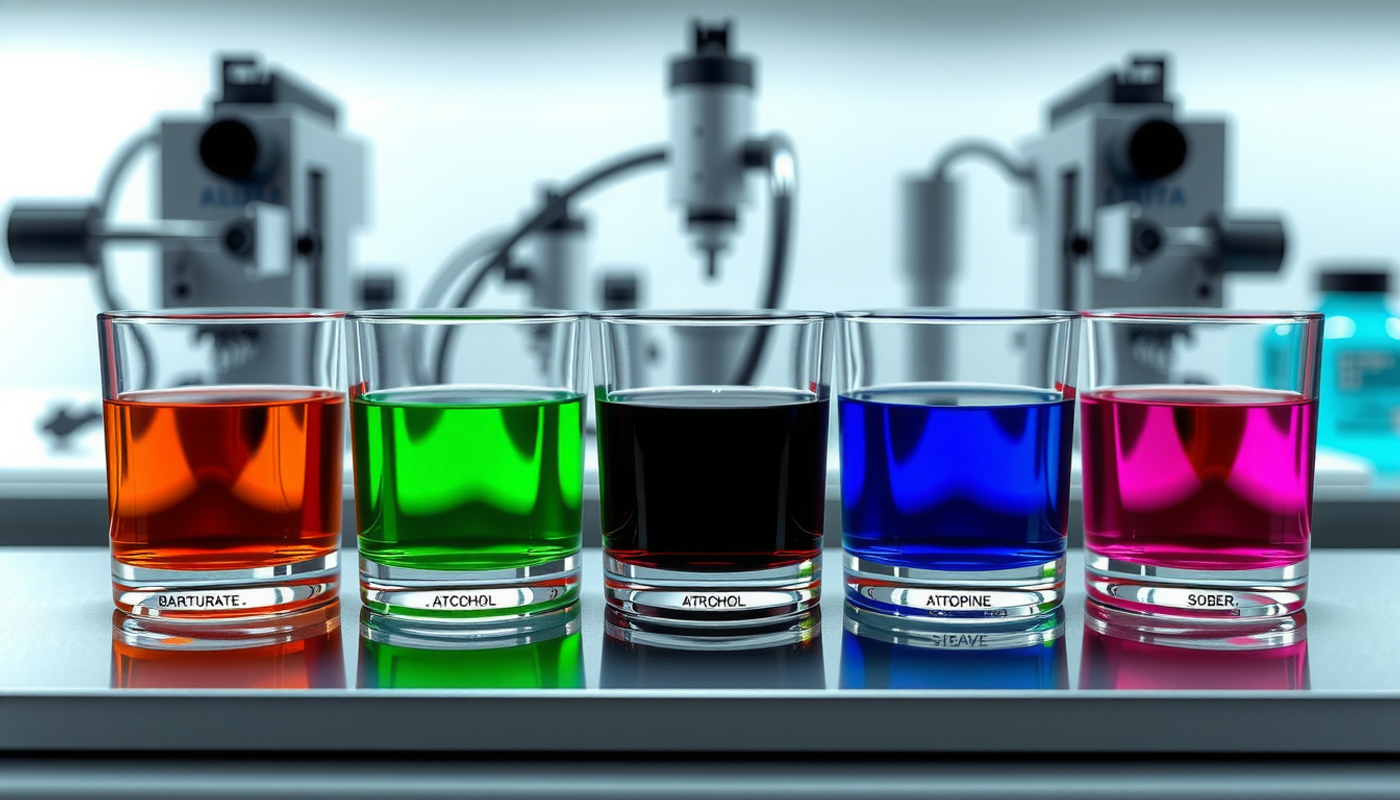
Two years later, Overton expanded the work dramatically. In a 1966 paper, he tested pentobarbital, phenobarbital, alcohol, urethane, meprobamate, and atropine — covering both depressant drugs and anticholinergic drugs [5]. The depressants were interchangeable. A response learned under pentobarbital could be recalled under alcohol, and vice versa, because both drugs shifted the brain into a similar neurochemical state. But atropine — which works on a completely different neurotransmitter system — produced its own separate dissociation. Learning under atropine did not transfer to the pentobarbital state or to the sober state.
This was a crucial insight. State dependent memory was not caused by a single drug effect. It was caused by the overall neurochemical state of the brain. Different drug classes created different internal states, and memories encoded in one state could only be retrieved in a state with a similar neurochemical profile. By the end of the 1960s, Overton had tested over one hundred psychoactive compounds and mapped their discriminability — how distinctly each drug created a unique internal state [6]. His T-maze paradigm became the standard method for studying drug discrimination, a field that continues today.
Forty-Eight Medical Students and Ten Ounces of Vodka
Animal experiments established the principle. But could state dependent memory be demonstrated in humans? In 1969, Donald Goodwin and his colleagues at Washington University in St. Louis designed one of the most audacious memory experiments ever conducted.
They recruited forty-eight male medical students — young, healthy men who could be expected to tolerate moderate alcohol consumption. On the first day, half the students drank enough vodka to reach moderate intoxication. The other half stayed sober. All participants then performed four memory tasks: a rote-learning task where they memorized sequences of nonsense syllables, a word-association task where they generated responses to prompt words, an avoidance task involving mild electric shock, and a picture recognition task [7].
Twenty-four hours later, the students returned. Half of each group switched states. This created four conditions: sober both days, intoxicated both days, sober then intoxicated, and intoxicated then sober. The researchers compared memory performance across all four conditions.
For recall tasks — the word-association test and the rote-learning task — performance was best when the state matched. Students who learned while intoxicated and were tested while intoxicated again made fewer errors than students who learned while intoxicated but were tested sober. The state-dependent advantage was strong enough to partially overcome the pharmacological disadvantage of being drunk. Sober-sober was still the best condition overall, but intoxicated-intoxicated outperformed intoxicated-sober. For the recognition task — where students simply had to identify whether they had seen a picture before — the state-dependent effect was absent or minimal [7].
This asymmetry between recall and recognition would prove to be one of the defining features of state dependent memory. Recall requires you to generate the memory from scratch, using whatever internal and external cues are available. Recognition provides the target itself and asks only whether it looks familiar. When external cues are strong — as in recognition — internal state cues become less important. When external cues are absent — as in free recall — internal state becomes one of the few available retrieval pathways.
Goodwin's experiment could probably not be replicated today. Ethics committees would not approve giving research subjects ten ounces of vodka. But the study remains a landmark. It demonstrated state dependent memory in humans, established the recall-recognition asymmetry, and connected directly to the clinical phenomenon that Goodwin would spend the rest of his career studying: alcoholic blackouts.
The Man Who Reframed Everything
By the late 1970s, state dependent memory research was in trouble. Studies were producing contradictory results. Some experiments showed robust state-dependent effects. Others found nothing. The field seemed unreliable.
Then a young Canadian psychologist named Eric Eich did something no one else had bothered to do. He read all of them.
In 1980, Eich published a review of fifty-seven experiments on human drug state-dependent retrieval in Memory & Cognition [8]. His conclusion reframed the entire field. The contradictions were not random, he argued. They followed a pattern. State dependent memory reliably appeared in one specific condition: free recall, where the participant had to generate memories without any external help. It reliably failed to appear in two other conditions: cued recall, where category names or other hints were provided, and recognition, where the target items were presented directly.
The explanation was elegant. State dependent memory is a retrieval phenomenon, not an encoding phenomenon. The drug does not damage the memory or weaken its encoding. It creates a unique internal context that becomes part of the memory trace. At retrieval, if no external cues are available, the internal state becomes the primary retrieval pathway. Change the state, and the pathway disappears. But if strong external cues are provided — a category name, a recognition probe — those cues are powerful enough to reach the memory directly, bypassing the internal state pathway entirely. The external cues outshine the internal ones.
Eich's reframing had a profound implication. The important variable was not the drug itself. It was the change in state. Any sufficiently large change in the internal neurochemical environment between encoding and retrieval should produce state-dependent effects. This opened the door to studying state dependency without drugs at all — using mood, arousal, exercise, or any other manipulation that shifts the body's internal state.
Five years earlier, Eich himself had demonstrated this with marijuana. Together with Weingartner, Stillman, and Gillin at the National Institute of Mental Health, he showed that free recall of word lists was significantly worse when participants switched between marijuana and placebo conditions, but cued recall — when category names were provided — showed no state-dependent effect at all [9]. The finding predicted exactly what his 1980 review would later confirm across fifty-seven studies.
When Sadness Remembers Only Sadness
In 1981, Gordon Bower at Stanford University published a paper in American Psychologist that would be cited over six thousand times. Its title was simple: "Mood and Memory" [2].
Bower used hypnotic suggestion to induce happy or sad moods in volunteers. Then he had them learn word lists, recall personal diary entries, and read stories about two characters — one happy, one sad. The results were striking on multiple levels. Subjects showed mood-state-dependent memory: they recalled more words when their mood at retrieval matched their mood at encoding. They showed mood-congruent recall: when sad, they remembered more sad childhood memories; when happy, more happy ones. And they showed mood-congruent processing: sad readers paid more attention to the sad character in a story, remembered more about that character, and identified more strongly with that character [2].
Bower proposed an associative network theory to explain these findings. In his model, each emotion functions as a node in a semantic network. When an emotion is active, it spreads activation to all memories, concepts, and associations connected to it. Happy mood activates happy memories. Sad mood activates sad memories. The emotion does not just color your perception. It literally changes which memories are accessible.
The clinical implications were immediate. Depression is not just a mood disorder. It is a memory disorder. When a person is depressed, the depressive state selectively retrieves negative memories — failures, losses, rejections — while positive memories become harder to access. This creates a vicious cycle. The negative memories reinforce the depressed mood, which retrieves more negative memories, which deepens the depression. As Reus, Weingartner, and Post had shown two years earlier, people cycling between mania and normal states showed state-dependent retrieval of their own verbal associations — memories generated in one mood state were more accessible in the same mood [10].
Eich continued refining this picture throughout the 1980s and 1990s. In 1989, together with Janet Metcalfe at Columbia University, he showed that mood-dependent memory was stronger for internally generated events — things the person created through imagination or reasoning — than for externally presented events like reading words on a screen [11]. In 1995, he published a framework identifying four conditions necessary for reliable mood-dependent memory: genuine and strong mood changes, free recall rather than recognition tests, internally generated rather than externally presented material, and stable moods maintained throughout the session [12].
What does this mean practically? It means the emotional state in which you learn something becomes woven into the fabric of that memory. Study for an exam while anxious, and the material is tagged with anxiety. If you feel calm on exam day, the retrieval pathway through anxiety is unavailable. The material feels unfamiliar, distant, as if you never learned it. But if anxiety returns — during the exam itself, perhaps — the material suddenly becomes accessible again. This is not a metaphor. It is a measurable neurochemical phenomenon.

The Molecule That Turns States Into Memories
For decades, state dependent memory was a behavioral observation without a molecular explanation. Researchers knew it worked. They could demonstrate it with a dozen different drugs. But they could not explain how the brain creates separate memory compartments for different internal states.
That changed in 2015, when Jelena Radulovic's laboratory at Northwestern University published a paper in Nature Neuroscience that cracked the mechanism open [13].
Radulovic's team worked with mice and a drug called gaboxadol — a compound that activates a specific type of GABA receptor called extrasynaptic GABA-A receptors. GABA — gamma-aminobutyric acid — is the brain's primary inhibitory neurotransmitter. It is the chemical brake system that keeps neurons from firing too much. There are two kinds of GABA receptors: synaptic ones, which sit right at the junction between neurons and mediate fast, precise inhibition, and extrasynaptic ones, which sit outside the synapse and produce a slower, more diffuse form of inhibition called tonic inhibition [14].
When Radulovic's team gave mice gaboxadol before fear conditioning — a standard memory task where a mouse learns to associate a chamber with a mild foot shock — something remarkable happened. The mice learned the association. They froze when placed back in the chamber while under gaboxadol, showing they remembered the shock. But when tested without gaboxadol, in their normal state, they showed no fear. The memory was completely inaccessible. Give them gaboxadol again, and the fear returned instantly [13].
The team then dug into the molecular mechanism. They found that gaboxadol dramatically shifted the balance between excitation and inhibition in hippocampal circuits — what neuroscientists call the E/I balance. Under gaboxadol, tonic inhibition increased, which changed which neurons were active, which circuits were engaged, and ultimately which pattern of neural activity represented the memory. The memory trace was encoded in a neural pattern that only existed in the altered E/I state. Returning to normal shifted the E/I balance back, and the pattern — along with the memory — became inaccessible.
Even more striking, they discovered that a tiny molecule called microRNA-33 — miR-33 — regulated this process. miR-33 normally suppresses the expression of extrasynaptic GABA-A receptors. When miR-33 was knocked down, extrasynaptic GABA-A receptor expression increased, and state-dependent fear conditioning became more pronounced. When miR-33 was overexpressed, the state-dependent effect diminished. A single microRNA was acting as a molecular switch for state dependent memory [13].
This finding was revolutionary for two reasons. First, it provided a concrete molecular mechanism for how internal states create separate memory compartments. Second, it suggested that state dependent memory is not an accident or a quirk. It is a regulated process — the brain has molecular machinery specifically designed to make certain memories accessible only in certain states. The question is no longer whether state dependent memory exists. The question is why the brain evolved a system to compartmentalize memories by internal state.
The Geography of State Inside the Brain
The hippocampus is not the only brain region involved in state dependent memory. A comprehensive review by Zarrindast and Khakpai in 2020 mapped the neural geography of state-dependent learning across multiple brain structures [15].
The CA1 region of the hippocampus — a strip of densely packed neurons in the hippocampus, the seahorse-shaped memory structure deep in the temporal lobe — is the most extensively studied. The CA1 is where opioid receptors, muscarinic cholinergic receptors, and alpha-2 adrenergic receptors all contribute to state dependent memory for drugs like morphine and muscimol. Block any of these receptor types, and state-dependent retrieval fails [15].
The central nucleus of the amygdala — the almond-shaped cluster of neurons that processes fear and emotional significance — mediates state dependent memory for morphine through cholinergic and serotonergic mechanisms. This makes sense. The amygdala tags memories with emotional weight. If the emotional state changes, the amygdala's tagging system changes, and the retrieval cue is lost.
The medial septum — a structure that sends cholinergic projections to the hippocampus and regulates hippocampal rhythms — shows cross-state-dependent memory between cannabinoids, acetylcholine, and ethanol. The ventral tegmental area — the midbrain hub of the dopamine reward system — mediates state dependent memory for morphine through cholinergic and glutamatergic receptors. And the nucleus accumbens — the brain's reward center — involves nitric oxide, cholinergic, and dopaminergic mechanisms [15].
A 2025 review by Liu and colleagues integrated these findings into a circuit-level model, proposing that state dependent memory emerges from coordinated changes across multiple interconnected brain regions, not from any single structure [16]. Internal states — whether drug-induced, emotional, or physiological — modulate neurotransmitter signaling across these circuits simultaneously, creating a unique configuration of neural activity. The memory is encoded in that configuration. Change the configuration, and the memory becomes unreachable.
This circuit-level view connects beautifully to the encoding specificity principle — the broader theory proposed by Endel Tulving in 1973 which states that retrieval depends on the match between encoding context and retrieval cues [17]. State dependent memory is encoding specificity operating at the level of internal neurochemistry. The "context" is not a room or a sound. It is the molecular state of the brain itself.
The Dark Applications — Blackouts, Trauma, and Addiction
State dependent memory is not just an academic concept. It operates in some of the most devastating clinical conditions.
Donald Goodwin — the same researcher who ran the vodka experiment in 1969 — spent the rest of his career studying alcoholic blackouts. In a separate 1969 paper, he and his colleagues reviewed one hundred alcoholics and found that blackouts were not simply the result of brain damage from alcohol [18]. Many alcoholics experienced fragmentary blackouts — islands of memory surrounded by gaps — that were consistent with state-dependent retrieval failure rather than encoding failure. The memories existed. They had been encoded while intoxicated. But they could not be accessed from the sober state. Some could be recovered when the person was intoxicated again. Modern research on alcohol-induced blackouts continues to support the role of state-dependent mechanisms, particularly through alcohol's effects on GABA-A receptors and NMDA receptors in the hippocampus, which disrupt both encoding and state-dependent retrieval [19].
Post-traumatic stress disorder presents perhaps the most disturbing application. Radulovic, Lee, and Ortony argued in a 2018 review that dissociative amnesia — the inability to recall traumatic events — may be a form of state dependent memory [3]. During extreme trauma, the brain shifts into a distinct neurochemical state characterized by massive surges of cortisol, norepinephrine, and other stress hormones. This shift dramatically alters the E/I balance in the hippocampus and amygdala. Memories encoded in this extreme state become accessible only when a similar state is reinstated — which is exactly what happens during a flashback. A trigger — a sound, a smell, a sensation — pushes the body back toward the traumatic state, and the memory erupts involuntarily. But in calm, everyday consciousness, the same memory is completely inaccessible. The patient is not repressing the memory. The memory is state-locked.
This framework has important implications for therapy. It suggests that traumatic memories are not lost and do not need to be "recovered" through hypnosis or other controversial techniques. They are intact but state-dependent. Effective therapy would work by creating controlled, safe contexts where the emotional state can be partially reinstated — allowing the memory to surface — while simultaneously building new associations that link the memory to a state of safety rather than terror. This is essentially what prolonged exposure therapy and EMDR accomplish, though neither was originally designed with state dependent memory theory in mind.
Addiction follows a similar logic. Drug-related memories — the pleasure of the high, the ritual of preparation, the relief from withdrawal — are encoded in a specific neurochemical state. When a recovering addict encounters internal cues that approximate that state — stress, withdrawal symptoms, even certain moods — those memories become accessible again, triggering craving and relapse [20]. This is why environmental change alone is often insufficient for recovery. The external environment is only part of the encoding context. The internal state — which can be triggered by stress, hormones, or even time of day — is the other part. Effective addiction treatment must address both.
The Caffeine Paradox and the Student Who Studies Wrong
State dependent memory has a practical implication that almost no student knows about.
In 2003, William Kelemen and Chad Creeley at the University of Missouri conducted an experiment with eighty-three college students [21]. Half received caffeine — four milligrams per kilogram of body weight, roughly equivalent to two strong cups of coffee — and half received a placebo. They studied word lists. Twenty-four hours later, they were tested again, but half of each group switched beverages. Students who had caffeinated coffee during both study and test recalled more than students who had caffeine only during study. The state-dependent effect was present for recall. The researchers also measured metamemory — students' confidence in their own memory — and found that metacognitive judgments were not state-dependent. Students did not realize their recall had been affected by the caffeine mismatch.

This finding has a quietly important implication. If you always study while drinking coffee, your brain encodes the material with caffeine as part of the internal context. If you then take the exam without coffee — perhaps because you slept poorly and skipped your morning cup — you have created a state mismatch. The material may feel less accessible. Not because you did not study enough, but because the retrieval context does not match the encoding context. The reverse is also true. Studying without caffeine and then drinking coffee before the exam creates the same mismatch.
Nicotine shows similar effects. Peters and McGee demonstrated in 1982 that cigarette smokers showed state-dependent memory: learning was better recalled when the smoking state matched across study and test [22]. Warburton and colleagues confirmed this in 1986 with controlled nicotine administration [23].
Even exercise creates state-dependent effects. In 1998, Colin Miles and Elizabeth Hardman at Cardiff University had participants learn word lists while either cycling on a stationary bicycle or sitting still [24]. Words learned during exercise were recalled better during exercise. Words learned at rest were recalled better at rest. The greater the heart rate difference between the two conditions, the larger the state-dependent effect.
The practical lesson is not that you should always study in the same state. That would be too restrictive. The lesson is subtler. Be aware that your internal state during studying — caffeinated or not, anxious or calm, exercising or still — becomes part of the memory trace. If your state on test day will be different from your state during study, you can compensate by using strong external cues: self-testing, elaborative encoding, spaced repetition. These strategies create retrieval pathways that are robust enough to work regardless of internal state — exactly as Eich's 1980 review predicted [8].

The Limits — When States Do Not Matter
Not every change in internal state produces state-dependent memory. The phenomenon has real boundaries, and understanding them prevents overstatement.
First, the effect size is modest in most human studies. Goodwin's vodka experiment showed meaningful differences, but the sober-sober condition was still the best. State matching helps, but it does not overcome the cognitive impairment caused by the substance itself. Studying while drunk and taking the test while drunk will produce slightly better recall than studying while drunk and taking the test sober — but studying sober and testing sober is still far superior [7].
Second, state-dependent effects diminish or disappear when strong external retrieval cues are available. This is the outshining principle identified by Smith and Vela's 2001 meta-analysis of environmental context-dependent memory [25]. Recognition tests, cued recall tests, and any condition where non-contextual information is abundant at retrieval will reduce or eliminate both environmental and state-dependent effects. The practical implication is encouraging: if you encode material deeply — using elaboration, self-explanation, testing — you create internal retrieval cues strong enough to outshine any state mismatch.
Third, recent exercise research has produced mixed results. While Miles and Hardman (1998) found robust exercise state-dependency, a 2024 study by Loprinzi and colleagues that carefully controlled for state-dependency found that the memory benefits of exercise were not primarily state-dependent [26]. Exercise may improve memory through other mechanisms — increased blood flow, neurotrophin release, arousal — rather than through state-dependent retrieval.
Fourth, mood-dependent memory effects are notoriously fragile. Bower himself struggled to replicate some of his early findings, and subsequent researchers found that mood-dependent effects appear reliably only when moods are strong, genuinely felt, and maintained throughout the session — not when they are weak, artificially induced, or fluctuating [12]. The failure of many studies to find mood-dependent memory may reflect the difficulty of inducing genuine mood states in a laboratory, rather than the absence of the phenomenon in real life.
These limitations do not undermine state dependent memory as a concept. They define its operating conditions. State dependent memory is real, measurable, and clinically significant. But it is most powerful when internal state changes are large, when external retrieval cues are weak, and when encoding is shallow. Deep, elaborative encoding creates memories that are resilient to state changes — which is, perhaps, the most important practical takeaway of all.

The Body Remembers What the Mind Forgets
State dependent memory reveals something profound about the relationship between body and mind. Memories are not stored only in the brain. They are stored in the brain-in-a-body — a system whose neurochemistry fluctuates with every cup of coffee, every surge of adrenaline, every shift in mood, every pill swallowed.
This has implications that stretch beyond the laboratory. It suggests that the common advice to "sleep on it" before making an important decision works partly because the decision made in an emotional state may not feel right — or even be accessible — when the emotion passes. It suggests that the therapist's office, with its calm and safety, may not be the best place to access traumatic memories encoded in states of terror. It suggests that the recovering addict who feels confident in rehab may discover, upon returning to the stress and triggers of normal life, that confidence was partly state-dependent too.
The encoding specificity principle taught us that every memory has an address made of external context [17]. State dependent memory adds a second address — an internal one, written in the language of neurotransmitters, hormones, and neural oscillations. To access a memory, you may need both addresses. Change either one, and the memory can slip away. Restore both, and something you thought was lost forever can return with startling clarity.
From Girden's paralyzed dogs to Goodwin's drunk medical students to Radulovic's fearful mice, the story of state dependent memory is the story of a hidden variable that was always there, shaping what we remember and what we forget, invisible until someone thought to look inside.

Frequently Asked Questions
What is state dependent memory?
State dependent memory is the phenomenon where information learned in a particular internal state — such as under the influence of a drug, caffeine, or a specific mood — is recalled more easily when the person returns to that same state. It is a form of context-dependent memory where the context is internal rather than external.
How is state dependent memory different from context-dependent memory?
Context-dependent memory involves external environmental factors like the room, sounds, or smells present during learning. State dependent memory involves internal physiological or psychological factors like drug states, mood, arousal level, or caffeine intake. Both fall under the encoding specificity principle.
Can state dependent memory explain alcoholic blackouts?
Partially. Research by Goodwin and others suggests that some blackout memories are not destroyed but become inaccessible in the sober state. When the person becomes intoxicated again, fragments of the lost memories can sometimes resurface, consistent with state-dependent retrieval failure.
Does caffeine affect state dependent memory?
Yes. Studies show that recall is better when caffeine intake matches between study and test sessions. If you study while caffeinated and test without caffeine, a small retrieval disadvantage can occur because the internal state no longer matches the encoding context.
What brain regions are involved in state dependent memory?
Research has identified several key regions including the CA1 area of the hippocampus, the central amygdala, the medial septum, the ventral tegmental area, and the nucleus accumbens. These regions interact through multiple neurotransmitter systems including GABA, glutamate, dopamine, and acetylcholine.


