
INTRODUCTION
You just spent two hours explaining photosynthesis to your roommate. You feel like you finally get it. But tomorrow on the quiz, you blank on half the details. Sound familiar? Two of the most popular study strategies — the Feynman Technique and active recall — promise to fix this problem. But they work in very different ways. One asks you to explain things simply. The other asks you to test yourself repeatedly. A landmark review by Dunlosky et al. (2013) in Psychological Science in the Public Interest rated practice testing as a "high utility" strategy and self-explanation as "moderate utility." So does that mean active recall is always better? Not exactly. The real answer is more interesting than a simple ranking. And understanding how these two methods relate to each other can change the way you study forever.
What Exactly Is the Feynman Technique?
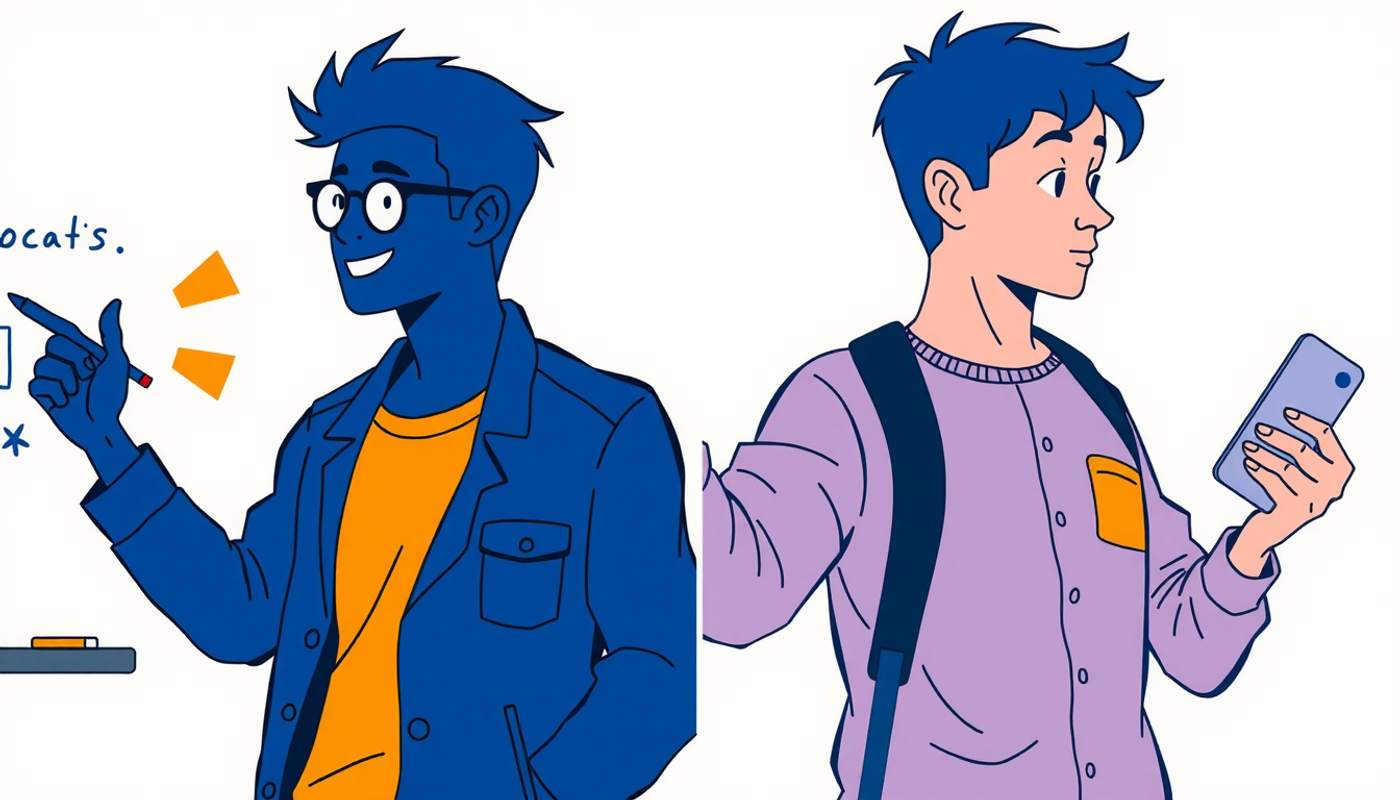
The Feynman Technique is named after Richard Feynman, a Nobel Prize-winning physicist famous for explaining difficult ideas in simple language. The method has four steps. Pick a topic. Try to explain it as if you're teaching a child. Identify the gaps where your explanation breaks down. Go back to the source material, fill those gaps, and simplify again.
What makes this work? Cognitive scientists call it the self-explanation effect. When you force yourself to put an idea into your own words, your brain has to organize the information, find connections between concepts, and build what researchers call a "coherent mental model." A meta-analysis by Bisra et al. (2018) reviewed 64 studies with nearly 6,000 participants and found that self-explanation produces a meaningful learning improvement with an effect size of g = 0.55. The benefit was strongest when students explained written material rather than solving problems.
Here's something even more surprising. Research by Nestojko et al. (2014) in Memory and Cognition found that simply expecting to teach material — without actually teaching anyone — was enough to improve how students organized and recalled information. The mere intention to explain changes how your brain processes what you read. That's the core power behind the Feynman Technique. It turns passive reading into active construction.
What Is Active Recall and Why Does It Work?
Active recall is different. Instead of explaining, you test yourself. You close the book, hide your notes, and try to pull the answer out of your memory. This can happen through flashcards, practice questions, blank-page dumps, or any method that forces retrieval without looking at the material.
The science behind this is called the testing effect. In a now-famous study, Roediger and Karpicke (2006) showed that students who took practice tests retained far more information after one week than students who simply re-read the material. On the immediate test, re-reading looked better. But on the delayed test, testing won by a wide margin. The students who re-read also felt more confident — even though they remembered less. This is what psychologists call the "illusion of competence." You feel like you know it because you just saw it. But you don't actually know it.
A later study published in Science by Karpicke and Blunt (2011) pushed this further. They compared retrieval practice against elaborative concept mapping — a method similar to self-explanation. Retrieval practice produced roughly 50% more learning on a one-week delayed test. This held true even when the final test required students to draw concept maps, not just answer factual questions.
And the evidence keeps growing. A large-scale meta-analysis by Yang et al. (2021) in Psychological Bulletin confirmed that testing boosts learning in real classroom settings with a medium effect size of g = 0.50. Brain imaging research by Marin-Garcia et al. (2021) even showed that retrieval practice creates distinct neural activation patterns and can double long-term memory strength compared to study-only conditions.
How Do These Two Methods Actually Compare?
This is where things get nuanced. Both techniques are backed by strong research. But they target different aspects of learning. The Feynman Technique builds understanding. Active recall builds retention.
The most thorough review of learning strategies ever published — Dunlosky et al. (2013) — evaluated ten popular study techniques. Practice testing and distributed practice earned the top rating of "high utility." Self-explanation earned "moderate utility." Common methods like highlighting, re-reading, and summarization were rated "low utility." This ranking suggests active recall has a broader and more consistent evidence base.
But there's a critical detail. Only one published study has ever directly compared retrieval practice and self-explanation head to head. Larsen et al. (2013) in Medical Education tested both strategies with medical students learning clinical neurology. Both methods outperformed a control condition. But at the six-month mark, retrieval practice produced better retention. This is the closest we have to a controlled horse race between the two. And active recall won on durability.
Does that mean the Feynman Technique is less useful? Not at all. Research by Rittle-Johnson and Loehr (2017) in the Psychonomic Bulletin and Review identified important boundary conditions. Self-explanation works best for conceptual material with underlying principles — like physics, biology, or mathematics. It's less effective for content that relies on rote memorization, like vocabulary lists or irregular verb conjugations. Active recall, on the other hand, works well across almost everything.
Why They're Not Competitors — They're Partners
Here's the real insight that most articles miss. These two strategies aren't doing the same thing. And research increasingly shows they work through separate, non-overlapping mechanisms.
Karpicke and Smith (2012) in the Journal of Memory and Language ran four experiments proving that elaboration (explaining, connecting) and retrieval practice operate through different memory pathways. Elaboration helps you get information into memory by building rich connections. Retrieval practice keeps it there by strengthening the pathways you use to pull it back out. Neither one replaces the other.
A 2023 framework published in Educational Psychology Review by Roelle et al. (2023) formalized this as the "construction-consolidation" model. Self-explanation supports construction — building a coherent mental representation of the material. Retrieval practice supports consolidation — locking that representation into long-term memory. You need both. Building a model without consolidating it means you'll forget. Consolidating something you never truly understood means you'll recall fragments without real comprehension.
Another 2023 review by McDaniel (2023) in the same journal found that the sequencing matters. Doing elaborative work like self-explanation before retrieval practice gives you a significant boost. But doing both simultaneously — trying to explain something while also testing yourself on it — can actually backfire because it overloads working memory. The takeaway is simple. Explain first. Test second.
The Optimal Study Workflow
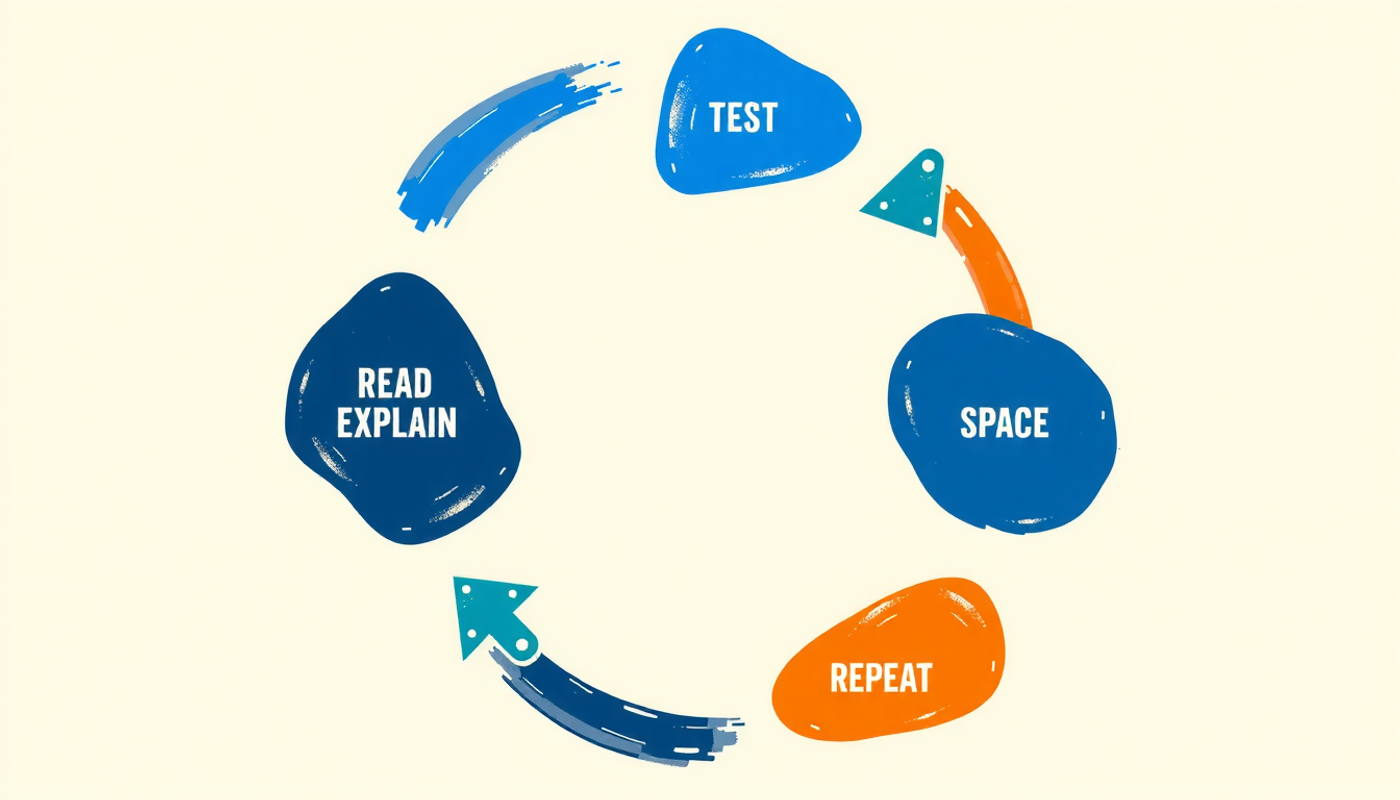
So what does this look like in practice? Based on the research, an effective workflow combines both strategies in the right order.
Start by reading or listening to the material. Then use the Feynman Technique — close the book and try to explain the concept in simple language, as if teaching someone who knows nothing about it. When your explanation breaks down, go back to the source and fill the gaps. This is your construction phase. Research by Fiorella and Mayer (2013) showed that the generative act of actually explaining — not just planning to explain — is what produces lasting learning benefits.
Once you feel solid, switch to retrieval practice. Use digital flashcards or practice questions to test yourself on the same material. This is your consolidation phase. Don't look at your notes. Force yourself to retrieve. Research by Roediger and Butler (2011) confirms that retrieval practice strengthens memories in ways that passive review simply cannot match.
Then space it out. The forgetting curve, famously documented by Ebbinghaus in 1885 and replicated by Murre and Dros (2015) in PLOS ONE, shows that memory decays exponentially without reinforcement. A landmark meta-analysis by Cepeda et al. (2006) covering over 800 assessments found that distributed practice consistently outperforms cramming. Using a spaced repetition system to schedule your reviews ensures you revisit material at the optimal time.
Recent research supports this combined approach even more directly. Endres et al. (2024) in Learning and Instruction tested what they call "constructive retrieval" — combining self-generated explanations with retrieval practice. Students who generated their own examples during retrieval achieved the best results for comprehension, motivation, and metacognitive accuracy. Creating your own flashcards rather than using premade ones also helps. Pan et al. (2023) found that user-generated flashcards produced better learning than premade ones across six experiments.
And one more thing. The desirable difficulties framework by Bjork and Bjork (2020) explains why both methods feel hard. Strategies that slow down initial learning — like struggling to explain or failing a practice test — actually build stronger long-term memory. If studying feels easy, you're probably not learning much. The difficulty is the point.
CONCLUSION
The Feynman Technique and active recall are not competing strategies. They are complementary tools that target different stages of the learning process. Self-explanation builds understanding by forcing you to organize information into coherent mental models. Retrieval practice builds retention by strengthening the neural pathways that store those models. The research is clear — using both in sequence, with spaced repetition to schedule reviews, is the most effective approach cognitive science has to offer. Platforms like Mindomax and other flashcard tools that combine active recall with spaced repetition algorithms can help students apply these evidence-based strategies without the overhead of managing the process manually. The science is settled. How you study matters more than how long you study.
Frequently Asked Questions
Is the Feynman Technique a form of active recall?
Partially. The Feynman Technique involves retrieving information from memory to explain it, which overlaps with active recall. However, its primary mechanism is self-explanation and knowledge construction rather than retrieval practice. Cognitive research shows these serve different functions — explanation builds mental models while retrieval strengthens memory storage.
Which method is better for exam preparation?
Active recall with spaced repetition is generally more effective for exam preparation because it directly strengthens memory retrieval under test-like conditions. The Feynman Technique is best used earlier in the study process to build deep understanding before switching to retrieval practice.
Can I use the Feynman Technique with flashcards?
Yes. A powerful approach is to use the Feynman Technique first to understand a concept deeply, then create flashcards to test yourself on that same material. Research shows that self-generated flashcards produce better learning outcomes than premade ones because the creation process itself strengthens memory encoding.
How much time should I spend on each method?
Start with a short Feynman Technique session to build understanding, then spend most of your study time on retrieval practice. A common ratio is about 20 to 30 percent explanation and 70 to 80 percent testing, adjusted based on how conceptual or factual the material is.
Does the Feynman Technique work for memorizing facts?
It is less effective for pure memorization tasks like vocabulary lists or historical dates. Research shows self-explanation works best for conceptual material with underlying principles, such as science or mathematics. For rote facts without clear logical structure, active recall with spaced repetition is the more efficient choice.


