
INTRODUCTION
Anki has been the go-to flashcard app for serious students since 2006. Its spaced repetition engine is powerful. Its community has created millions of shared decks. And for medical students in particular, it has become almost required — a 2023 study in SAGE Open Medical Education found that over 84% of medical students use Anki at some point during their training.
But Anki comes with real problems. The interface looks like it was built two decades ago. Creating cards is entirely manual. The iOS app costs $24.99. And configuring it properly can take hours of watching tutorials and reading Reddit threads. These are not small complaints. They are the reasons students keep searching for Anki alternatives with AI features that can reduce the gap between learning and doing.
This guide compares six Anki alternatives with AI that use artificial intelligence to automate flashcard creation, improve review scheduling, or both. Each tool is evaluated on its algorithm, AI features, pricing, platform support, and honest limitations.

Why the Science Behind Your Flashcard App Matters
Not all flashcard apps are built on the same scientific foundation. And the difference matters more than most students realize.
A landmark review by Dunlosky et al. (2013) in Psychological Science in the Public Interest evaluated ten common study techniques. Only two received the highest effectiveness rating: practice testing and distributed practice. Highlighting, rereading, and summarization all scored low. These findings have been replicated and expanded in the decade since.
Practice testing is exactly what happens when you flip a flashcard and try to recall the answer before looking. Roediger and Karpicke (2006) demonstrated in Psychological Science that students who tested themselves retained significantly more material after one week than those who simply reread their notes. Karpicke and Blunt (2011) later showed in Science that retrieval practice even outperformed concept mapping on questions requiring inference.
Distributed practice means spreading study sessions over time. Kornell (2009) studied this directly with flashcards and found that 90% of participants performed better with spaced review. Here is the twist: 72% of those same participants believed cramming was more effective. This metacognitive illusion is exactly why algorithm-driven scheduling matters. A good spaced repetition system removes guesswork and shows each card at the optimal moment for retention. Research by Kang (2016) confirms that spacing practice over time produces substantially better long-term learning compared to massed sessions.
When evaluating any Anki alternative, the first question should be: does the science behind it actually hold up? The best Anki alternatives do not just look prettier than Anki. They implement these same evidence-based principles in ways that are easier to use.
What to Look for in an AI-Powered Anki Alternative
Six factors separate a strong Anki alternative from a weak one. Not every tool that calls itself an Anki alternative actually matches Anki's scientific rigor.
The spaced repetition algorithm is the foundation. Anki now runs FSRS 6, a machine-learning model trained on roughly 700 million reviews from 20,000 users. It reduces unnecessary reviews by 20 to 30% compared to the older SM-2 algorithm. Any replacement needs scheduling that is at least comparable. AI card generation is the second factor. The biggest time drain in flashcard studying is creating the cards themselves. Tools that turn a PDF, a set of notes, or an audio file into study-ready flashcards can save hours every week.
Platform availability matters because a flashcard app locked to one device creates friction. Cross-platform sync between iOS, Android, and web is essential for most students. Pricing and value come next. Students have limited budgets, and some tools hide core features behind expensive paywalls. Ease of use is the fifth factor. If an app requires a tutorial before you can start studying, many students will quit before they benefit. The sixth factor is honest limitations. No tool does everything well, and knowing what each one cannot do is just as useful as knowing what it can.
With those criteria in mind, here are six Anki alternatives with AI worth considering in 2026. Each one takes a different approach to solving the problems that drive students away from Anki.

1. Quizlet — Best for Beginners Who Want AI Without Complexity
Quizlet is the largest flashcard platform in the world, with over 300 million registered learners and more than 700 million study sets. For students who find Anki overwhelming, Quizlet offers a polished experience that requires no setup and no configuration. As an Anki alternative, it trades customization depth for simplicity.
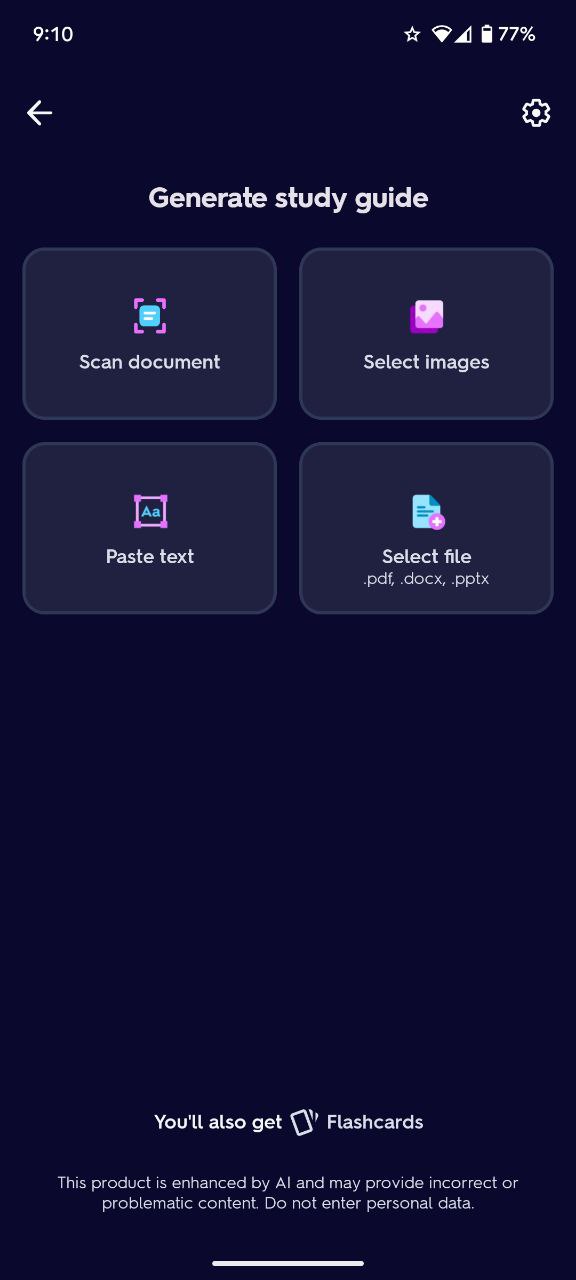
In recent years, Quizlet added Q-Chat, an AI tutor powered by large language models that can explain concepts, quiz students conversationally, and adapt to individual knowledge gaps. The platform also introduced Magic Notes, which lets students upload handwritten notes or PDFs and generates flashcards automatically. Multiple study modes including Learn, Test, Match, and Quizlet Live make it versatile for both individual and group use. The AI education market reached $5.88 billion in 2024 according to Grand View Research, and Quizlet has been among the fastest adopters of AI features in this space.
The spaced repetition system inside Quizlet is simpler than Anki's FSRS. It works for casual studying but does not offer the fine-grained scheduling that power users expect.
Pros:
- Largest content library with over 700 million study sets across virtually every subject
- Modern, intuitive interface with no learning curve
- Strong AI features including Q-Chat tutor and Magic Notes for PDF-to-flashcard conversion
- Polished mobile apps on both iOS and Android
Cons:
- Spaced repetition algorithm is less advanced than Anki's FSRS or SuperMemo's SM-18
- Free tier now limits Learn mode to five rounds per set and shows ads
- Community-generated content varies in quality and accuracy
Download: iOS (Free) · Android (Free) · Web App
Pricing: Free with limitations. Quizlet Plus costs $7.99 per month or $35.99 per year.
2. RemNote — Best for Students Who Need Notes and Flashcards in One Place
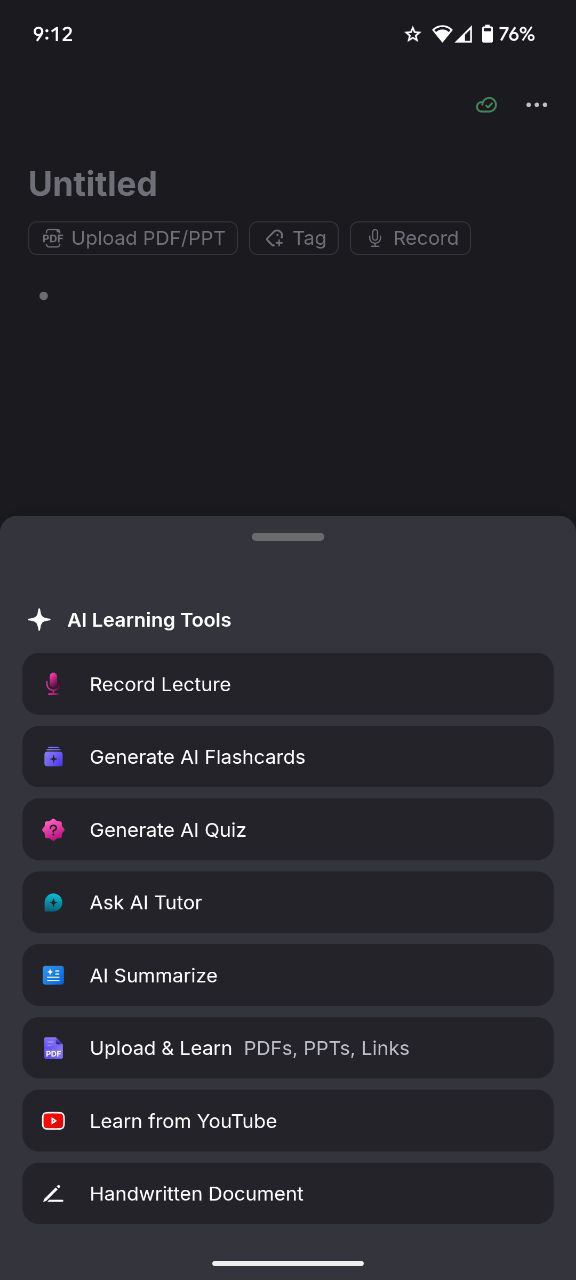
RemNote takes a fundamentally different approach from most flashcard apps. It is a note-taking tool first and a flashcard system second. The core idea is simple: students should not have to write notes and then create flashcards separately. In RemNote, you write your notes using a special syntax, and the app automatically turns key concepts into flashcards the moment you finish typing.
For students who already take detailed notes, this removes one of the biggest bottlenecks in flashcard-based studying. RemNote also supports PDF annotation, bidirectional linking between concepts, and a knowledge graph that shows how ideas connect across your notes. The platform is used at institutions including Oxford, Stanford, and MIT, with over one million students on the platform.
The AI features include automatic card generation from uploaded PDFs and text, an AI tutor, and AI-assisted grading. The free plan offers 100 AI credits per month. RemNote also supports Anki deck import, which makes migration easier for existing users looking at Anki alternatives with built-in AI capabilities.
Pros:
- Unique integration of note-taking and flashcards eliminates duplicate effort
- Bidirectional linking and knowledge graph for building connected understanding
- AI card generation from PDFs, slides, and text with AI grading
- Supports Anki deck import for straightforward migration
Cons:
- Steeper learning curve than simpler tools like Quizlet
- Mobile app has reported issues with indentation and scrolling on some devices
- Free tier limits PDF uploads to three documents and offers only 100 AI credits per month
Download: iOS (Free) · Android (Free) · Web App
Pricing: Free plan available. Pro costs $8 per month billed annually. Pro with full AI access is $18 per month.
3. Brainscape — Best for Structured Exam Preparation
Brainscape uses a system called Confidence-Based Repetition. After reviewing a card, you rate your confidence on a scale from 1 to 5. A rating of 1 means the card comes back within a few cards. A rating of 5 pushes it days or weeks into the future. This puts some control in the student's hands, though a 2024 review by Fleming (2024) in the Annual Review of Psychology notes that self-assessed confidence can sometimes diverge from actual knowledge.
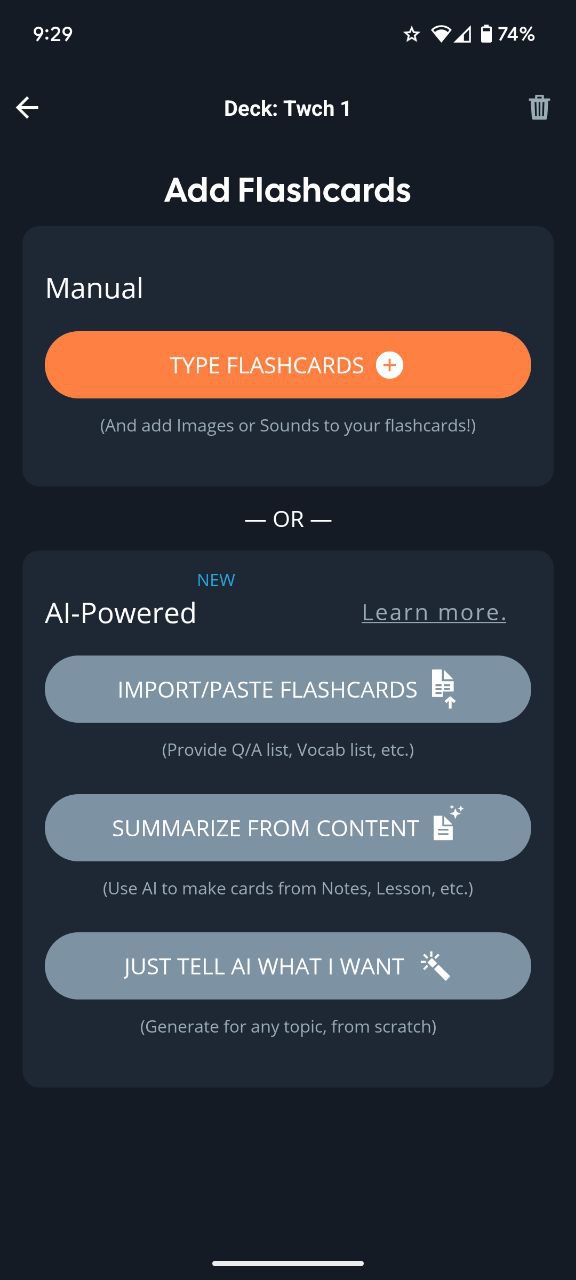
Brainscape's second strength is curated content. The platform offers expert-verified flashcard sets for standardized tests including the MCAT, GRE, LSAT, and bar exam. These are professionally created decks, not community uploads. The platform recently added AI card generation, allowing users to produce hundreds of flashcards from text input automatically. A library of billions of cards from what Brainscape calls the Knowledge Genome rounds out the content offering.
The free plan includes unlimited self-made flashcards and AI generation plus 2,500 cards from the pre-loaded library. The Pro plan unlocks everything.
Pros:
- Confidence-Based Repetition is intuitive and needs no technical configuration
- High-quality expert-certified content for major standardized exams
- Clean, modern interface with progress tracking and leaderboards
- AI flashcard generation from text input
Cons:
- Pro pricing is steep at $19.99 per month without an annual commitment
- Free tier limits pre-made content to 2,500 cards
- Less customizable than Anki — no native cloze deletion and limited card templates
Download: iOS (Free) · Android (Free) · Web App
Pricing: Free plan available. Pro costs $19.99 per month, $9.99 per month on a semester plan, or $7.99 per month billed annually. Lifetime access costs $199.99.
4. Mindomax — Best for AI-Powered Multi-Format Conversion
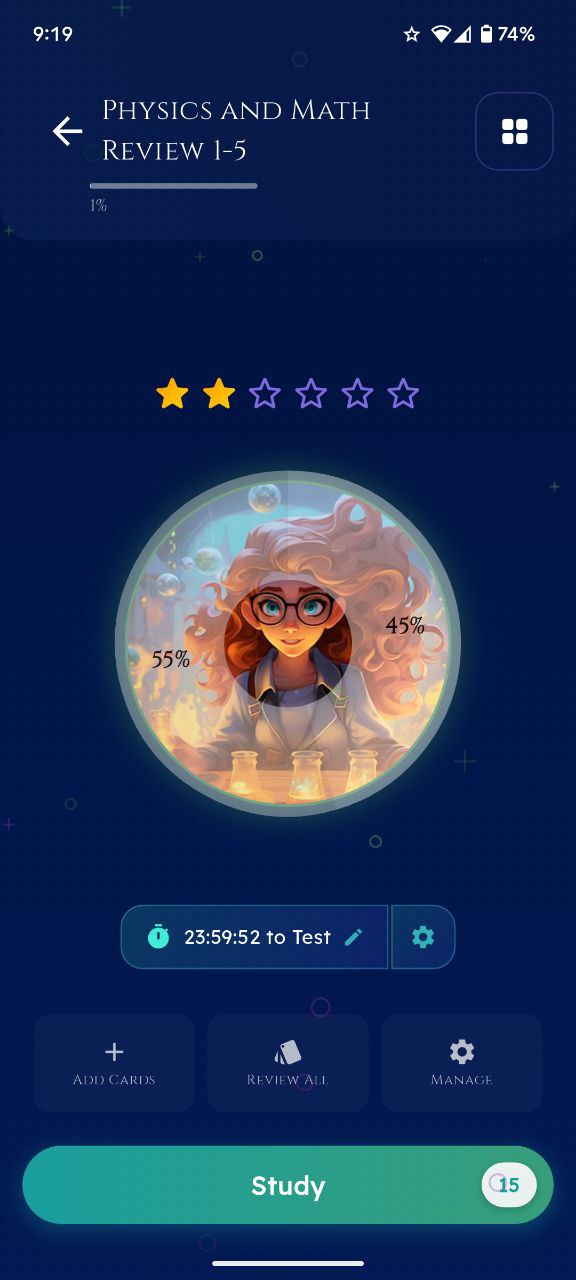
Mindomax is a newer entry in the flashcard space that focuses on AI-driven content creation from multiple input types. The platform can generate flashcards from uploaded PDFs, audio files, and images. For students who regularly work with lecture recordings, textbook scans, or slide decks, this multi-format approach addresses a real gap that many established tools have not filled.
The app includes a LaTeX formula editor with AI assistance, which is useful for STEM students dealing with complex equations. Pronunciation support covers 14 languages, and the platform provides a library of over 150,000 pre-made flashcards. An AI image generation feature lets students create custom visuals for their card fronts and backs, which is unusual in this category. The spaced repetition system handles review scheduling automatically.
The free plan includes one box with unlimited cards and three AI requests per day. The premium plan at $5 per month raises that to 90 daily AI requests. It is fair to point out that Mindomax is a younger platform with a smaller user community compared to tools like Anki or Quizlet. Independent reviews and third-party coverage are still limited, so students should evaluate the features firsthand.
Pros:
- AI flashcard generation from PDF, audio, and images covers multiple input formats
- LaTeX editor with AI assistance for STEM students
- Pronunciation features in 14 languages for language learners
- Premium at $5 per month is more affordable than most competitors
Cons:
- Smaller user community means fewer shared decks and limited peer support
- Newer platform with a shorter track record than established alternatives
- Full AI access requires premium — free plan allows only 3 requests per day
- Fewer third-party integrations and less customization flexibility than Anki
Download: iOS (Free) · Android (Free) · Web App
Pricing: Free forever plan with one box and unlimited cards. Premium costs $5 per month with 90 AI requests per day.
5. Knowt — Best Free AI Alternative for Budget-Conscious Students
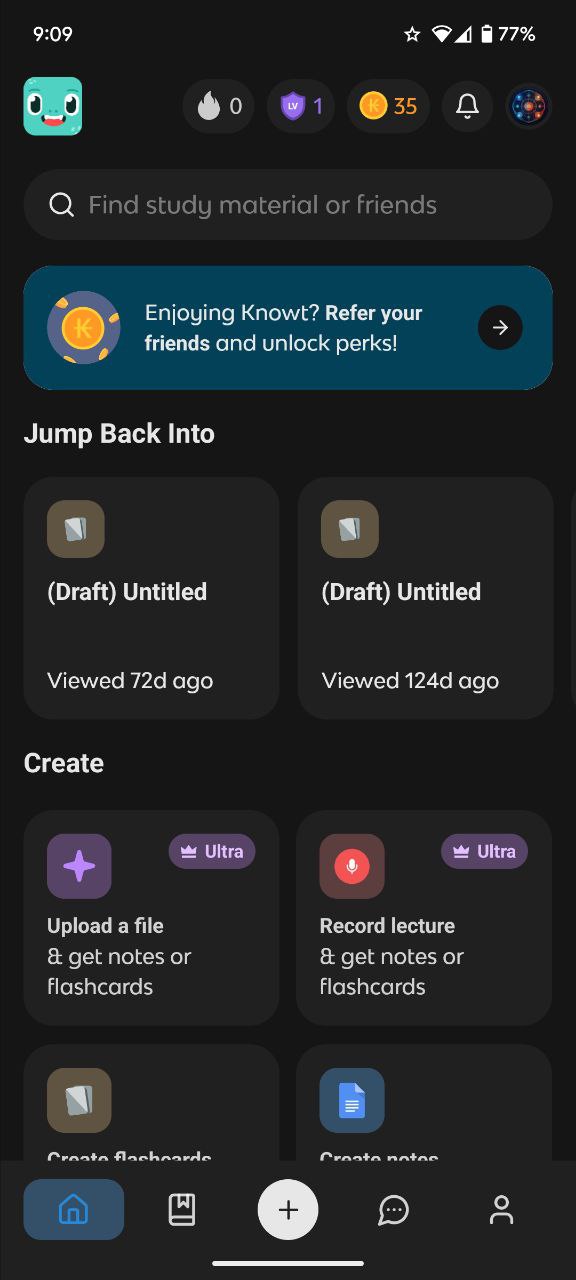
Knowt has grown quickly, reaching over five million students and teachers since launch. Much of that growth came from students looking for a free Anki alternative with AI after Quizlet moved key features behind a paywall. Knowt keeps most study modes free, including flashcards, learn mode, practice tests, and matching games.
The AI capabilities are among the strongest in this category. Knowt generates flashcards from notes, PDFs, YouTube videos, and webpages. During the May 2025 AP exam season, over 700,000 students used the platform for test preparation. A Chrome extension also enables one-click import from Quizlet, which makes switching painless for existing Quizlet users. Research on student AI adoption supports this trend — a 2024 global survey by the Digital Education Council found that 86% of students already use AI tools in their studies.
AI-generated flashcards need manual review since accuracy sits around 90%. The free plan includes ads, and some advanced features like the Kai AI chatbot require the Ultra subscription.
Pros:
- Most study modes remain free, unlike increasingly restricted alternatives
- Powerful AI generation from notes, PDFs, YouTube videos, and webpages
- Chrome extension for one-click Quizlet import
- Growing community with strong AP and standardized test resources
Cons:
- Intrusive ads on the free plan can disrupt the study experience
- AI-generated cards need manual review — accuracy is around 90%
- Pricing has changed multiple times, making long-term cost predictions difficult
- Less customization and fewer add-ons than Anki's open-source ecosystem
Download: iOS (Free) · Android (Free) · Web App
Pricing: Free with ads. Student Plus costs $5.99 per month or $23.99 per year. Student Ultra costs $12.99 per month or $95.99 per year.
6. SuperMemo — Best for Spaced Repetition Purists
SuperMemo is where spaced repetition began. Piotr Woźniak created the first spaced repetition algorithm in 1985, and the software has evolved through nearly 20 iterations since. Anki's original algorithm was actually based on SuperMemo's SM-2 design from 1987. The current version uses SM-18 and SM-19, which remain the most extensively researched spacing algorithms available.
The desktop version for Windows offers incremental reading, a feature that lets students process large texts — textbooks, research papers, dense articles — and gradually extract key passages into flashcards over time. For anyone working through heavy academic material, this is something no other tool on this list provides. The forgetting curve, first described by Ebbinghaus in 1885 and successfully replicated by Murre and Dros (2015) in PLOS ONE, forms the theoretical core of all SuperMemo algorithms.
The web and mobile apps added AI features including MemoChat for conversational language practice, an AI assistant for personalized tutoring, and MemoTranslator for voice translations. The platform also includes over 300 professionally designed language courses. The main drawback is the split ecosystem. The desktop app and the web platform feel like two separate products, and sync between them has been reported as unreliable. For students seeking a straightforward Anki alternative, this complexity can be a dealbreaker.
Pros:
- Most advanced and extensively researched spaced repetition algorithms available
- Incremental reading for processing dense academic texts on desktop
- AI-powered language practice with MemoChat and voice translation
- Over 300 built-in language courses
Cons:
- Desktop version is Windows-only with a dated interface and steep learning curve
- Web and mobile platforms feel separate from the desktop app
- Sync between desktop and web has reliability issues reported by users
- Web platform is primarily focused on language learning rather than general flashcards
Download: iOS (Free) · Android (Free) · Web App
Pricing: Free plan with basic access. Premium costs $9.90 per month with a free first month. Annual plan available at approximately $99.99 per year.

CONCLUSION
Anki earned its reputation through years of community effort, a proven algorithm, and the trust of millions of students around the world. But the flashcard space has changed. The six tools in this guide combine the same evidence-based principles — retrieval practice, spaced repetition, active recall — with AI features that remove much of the manual work.
For beginners, Quizlet remains the easiest starting point. Students who want notes and flashcards combined should look at RemNote. Brainscape works well for structured exam preparation with expert-certified content. Knowt stands out for anyone who needs strong AI features without a premium subscription. SuperMemo appeals to those who want the most researched algorithm in existence. And tools like Mindomax, along with other newer AI-powered platforms, are expanding what is possible by turning audio, images, and PDFs into study-ready material.
The best Anki alternative is the one you will actually use consistently. The science is clear on that point. Practice testing and spaced repetition work. The only question is whether the tool you choose makes it easy enough for you to show up and study every day. These six Anki alternatives offer different paths to the same goal.
Frequently Asked Questions
Is there an AI version of Anki?
Anki itself now uses FSRS, a machine-learning-based scheduling algorithm trained on hundreds of millions of reviews. For AI card generation, third-party add-ons and tools like AnkiHub are available. Several standalone alternatives including Quizlet, RemNote, and Knowt offer built-in AI flashcard creation without add-ons.
What do medical students use instead of Anki?
Most medical students still use Anki — over 84% according to published surveys. However, some are moving to tools like RemNote for its note-taking integration or Brainscape for its certified MCAT and USMLE content decks. Quizlet and Knowt are popular for lighter memorization tasks alongside Anki.
Can I import my Anki decks into another app?
Yes. RemNote and several other platforms support direct Anki deck import. Knowt offers Quizlet import through a Chrome extension but does not support direct Anki files. Brainscape accepts CSV imports, which Anki can export to. Always test a small deck first to verify formatting transfers correctly.
Is Quizlet better than Anki for studying?
It depends on your goals. Anki has a more powerful spaced repetition algorithm and far greater customization. Quizlet is easier to use, offers more study modes, and has stronger AI features built in. For long-term retention of large volumes of material, Anki's FSRS algorithm is generally considered more effective by learning researchers.
What is the best free Anki alternative with AI?
Knowt currently offers the most generous free plan among AI-powered flashcard apps, keeping most study modes available without payment. The free tiers of RemNote and Brainscape also include limited AI features. Each free plan has trade-offs in terms of daily limits, ads, or content restrictions.