
INTRODUCTION
You're three weeks into your first medical terminology course. The list of prefixes, roots, and suffixes keeps growing. You made flashcards for the first chapter, maybe the second. But now you're behind, and the exam covers everything. Sound familiar? According to research by Murre and Dros (2015) on the forgetting curve, people lose 50 to 70% of new information within 24 hours without reinforcement. For medical students facing 10,000 or more new terms per year, that's a serious problem. The good news is that a new generation of medical terminology study app tools has arrived — powered by AI, game mechanics, and spaced repetition. Here are six worth knowing about in 2026.

Why Medical Terminology Feels Impossible
Most vocabulary learning follows simple patterns. One word, one meaning, maybe a synonym. Medical terminology is different. A single term like "electroencephalography" contains three separate morphemes — electro (electrical), encephal (brain), and graphy (recording). Miss one piece and the whole meaning falls apart.
Research by Patel et al. (2018) in Anatomical Sciences Education found that students who learned terms through morphological analysis — breaking words into roots, prefixes, and suffixes — performed significantly better than those who relied on rote memorization. That's why the best medical terminology study app options now focus on word-part learning alongside traditional flashcard review.
Nursing, CNA, pharmacy tech, and medical coding students face similar challenges at different scales. Without a good medical terminology study app or study system, most students hit a wall around week four when terms start blurring together.
The Science That Should Guide Your Choice
Not every study method works equally well. Before picking a tool, it helps to understand what the research actually says.
Dunlosky et al. (2013) reviewed hundreds of learning studies in Psychological Science in the Public Interest and found two techniques standing clearly above the rest: retrieval practice and spaced repetition. Retrieval practice means testing yourself — pulling answers from memory rather than rereading. Spaced repetition means reviewing information at increasing intervals instead of cramming. A good medical terminology study app should build both into its core design.
Research by Roediger and Butler (2011) in Trends in Cognitive Sciences confirms that self-testing is one of the most effective techniques for long-term memory. This matters because medical terminology isn't something you memorize once — you need these roots and prefixes for the rest of your career.

What to Look For in a Medical Terminology Study App
Does the app cover pronunciation? Medical terms derived from Greek and Latin are notoriously hard to say correctly, and many clinical settings expect you to pronounce them properly. Can you study offline on the bus or between shifts? Is there a free tier that's actually usable, or does the app lock everything behind a paywall after day one?
For medical terminology specifically, look for apps that teach word parts — not just whole terms. An app that helps you learn the prefix "brady-" (slow) and the root "cardia" (heart) gives you the tools to decode "bradycardia" and hundreds of other terms on your own. That's more powerful than memorizing one definition at a time.
Each medical terminology study app below was evaluated on these criteria: learning method, AI features, spaced repetition, pronunciation support, platform availability, pricing, and user ratings.
1. Gizmo — Best AI-Powered All-in-One Study Tool
Gizmo is an AI flashcard platform built by three Cambridge University graduates. With over 3.7 million downloads on Android alone, it has become one of the most popular study tools among medical students worldwide. Gizmo isn't exclusively a medical terminology study app, but its AI capabilities make it exceptionally good at generating terminology flashcards from any source — lecture PDFs, YouTube videos, PowerPoint slides, even photos of handwritten notes. The built-in AI Tutor can explain any medical term in plain language, and an "Explain like I'm 5" mode helps decode complex morphemes.
Pros:
- AI generates flashcards instantly from PDFs, YouTube lectures, PowerPoints, and audio recordings
- Built-in voice recorder transcribes live lectures into flashcards automatically
- AI Tutor provides step-by-step explanations for any term
- Over 1,000,000 community-created decks including medical terminology sets
- Spaced repetition and active recall built into the core study loop
Cons:
- Premium pricing is steep at $155/year (student discount brings it to $77/year)
- Not purpose-built for medical terminology — you need to find or create medical content
- Free tier limits you to 15 daily lives and 10 AI quizzes per day
- No desktop macOS app — web and mobile only
Download: iOS (Free) · Android (Free) · Web App
Pricing: Free tier available. Premium: ~$155/year (~$77/year student)

2. Picmonic — Best for Visual Learners Who Need Mnemonics
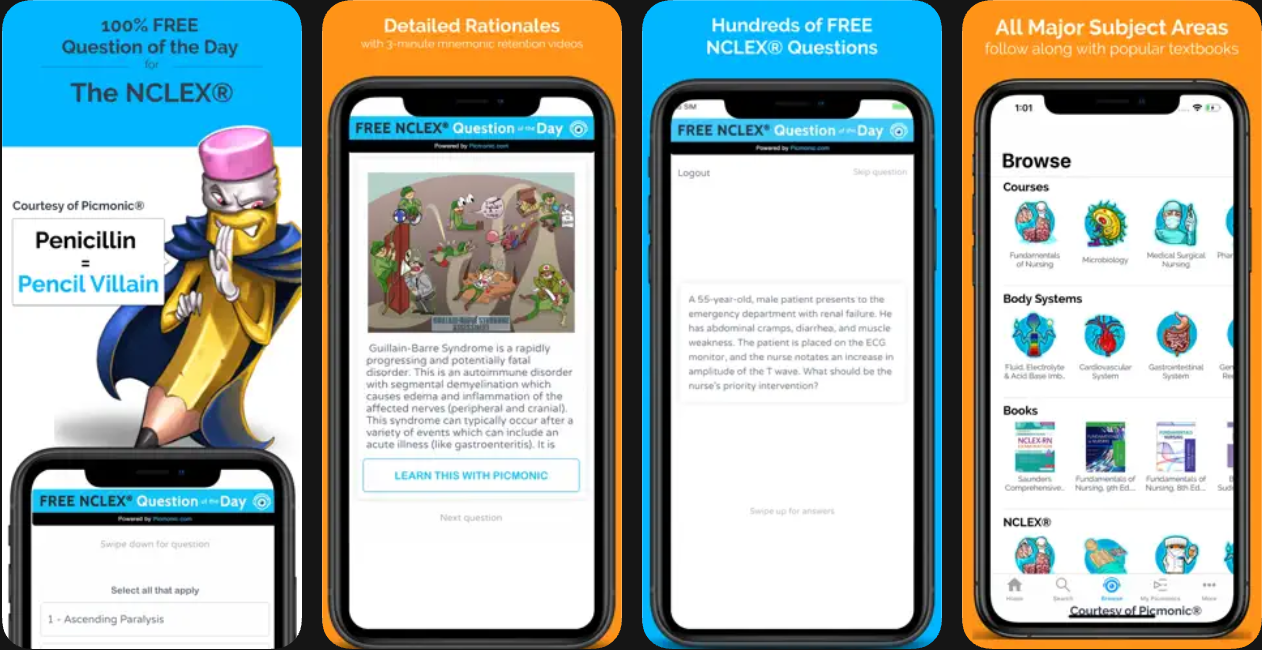
Picmonic takes a completely different approach from flashcard tools. Instead of text on cards, it delivers 3-minute animated mnemonic videos that link medical terms to memorable visual characters and stories. Their dedicated medical terminology module covers 310+ visual mnemonics and 900+ facts about prefixes, roots, and suffixes — enough to decode over 10,000 complex terms. An IRB-approved study published by Shabir et al. (2014) showed a 331% improvement in long-term retention compared to traditional study methods.
Pros:
- 310+ visual mnemonic videos specifically for medical terminology word parts
- Peer-reviewed evidence showing 331% retention improvement
- Built-in spaced repetition through the Daily Quiz feature
- AI mnemonic generator lets you create custom visual associations
- Also covers pharmacology, pathology, and board prep content
Cons:
- Expensive for the full Medicine plan at $179.88/year
- Visual mnemonic style does not work for every learner — some prefer plain text
- Mobile app interface can feel cluttered
- Video content requires internet — no true offline mode
Download: iOS (Free trial) · Android (Free trial) · Web: picmonic.com
Pricing: Free 5-day trial. Medical Terminology module may be free. Full Medicine plan: $179.88/year
3. RootWords — Best for Greek and Latin Morphemes Through Games
RootWords launched in April 2025 and takes a radically different approach. There are no flashcards at all. Students learn medical terminology through a tumbler-style word game backed by a National Science Foundation America's Seed Fund grant. You pick a root word, spin the tumbler to form real words, and show you understand the meaning of each one. The idea is that learning morphemes gives you tools to decode any medical term you encounter — even ones you've never seen before.
Pros:
- Backed by NSF research funding — scientifically validated morpheme approach
- Game-based learning avoids flashcard fatigue
- Audio pronunciations added in September 2025
- Teaches transferable word-building skills beyond medical terminology
Cons:
- Very new app with roughly 100 downloads on Google Play — still growing
- No traditional flashcard or quiz modes
- No spaced repetition algorithm — retention relies on game replay
- Subscription pricing not clearly listed on the app store page
Download: iOS (Free with subscription) · Android (Free with subscription) · Web Practice Mode
Pricing: Free to download with subscription. 7-day free trial available
4. Medical Findings — Highest-Rated Game-Based Option
Medical Findings holds the highest user rating of any dedicated medical terminology study app on the iOS App Store — 4.8 out of 5 from roughly 1,700 reviews. Built by Humanity Games Software, it combines scrambled-letter word games with study flashcards and a recently added Exam Mode with multiple-choice questions. It covers six topic areas: Word Parts, Medical Abbreviations, Anatomy, Pharmacology, Diseases, and Procedures. Offline high-yield notes for about 5,000 terms are available to premium users.
Pros:
- Highest iOS rating (4.8/5) among dedicated terminology apps with 1,700 reviews
- Three distinct modes: Play (word scramble), Study (flashcards), Exam (multiple choice)
- Covers pharmacology, diseases, and procedures — not just prefixes and suffixes
- Offline high-yield notes for approximately 5,000 terms (premium)
Cons:
- iOS only — no Android version yet (developer says "coming soon")
- No AI features and no automatic flashcard generation
- No spaced repetition algorithm
- Some users report limited question counts per topic
Download: iOS (Free) · Android (Coming soon) · No web app
Pricing: Free to download. Premium subscription unlocks all topics, ad-free, and offline notes
5. KardsAI — Best Budget AI Flashcard Maker
KardsAI is a German-built AI flashcard maker that launched in March 2024. Its standout feature is prompt-based generation — type three keywords like "medical prefixes suffixes" without uploading any document, and the AI creates a complete flashcard deck instantly. It already has pre-made medical terminology decks in its library alongside EMT and Medical Assistant exam prep content. At $29.99 per year for the Pro plan, it is the most affordable AI-powered medical terminology study app on this list by a wide margin.
Pros:
- Most affordable AI option at $29.99/year (roughly $2.50/month)
- Generates flashcards from PDFs, images, text prompts, and handwritten notes
- Five learning modes: flashcards, multiple choice, match games, true/false, Voice Tutor
- Speak Out text-to-speech helps with pronunciation of complex terms
- True offline learning support
Cons:
- Small user base (213 Google Play reviews) means fewer community decks than Gizmo
- Free tier restricts PDF imports to 3 pages and 2,000 words
- AI quality can be inconsistent on specialized medical content
- No macOS desktop app
Download: iOS (Free) · Android (Free) · Web: kardsai.app
Pricing: Free tier available. Pro Monthly: $5.99/month. Pro Yearly: $29.99/year
6. Mindomax — Best Cross-Platform Option With macOS Desktop
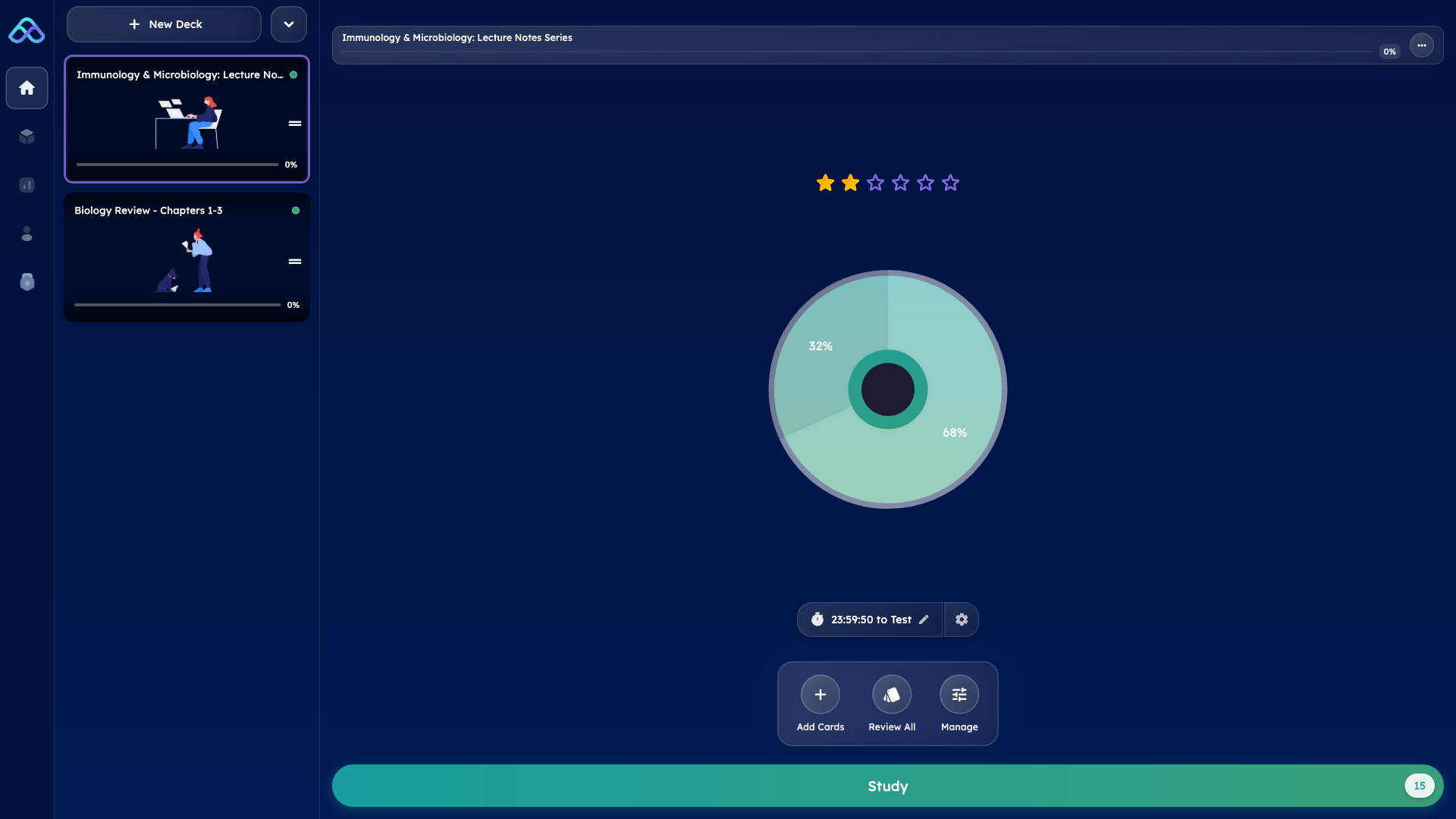
Mindomax is a Canadian-built AI flashcard platform that launched in November 2025. What sets it apart is genuine cross-platform coverage: iOS, Android, web, and — unusually for a flashcard app — a native macOS desktop application for Apple Silicon Macs. For medical terminology students, Mindomax ships with 10,000+ pre-built USMLE Step 1 flashcards and 20,000+ MCAT flashcards, alongside a broader library of 450,000+ ready-made cards. The AI assistant generates flashcards from PDFs, audio files, images, and text. An AI Tutor sits on every card for instant explanations.
Pros:
- True cross-platform: iOS, Android, web, and native macOS desktop app
- 10,000+ USMLE and 20,000+ MCAT pre-built flashcards ready to study
- AI generates flashcards from PDF, audio, images, and text
- AI Tutor on every card provides instant explanations
- Pronunciation support in 14 languages
- Affordable at $5/month for Premium
Cons:
- Very new platform (launched November 2025) with a small user community
- Fewer third-party integrations compared to established platforms
- Limited customization compared to open-source tools
- AI features require Premium for full access (Free tier: 3 AI requests/day)
Download: iOS · Android · macOS Desktop · Web
Pricing: Free Forever plan (1 box, unlimited cards). Premium: $5/month
How to Pick the Right Medical Terminology Study App
The right choice depends on how your brain works and what you can spend. If you remember stories and images, Picmonic's mnemonic videos have the strongest research backing. If you want raw AI power to turn any PDF or lecture into flashcards, Gizmo is the most capable tool right now. If budget matters and you still want AI generation, KardsAI at $29.99 per year is hard to beat. RootWords and Medical Findings offer engaging game-based approaches for students who get bored with traditional cards. And if you study on a Mac desktop alongside your phone, Mindomax is the only option that covers both natively.
Whatever you pick, look for retrieval practice and spaced repetition. Those two features — backed by decades of research — matter more than any other app feature. A flashy interface means nothing if the app doesn't push you to pull answers from memory at the right intervals.
CONCLUSION
Medical terminology doesn't have to feel like memorizing a phone book in ancient Greek. The medical terminology study app options available in 2026 are genuinely smarter than what existed even two years ago. AI can generate study material from a lecture recording in seconds. Visual mnemonics can make root words stick after a single 3-minute video. Game mechanics can turn a dreaded study session into something you actually want to do. The science — from the forgetting curve to spaced repetition to retrieval practice — supports all of these approaches. The only real question is which style fits the way your brain actually works.

Frequently Asked Questions
What is the fastest way to learn medical terminology?
Research shows that combining active recall with spaced repetition produces the strongest long-term retention. A medical terminology study app that tests you on word parts at increasing intervals works faster than rereading lists or highlighting textbooks. Game-based and visual mnemonic approaches can also speed up the process significantly.
Are AI flashcard apps accurate for medical terminology?
Most AI-generated flashcards are accurate for common prefixes, roots, and suffixes. However, no AI is perfect and occasional errors in definitions or pronunciation can slip through. Always review generated cards before studying, especially for specialized clinical terms that require precise definitions. Editing tools in most apps make corrections quick.
Do I need a paid app to study medical terminology?
No. Several apps offer genuinely useful free tiers for studying medical terminology without paying. Medical Findings, Gizmo, KardsAI, and Mindomax all let you start studying immediately at no cost. Paid plans typically unlock AI generation, offline access, larger content libraries, and more advanced spaced repetition scheduling options.
Can I use these apps for nursing and CNA exam prep?
Yes. Medical terminology is foundational across all healthcare fields, not just physician training programs. Apps like Picmonic and Medical Findings specifically include content for nursing, CNA, pharmacy tech, medical coding, and paramedic students. The prefixes, roots, and suffixes you learn transfer directly across every healthcare specialty and certification exam.
Which app is best for learning medical prefixes and suffixes?
RootWords is the only app built entirely around morpheme learning through interactive word games, making it ideal for prefix and suffix mastery. Picmonic offers 310+ visual mnemonics dedicated to prefixes, roots, and suffixes. Both focus on word-part understanding rather than full-term memorization, helping you decode unfamiliar terms independently.


