
INTRODUCTION
The PMP exam changed everything in 2021. Gone were the memorization-heavy ITTOs. In came situational judgment. And yet, flashcards remain one of the most effective study tools for the exam, when used correctly. A landmark review by Dunlosky et al. (2013) in Psychological Science in the Public Interest rated only two study techniques as "high utility": practice testing and distributed practice. Flashcards combine both. The challenge is finding a best flashcard app for PMP that fits the modern exam format. Most ranking pages still recommend tools aligned with PMBOK 6th Edition or earlier. Worse, the PMP exam changes again in July 2026 with PMBOK 8th Edition alignment and new testable topics including AI and sustainability. The apps below are built for how the exam works now, and where it's heading next.
1. Knowt: Free AI Flashcards With Quizlet Import
Knowt has grown past four million users by offering what Quizlet increasingly locks behind paywalls. Upload PDFs, lecture notes, or YouTube videos and the AI generates flashcards automatically. A Chrome extension imports existing Quizlet sets with one click. The spaced repetition algorithm is basic compared to FSRS or SM-2. It adapts review frequency but does not use true interval-based scheduling. That makes Knowt better for short-term exam prep than year-long retention. For a 60-day PMP sprint, this is often enough. The free tier is generous. Ultra starts at roughly $5 per month billed annually for unlimited AI generation and the Kai chatbot tutor.
2. Mindomax: AI Flashcards From PDFs, Audio, and Images
Mindomax addresses the main reason people abandon flashcard apps: making cards takes too long. Upload a PDF, record a lecture, or photograph handwritten notes. The AI generates flashcards in seconds. The app includes a LaTeX formula editor for EVM calculations, pronunciation in fourteen languages, and over 450,000 pre-made flashcards covering professional certifications. Its scheduling uses a proprietary algorithm called Windcatcher Theory. Free allows one box with unlimited cards and three AI requests daily. Premium at $5.99 per month unlocks ninety daily AI requests. As a late-2025 launch, Mindomax still has a smaller user community than established platforms and no Anki import feature.
3. MintDeck: Native FSRS Algorithm for iPhone
MintDeck launched in late 2025 as an iPhone-first flashcard app with native support for the FSRS algorithm. FSRS uses machine learning trained on millions of reviews to personalize scheduling, typically reducing total reviews by 20 to 30% compared to legacy SM-2 at the same retention level. MintDeck supports AI deck generation, Anki import, and offline study. The interface is clean and modern. The limitation is platform: iOS only. No Android, no web app. For candidates who study exclusively on iPhone, this is one of the most scientifically current options available. Free core features with credits for AI generation.
Download: iOS
4. Mochi: Minimalist Markdown Flashcards
Mochi is for candidates who prefer plain text over visual editors. Cards and notes are written in Markdown with full LaTeX support, useful for PMP formulas like EV, PV, AC, and variance calculations. Notes convert to flashcards with one click. Image occlusion is built in. In June 2025, Mochi added FSRS beta scheduling as an option. The app runs natively on macOS, Windows, Linux, iOS, and Android. Free tier works offline with unlimited local cards. Pro at $5 per month adds sync across devices. The main limitation is a tiny ecosystem. No shared deck library, no pre-made PMP content. Every card must be created manually or imported from Anki.
Download: iOS . Android , Desktop
5. RemNote: Where Notes Become Flashcards Automatically
RemNote eliminates the gap between note-taking and studying. A keyboard shortcut turns any bullet point into a flashcard linked to its original context. The app supports both SM-2 and the newer FSRS algorithm, PDF annotation with highlight-to-flashcard conversion, image occlusion, and a knowledge graph connecting concepts across documents. AI features on the highest tier generate cards from PDFs and include a lecture recorder. Pro costs $8 per month with a student rate at $6. The learning curve is steeper than single-purpose flashcard apps. RemNote is best for candidates who want to build an integrated knowledge system rather than just study from cards.
Why Flashcards Still Work for a Situational Exam
The PMP exam is roughly 50% situational judgment questions. Critics argue flashcards cannot prepare candidates for scenario-based problems. This misunderstands how memory supports reasoning.
A meta-analysis by Rowland (2014) found that testing with feedback produces effect sizes of g = 0.73 compared to restudying alone. The act of retrieval strengthens memory traces in ways passive review cannot. Roediger and Butler (2011) showed in Trends in Cognitive Sciences that this process is among the most effective methods for building durable knowledge.
Situational questions require applying frameworks, not just recalling facts. But applying a framework requires having it in memory first. Flashcards build the foundation. The candidate who cannot recall the difference between gold plating and scope creep will struggle to answer a question about what happens when a developer adds an unrequested feature.
The key is card design. Definition-only cards help less than cards that present a mini-scenario and ask for the right response. "What is gold plating?" is less useful than "A developer adds extra functionality without approval. What is this called and what should the PM do?"
The Science Behind Spaced Repetition
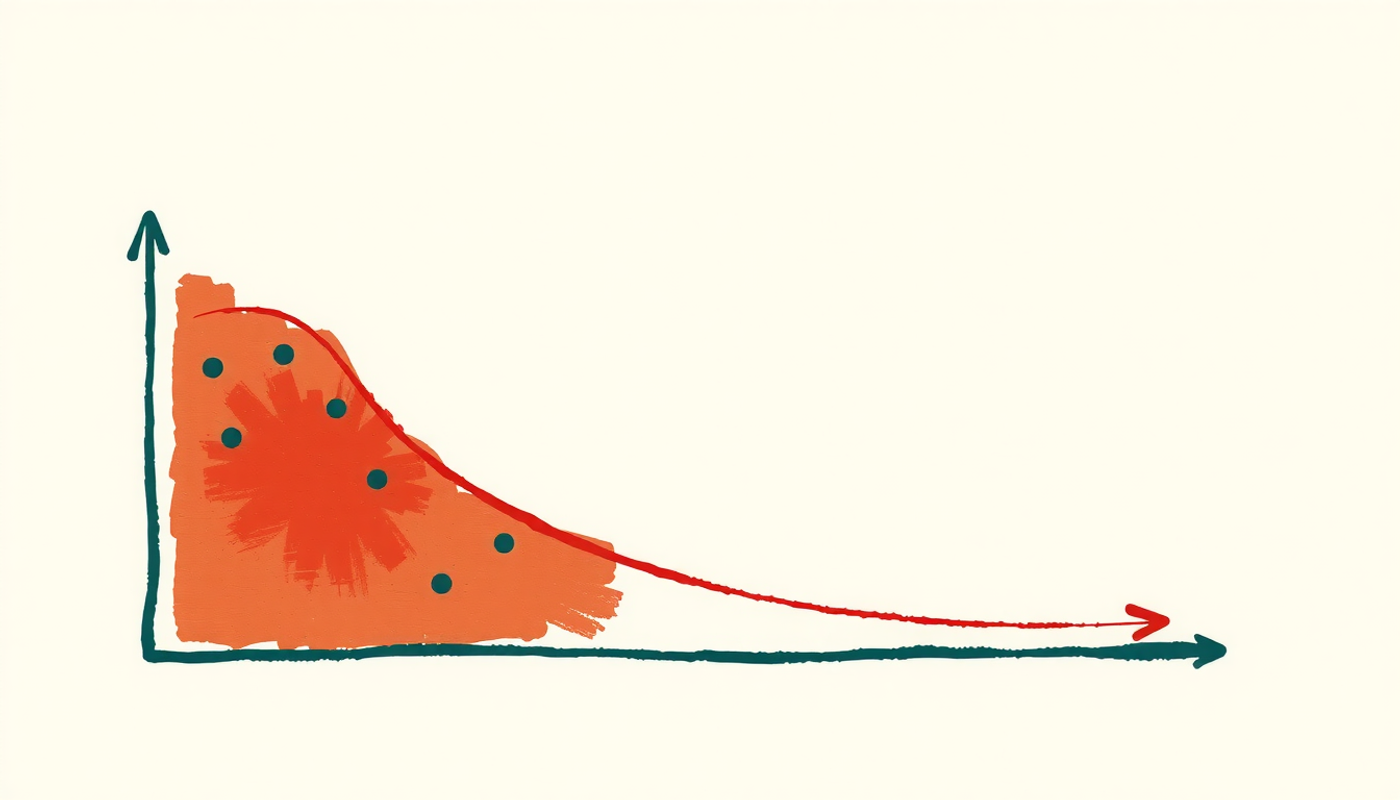
Hermann Ebbinghaus discovered the forgetting curve in 1885. A replication by Murre and Dros (2015) confirmed that most people forget 50–70% of new information within a day without review. But each successful retrieval at the right moment flattens the curve.
Cepeda et al. (2006) analyzed 317 experiments in Psychological Bulletin and found that the optimal review gap is roughly 10–20% of the desired retention interval. For a PMP exam 60 days away, this suggests first reviews at 6–12 days, then expanding intervals after that.
A 2021 meta-analysis by Latimier, Peyre, and Ramus in Educational Psychology Review reported effect sizes of g = 1.01 for spaced versus massed retrieval practice, among the largest in educational psychology research. And Kang (2016) confirmed in Policy Insights from the Behavioral and Brain Sciences that spacing produces substantially better long-term learning than cramming.
The practical implication: any spaced system beats no system. The differences between SM-2, FSRS, and proprietary algorithms are real but incremental compared to the massive gain from using spaced repetition at all.
What Changes With the July 2026 PMP Exam
PMI announced a significant exam update effective July 9, 2026. The changes affect how flashcard study should be structured.
The Business Environment domain triples from 8% to 26%. This means flashcard decks need significant new content on strategic alignment, governance, compliance, organizational change, and benefits realization. The addition of AI in project management and sustainability as testable topics is entirely new. No legacy flashcard set covers this material.
Candidates taking the exam before July 9, 2026 can use current materials. Those testing after should verify that any flashcard app or deck explicitly covers the updated ECO.

How Many Flashcards Are Actually Needed
Sources cite wildly different numbers. Master of Project offers 96 free cards. PM PrepCast had 1,500. Some apps claim over 2,000.
The right number depends on study strategy. Flashcards work best for foundational knowledge: terminology, formula recognition, process group characteristics, framework distinctions. They work less well for situational judgment, which requires practice exams.
A reasonable approach: 200–400 high-quality cards covering foundational concepts, combined with 1,000+ practice questions in a separate question bank. The flashcards build the knowledge base. The practice questions build application skill. Neither alone is sufficient.
Kornell (2009) found that one large mixed deck outperforms multiple small topic-sorted stacks. Interleaving different concepts during review strengthens discrimination and transfer. An app that shuffles cards across all three domains will produce better results than one that reviews People, then Process, then Business Environment in separate sessions.
PMP Certification Statistics
Understanding the market context helps candidates calibrate their preparation intensity.
PMI has not published official pass rates since December 2005, when the figure was 61%. Current estimates come from training providers, not PMI. The salary premium of 24% in the US and 33% globally makes the certification one of the highest-ROI professional credentials available.
CONCLUSION
The science is clear. Retrieval practice plus spaced repetition produces better long-term memory than any other study method with empirical support. What has changed in 2026 is the tooling. AI can turn a PDF chapter into flashcards in seconds. Open-source algorithms like FSRS personalize review schedules to individual memory patterns. And modern apps offer interfaces that would have seemed impossible when Anki launched two decades ago. The apps on this list, Knowt, Mindomax, MintDeck, Mochi, and RemNote, each take a different approach. Some prioritize AI generation. Others prioritize algorithm sophistication. The best choice depends on how each candidate studies. But the worst choice is not using spaced repetition at all.
Frequently Asked Questions
Are flashcards enough to pass the PMP exam?
Flashcards build foundational knowledge but cannot replace scenario-based practice. Most successful candidates combine 200–400 flashcards for terminology and concepts with 1,000+ practice questions from a dedicated question bank. The flashcards support recall; the practice questions build application skill.
How do I create flashcards for situational PMP questions?
Instead of definition-only cards, create mini-scenario cards. Present a situation and ask what the PM should do or what concept applies. "A stakeholder requests a change after scope baseline is set. What process should the PM follow?" This trains application, not just recall.
Should I make my own flashcards or use pre-made decks?
Research suggests the creation process itself aids learning. However, time constraints often make AI-generated or pre-made cards practical. A hybrid approach works well: start with a pre-made deck covering fundamentals, then add custom cards for concepts that are personally difficult.
How long should I study flashcards each day for PMP?
Fifteen to thirty minutes of daily review maintains strong retention across several hundred active cards. Consistency matters more than session length. Short daily sessions significantly outperform occasional long cramming sessions, per spacing effect research.
Will current flashcard apps work for the July 2026 exam?
Only if updated for the new ECO and PMBOK 8th Edition. The Business Environment domain triples to 26%, and new topics like AI in project management and sustainability appear. Verify that any app or deck explicitly covers the 2026 exam content before relying on it.


