
INTRODUCTION
Psychology and sociology is the MCAT section with the highest average section score and the densest vocabulary load. The AAMC content outline lists roughly 500 to 800 testable terms, and community decks like Mr. Pankow push that number past 2,200 cards for psych/soc alone. That density is exactly why students end up searching for the best flashcard app for MCAT psychology and sociology 2026. Finding one that schedules reviews efficiently, imports existing decks, and does not cost as much as a UWorld subscription is harder than it sounds. A 2013 review by Dunlosky and colleagues in Psychological Science in the Public Interest rated practice testing and distributed practice as the two highest-utility learning techniques among ten studied. Flashcard apps are where those two methods live. This article compares eight modern options released or rebuilt in 2025 and 2026, explains what AAMC's Scientific Inquiry and Reasoning Skills mean for card design, and walks through three psych/soc card formats that pass the application test. A decision matrix is included at the end.
1. UWorld MCAT Flashcards : Expert-Authored Cards Tied to QBank
UWorld MCAT Flashcards pairs roughly 4,000 expert-written cards with the UWorld question bank. Every card is linked to a full explanation in the QBank, which means studying a missed psych/soc question and reinforcing it with a card happens in one workflow. The 2025 rebuild added improved tagging by Foundational Concept and a redesigned mobile study view. Cards cover all six MCAT disciplines including Behavioral Sciences. UWorld's own adaptive scheduling engine replaces SM-2 with a proprietary system. The trade-off is price and access. The flashcards are not sold as a standalone app. They live inside the UWorld MCAT Comprehensive Course subscription, which usually runs between $1,500 and $2,500 depending on duration. Students on tight budgets will find that a significant barrier.
Download: Web
2. MintDeck : FSRS-Native With Full Anki Deck Import
MintDeck is the rare new flashcard app built natively on FSRS, the machine-learning scheduler released in 2022 and adopted by Anki in 2023. It imports Anki .apkg files with scheduling history intact, which means premed students can bring the AnKing MCAT deck with its 2,000-plus psych/soc cards into a cleaner interface without losing review progress. AI card generation pulls from text, PDFs, URLs, and YouTube using Google Gemini. Image occlusion ships natively, which matters for brain anatomy cards like amygdala or substantia nigra function. Core features are free, and AI generation runs on pay-as-you-go credits that do not expire. The limitation is platform reach. MintDeck runs only on iPhone, iPad, and Apple Silicon Macs. No Android, no Windows, no web study client.
Download: iOS / macOS · Web
3. Mindomax : AI Card Generation From PDFs, Audio, and Images
Mindomax launched in late 2025 with a focus on automating the slow part of flashcard use: card creation. The app turns a PDF into cards, transcribes a lecture recording, and reads handwritten notes through its image pipeline. A library of 450,000-plus pre-made cards covers MCAT, USMLE, and several other exams. Pronunciation in sixteen languages helps with researcher names that trip up psych/soc students, like Schachter-Singer or Bronfenbrenner. Premium costs roughly $5 to $6 per month. Two honest caveats matter. The scheduling algorithm is proprietary and has not been independently benchmarked against FSRS or SM-2. And there is no Anki import, so students migrating from AnKing MCAT or Pankow would have to rebuild their deck from scratch or use the library content.
4. RemNote : Note-Taking That Becomes Flashcards Automatically
RemNote collapses the gap between reading Khan Academy's 86-page psych/soc document and reviewing the terms inside it. Any bullet in a note becomes a flashcard through a keyboard shortcut, linked back to its original paragraph. The scheduler supports FSRS as a beta option, and image occlusion helps with brain-region diagrams and the Yerkes-Dodson curve. PDF annotation lets students highlight AAMC practice passages and turn the highlights into cards. Pro costs $8 per month with a $6 student rate. Native desktop apps run on Windows, macOS, and Linux. The 2025 AI Tutor and Any-Source-to-Cards features reduced friction significantly. The downside is the learning curve. RemNote has the steepest first-week effort of any app on this list, and AI credits on lower tiers run out faster than most students expect.
5. FlashRecall : Multi-Input AI Flashcards for iOS
FlashRecall is built around fast card creation from mobile sources. Snap a photo of a textbook page, paste a YouTube URL, upload a PDF, or record audio. The AI generates cards from all of them. A per-card tutor chat explains concepts when a term confuses the learner, which is useful for nuanced psych/soc distinctions like attribution theory or the elaboration likelihood model. The app supports thirteen languages. The scheduler is proprietary rather than FSRS or SM-2, which makes it harder to benchmark against the literature. The free tier caps AI generation, and paid tiers remove the cap. FlashRecall is iOS-only with no Android version and no dedicated desktop client. Pre-made MCAT decks are not shipped, so users build from Khan Academy notes, the AAMC outline, or UWorld question reviews.
6. Knowt : Cross-Platform AI Flashcards With a Generous Free Tier
Knowt rebuilt itself in March 2025 into a full AI study platform. The v2.0 release added learn mode, practice tests, and the Kai AI tutor. PDFs, lecture videos, PowerPoints, and handwritten notes all feed card generation. A Chrome extension imports Quizlet sets with one click, which matters for anyone with legacy psych/soc sets. The spaced repetition mode is basic. It adapts review frequency but does not run true interval scheduling like FSRS. That makes Knowt stronger for short-term exam prep than long-term retention. Free Basic is genuinely free with no paywalls on core study modes. Ultra Student costs $19.99 per month or $119.99 per year, with a 15 percent UNiDAYs student discount. The app runs on iOS, Android, and Web with no native desktop client.
7. Mochi : Markdown Flashcards With FSRS Beta
Mochi is the opposite of feature-maximalist. Cards and notes are written in plain Markdown with LaTeX support, the interface is deliberately stripped down, and FSRS arrived as a beta scheduler in June 2025 with version 1.19.0. Image occlusion is built in, which helps for diagrams of the limbic system or circadian-rhythm models. Linked cards create concept networks, so Piaget's stages and Erikson's stages can reference each other. Mochi runs natively on Windows, macOS, and Linux with mobile apps for iOS and Android. Free offline use includes unlimited local cards. Syncing across devices requires Pro at $5 per month. The trade-off is ecosystem size. No shared deck library, no pre-made MCAT content, and no AI generation out of the box.
Download: iOS · Android · Desktop
8. Traverse : Concept Graphs for Psych/Soc Theory Networks
Traverse treats learning as a network rather than a flat deck. Cards sit on a visual map where related concepts are connected, which fits how MCAT psych/soc actually tests. Functionalism, conflict theory, and symbolic interactionism are not independent facts. They make sense relative to each other. Traverse imports Anki .apkg files with full compatibility, so the AnKing MCAT deck or Mr. Pankow's psych/soc cards port over without data loss. Mind-mapping layers on top of the deck, which suits the identity-formation and attribution-theory clusters in Foundational Concept 8. The algorithm is built on SM-17 principles. Pricing is freemium with a paid tier for advanced features. The weakness is a smaller user community, which means less shared content and fewer troubleshooting threads than mainstream options.
Download: iOS / Android / Web
How the MCAT Psychology and Sociology Section Actually Works
The AAMC splits the Psychological, Social, and Biological Foundations of Behavior section into five Foundational Concepts, weighted differently. Concept 7 dominates at 35 percent and covers biological bases of behavior, personality, psychological disorders, motivation, and the full menu of social processes from bystander effect to groupthink. Concept 6 at 25 percent handles sensing, perceiving, cognition, consciousness, memory, language, and emotion. Concept 8 at 20 percent covers self-identity, attribution, prejudice, and stereotype threat. Concept 9 at 15 percent handles sociological theory and demographics. Concept 10 at 5 percent covers social inequality.
Discipline split is 65 percent introductory psychology, 30 percent introductory sociology, and 5 percent introductory biology, per the official content outline PDF. Students who skimp on sociology because "there is less of it" end up missing nearly a third of the section.
The scoring scale runs 118 to 132 with a mean of 125. AAMC's current percentile tables, built from 293,882 administrations across 2022 through 2024, put the psych/soc mean at 125.9 with a standard deviation of 3.3. That is the highest mean of any MCAT section. Scoring 127 places a student at the 66th percentile. Scoring 130 reaches the 93rd.
The section runs 95 minutes. Roughly ten passages generate 44 questions, and 15 discrete items stand alone. Psych/soc is the last section of test day, which matters more than most students expect. Jack Westin and multiple 520-plus scorer reports note that fatigue after seven hours of testing causes otherwise-prepared students to drop two or three scaled points here. None of this explains why flashcards matter so much. The answer sits one layer deeper, in AAMC's Scientific Inquiry and Reasoning Skills framework.
Why the 35/45/10/10 Split Changes Flashcard Strategy
AAMC distributes psych/soc questions across four reasoning skills. Skill 1 (knowledge of scientific concepts) accounts for 35 percent. Skill 2 (scientific reasoning and problem-solving) is the heavyweight at 45 percent. Skills 3 and 4, covering research design and data-based reasoning, each contribute 10 percent.
Flashcards directly train Skill 1. They prime Skill 2 by building the vocabulary base that application questions assume. They barely touch Skills 3 and 4, which demand passage-based practice with AAMC materials and question banks like UWorld. That is why 520-plus scorers universally report using flashcards plus passages. Flashcards alone cannot carry this section, no matter how polished the app is.
The implication for card design is specific. Definition-on-one-side, term-on-the-other cards handle 35 percent of questions well. Comparison cards with two or three competing theories handle a large share of Skill 2 application items. And cards tagged to specific practice-passage errors become the student's personal weak-spot deck. Any app that cannot support this three-layer card structure is a poor fit for psych/soc prep regardless of features.
The Science of Spaced Repetition for Vocabulary-Heavy Content
Psych/soc is the most vocabulary-heavy section of the MCAT. That matters because the strongest evidence base for spaced repetition comes from verbal recall tasks. Cepeda and colleagues (2006) pooled 839 assessments from 317 experiments into a single meta-analysis in Psychological Bulletin. The central finding: spaced practice beats massed practice for delayed recall, and the optimal gap between reviews rises as the retention interval grows.
For a student taking the MCAT in twelve weeks, the math works out to daily-to-weekly gaps per card. For content seen six months before the test, intervals of two to three weeks are optimal. No flashcard app schedules manually at this precision, which is precisely why algorithmic scheduling exists.
The Dunlosky review (2013) rated distributed practice and practice testing as the only two high-utility learning techniques among ten studied. Highlighting, rereading, summarizing, and keyword mnemonics all received low or moderate ratings. Flashcard apps combine both high-utility methods by design. They force retrieval before showing the answer, and they schedule the next review when memory is fading but not lost. A follow-up review by Carpenter and colleagues (2012) in Educational Psychology Review confirmed that spacing effects apply across different types of learning materials and contexts, which directly supports their use in definition-heavy content like psych/soc.
For MCAT psych/soc, this generalization holds strongly at the vocabulary layer. Role conflict versus role strain. Functionalism versus symbolic interactionism. Proactive versus retroactive interference. These are exactly the kinds of term pairs where spaced retrieval practice produces measurable retention gains.
FSRS vs SM-2: Why Algorithm Choice Matters on a Fixed Test Date
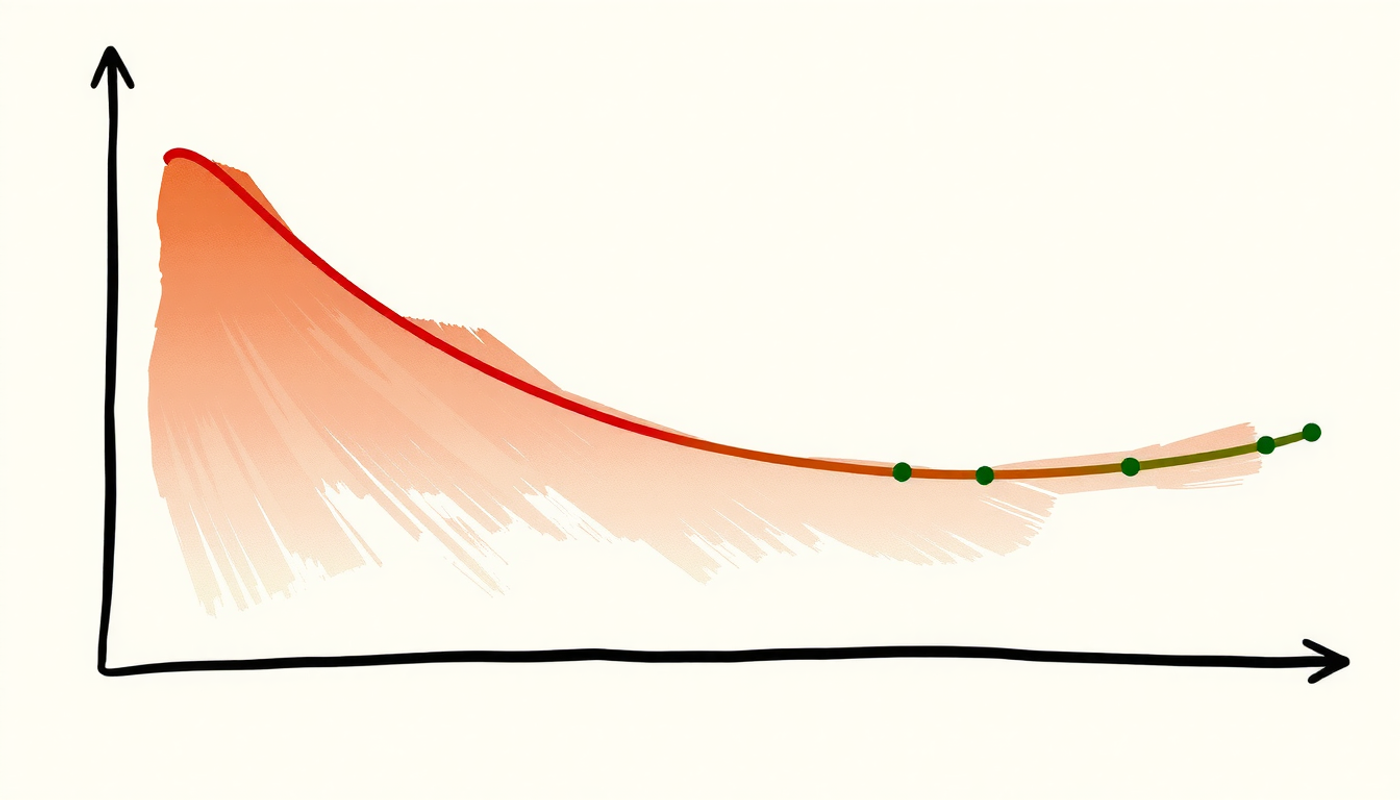
Two scheduling algorithms dominate the flashcard world. SM-2 came from Piotr Wo≈∫niak's 1990 master's thesis and has powered Anki since 2006. It uses a fixed formula. Each card has an ease factor starting at 2.5. A correct review multiplies the interval by that ease factor. An incorrect review drops the ease factor and restarts the cycle. Every learner, every card, same math.
FSRS is different. Developed by Jarrett Ye and collaborators and published at KDD 2022, FSRS uses a three-parameter memory model built on Difficulty, Stability, and Retrievability. The model trains itself on the learner's own review history through gradient descent. Anki added FSRS as an option in version 23.10 and shipped FSRS-6 in 2025. Developer-reported benchmarks suggest roughly 20 to 30 percent fewer reviews at the same retention level. That claim is simulation-based rather than from a randomized controlled trial, but the underlying dataset involves 220 million review logs.
For MCAT psych/soc, three properties of the section favor FSRS. First, the timeline is fixed. Students prep intensively for 8 to 12 weeks before a known test date, which is a different schedule shape than open-ended language learning where SM-2 originated. FSRS's per-user optimization fits this better. Second, the card count is large. A 2,200-card Pankow deck plus custom cards from passage reviews adds up fast. A 25 percent review-load reduction translates to about 20 extra minutes per day, which is real time on a 60-hour study week. Third, card difficulty is heterogeneous. Piaget's stages are easy. Distinguishing Schachter-Singer from Cannon-Bard is hard. FSRS tunes intervals per card. SM-2 cannot.
Apps that support FSRS natively or as an option in 2026 include Anki itself, RemNote, Mochi, and MintDeck. Proprietary schedulers at Mindomax, Knowt, and FlashRecall may perform well, but they have not been independently benchmarked against FSRS or SM-2 in peer-reviewed settings.
Active Recall, Transfer, and What Flashcards Cannot Train
The testing effect is the other pillar. Karpicke and Roediger's 2008 paper in Science showed that repeated testing produced large gains in delayed recall while further study after initial learning produced none. Students' predictions of their own performance were uncorrelated with actual performance, which is a direct argument for algorithmic scheduling over gut-feel judgments like "I know this already."
The question for MCAT prep is whether the testing effect transfers beyond recall to the application-heavy 45 percent of psych/soc. The strongest evidence comes from Pan and Rickard's 2018 meta-analysis in Psychological Bulletin. Across 192 transfer effects, the overall effect size was d = 0.40. Transfer was strongest to application and inference questions and to medical diagnostic problems. That is a smaller effect than raw recall, but it is meaningful. Roediger and Butler (2011) in Trends in Cognitive Sciences reached the same conclusion through a different review path: retrieval practice builds durable, transferable memory.
So flashcards do help with Skill 2 questions. They do not fully train them. A student who has mastered 2,000 psych/soc cards but never read an AAMC passage will still lose 15 to 20 percent of application items. The pattern in 520-plus score reports is consistent: flashcards plus practice passages plus AAMC materials, not flashcards alone.
Where flashcards genuinely fail is Skills 3 and 4. Interpreting a figure, identifying a confounding variable, evaluating ecological validity. These require passage practice, not spaced repetition.
One more caveat deserves attention. Observational studies of Anki use among medical students consistently show correlations with higher exam scores, but all such studies share a self-selection problem. Motivated students use Anki. Motivated students also score higher for reasons unrelated to any specific study tool. The correlation is strong. The causal claim is less settled than marketing pages suggest.
Three Psych/Soc Card Formats That Actually Work
Card design matters more than app choice. Three formats consistently appear in high-performing AnKing MCAT and Pankow setups.
Format one is the three-way theory contrast. The classic example is the theories of emotion. Front: "A student sees a snake, their heart races, and they feel fear. How do James-Lange, Cannon-Bard, and Schachter-Singer explain this differently?" Back: "James-Lange says the racing heart causes the fear, so arousal comes before emotion. Cannon-Bard says the racing heart and the fear happen simultaneously and independently. Schachter-Singer adds a cognitive label, so arousal plus the interpretation 'I am in danger' produces the emotion." One card, three theories, with a clinical-style scenario. This kind of card hits Skill 2 directly because it demands application rather than definition.
Format two is the definitional triangle. Sociology is full of near-synonyms that trip up careful readers. Role conflict happens when two different roles have incompatible demands, like a doctor-parent called into emergency surgery during a child's recital. Role strain happens when one single role has incompatible internal demands, like a parent who must be both disciplinarian and nurturer in the same moment. Role exit is the process of leaving a role entirely, like retirement or divorce. Front of card: "Which concept does each scenario describe?" followed by three short scenarios. Back: the name plus a one-line definition. Students who confuse these three concepts lose predictable points on the MCAT because the AAMC loves testing this cluster.
Format three is the temporal-direction mnemonic. Memory interference has two directions that sound almost identical. Proactive interference is when old information blocks new learning. Retroactive interference is when new information overwrites old material. The mnemonic: Pro goes forward, Retro goes back. Front: "You learned French in high school. Now you are learning Spanish, and French keeps intruding on your Spanish practice. Which kind of interference is this?" Back: "Proactive interference. The old material, French, is blocking the new, Spanish. Mnemonic: Pro means forward." The card tests discrimination between two nearly-identical terms, which is exactly what psych/soc does on test day.
These three formats handle the bulk of psych/soc recall. Any app on the list above can hold them. The differentiator is whether the app makes the cards quick to build and schedules them intelligently.

A Decision Matrix for Picking the Right App
No single app is the best choice for every student. The right pick depends on timeline, platform, budget, and starting point.
Two points matter across every scenario. First, algorithm beats interface in the long run. Over twelve weeks, FSRS-native apps run 20 to 30 percent less review time than proprietary schedulers according to developer benchmarks. Second, no app replaces passage practice. The strongest psych/soc scores pair daily flashcard drilling with weekly AAMC section-bank sessions and third-party QBanks like UWorld.
CONCLUSION
The science has been clear for forty years. Spaced retrieval beats every other study method with strong empirical support. What has changed in 2026 is the tooling. FSRS now runs natively on at least four modern flashcard apps. AI generates cards from PDFs and lecture recordings in seconds rather than hours. Cross-platform sync and generous free tiers make quality spaced repetition accessible without a 25-dollar Anki iOS payment. Tools like MintDeck, Mindomax, Knowt, RemNote, and the others above take the cognitive science of retrieval practice and put it in interfaces that a 16-year-old can use. The best psych/soc score still belongs to the student who drills cards daily and reads passages weekly. The app is the delivery vehicle. It is not the destination.
Frequently Asked Questions
Is Anki still the best option for MCAT psych/soc in 2026?
Anki has the largest community ecosystem and the most shared decks, including AnKing MCAT and Pankow's 2,200-card psych/soc deck. Modern alternatives like MintDeck offer the same FSRS algorithm with cleaner interfaces and full Anki import. The honest answer: Anki is no longer the only good option, just the most established.
How many psych/soc flashcards does the average high-scoring MCAT taker review?
Most 515-plus scorers review between 1,500 and 2,500 psych/soc cards total. Mr. Pankow's dedicated psych/soc deck has about 2,200. AnKing MCAT includes roughly 2,000 psych/soc cards as a subset. Fewer cards still work if each one is high-quality and drawn from AAMC content outlines rather than random online sources.
Can AI-generated flashcards replace manually written ones for the MCAT?
AI card generation saves significant time on factual content like definitions and theorist names. Quality drops on nuanced material like distinguishing Schachter-Singer from Cannon-Bard. Most students use AI for first-pass card creation, then edit cards manually to sharpen comparisons and add personal examples that aid retrieval.
How long per day should students review psych/soc flashcards?
Most evidence supports 20 to 40 minutes of daily psych/soc review once the deck is built. Consistency matters more than session length. Daily 30-minute sessions outperform weekly 3-hour cramming blocks for long-term retention, and missed days compound quickly when the deck has 2,000-plus cards.
Do psych/soc flashcards help with passage-based MCAT questions?
Partially. Flashcards directly train the 35 percent of questions focused on knowledge recall. They prime the 45 percent focused on application by building the vocabulary base. They do not train research methods or data-based reasoning, which account for another 20 percent. Passage practice is required for those reasoning skills.


